MiCA Is Not Only for Crypto. It Will Also Decide Prediction Markets’ European Future
While the industry spent the summer arguing about stablecoin reserves and DeFi certification schemes, the most consequential question in European crypto policy slipped in almost unnoticed. On May 20, 2026, the European C...
Archive context
Older archive item. Useful for background and entity history, but not a fresh market-moving signal.
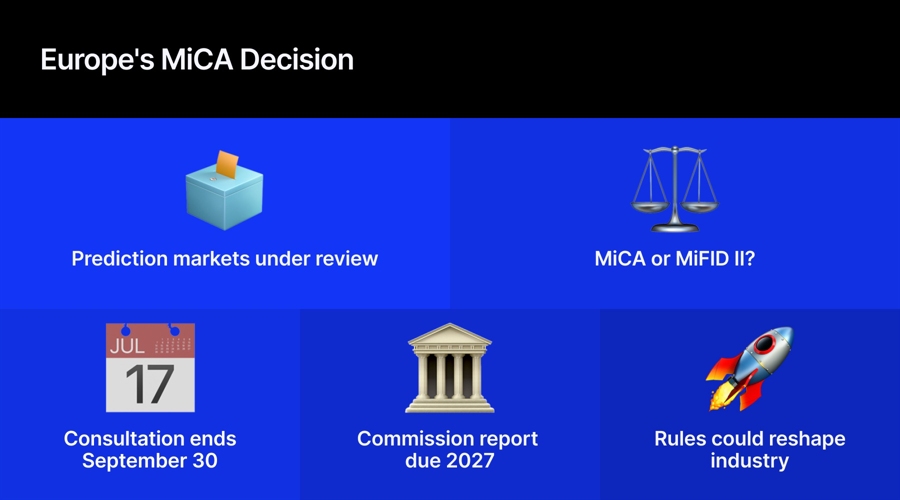
While the industry spent the summer arguing about stablecoin reserves and DeFi certification schemes, the most consequential question in European crypto policy slipped in almost unnoticed. On May 20, 2026, the European Commission opened a targeted consultation on the review of the Markets in Crypto-Assets Regulation, and for the first time, Brussels is formally asking whether DLT-based prediction markets belong inside the EU rulebook, and if so, which one.
The deadline was originally August 31. It has since been quietly pushed to September 30, 2026, according to the Commission's consultation page.
That extension is more than an administrative footnote. It is the last window the prediction market industry will get to shape the rules before the Commission drafts its mandated report to the European Parliament and Council, due by June 30, 2027, under Articles 140 and 142 of MiCA, a report that may arrive “accompanied by a new legislative proposal.”
In simple words, it means that whatever lands in that consultation inbox by September 30 will echo through European law for the next decade.
The Question Brussels Is Really Asking
The consultation document, prepared by DG FISMA's digital finance unit, identifies prediction markets alongside DeFi, staking, lending, NFTs, perpetual futures, and tokenized deposits as fast-growing activities that currently sit outside MiCA's scope.
The core question posed to respondents is deceptively simple: should DLT-based prediction markets and crypto perpetuals be governed by MiCA, the bespoke crypto framework, or by MiFID II, the EU's far stricter regime for traditional financial instruments?
The distinction is existential. Under MiCA, a prediction market operator could conceivably become a licensed crypto-asset service provider and passport across the European Economic Area member states. Under MiFID II, event contracts with binary payouts run headlong into the EU's product-intervention machinery, the same apparatus that banned binary options for retail clients across the bloc in 2018.
And Europe's supervisors have already shown their hand. On July 3, 2026, ESMA issued a public statement declaring that event contracts whose underlyings fall within MiFID II's Annex I qualify as financial instruments and are therefore captured by the national binary options prohibitions on marketing, distribution, or sale to retail clients.
In one stroke, the EU's markets watchdog tied the hottest product category in global trading to a framework designed to keep retail out.
A $44 Billion Market Meets a Wall of Enforcement
The timing is no accident. Combined monthly volume on Kalshi and Polymarket hit $44.8 billion in June 2026, more than triple the average monthly handle of every legal US sportsbook combined in 2025.
Kalshi's latest funding round reportedly valued the firm at roughly $22 billion, and ICE's $2 billion bet on Polymarket signalled that Wall Street infrastructure players see event contracts as an asset class, not a novelty.
Europe's response has been anything but welcoming. Portugal ordered ISPs to block the platforms in March 2026. Spain opened sanction proceedings against both Kalshi and Polymarket in May for operating without gambling licenses.
In mid-June, nine gambling regulators, spanning Belgium, France, Germany, Italy, the Netherlands, Poland, Portugal, Spain, and Switzerland, signed a joint declaration to coordinate enforcement against unlicensed prediction-market platforms.
The result is a jurisdictional pincer: gambling authorities attacking from one flank, securities regulators from the other, and no purpose-built framework anywhere in between. The MiCA review consultation is the first and possibly only official acknowledgment from Brussels that this vacuum needs filling by design rather than by enforcement.
The Transatlantic Split Widens
The contrast with Washington could hardly be sharper. On June 10, the CFTC published a 267-page proposed rulemaking laying out which sports and event contracts are permitted, a constructive, if complex, path toward a stable federal regime. The US is carving categories; Europe is building walls.
That divergence carries real commercial stakes. If the MiCA review concludes that prediction contracts are MiFID financial instruments, full stop, EU retail access is effectively finished, and operators face a choice between institutional-only European desks and wholesale retreat.
If, instead, respondents persuade the Commission that a calibrated MiCA-style regime, disclosure, custody, market-integrity rules, without the binary-options ban, is workable, Europe could yet become a licensed home for the industry rather than its largest geoblocked territory.
LATEST: ⚡ MiCA-compliant euro stablecoins grew 128% in market cap to $673.9M in the year before Europe’s MiCA transition period ended, according to Decta. pic.twitter.com/DHPQwoFNxS
— CoinMarketCap (@CoinMarketCap) July 7, 2026Industry lawyers are already framing the stakes. Skadden titled its client briefing on the consultation “Fit for Purpose?” and that is precisely the question. MiCA was drafted before prediction markets existed at scale. The review is the mechanism for catching up.
The Clock Is Running
The consultation is targeted at a specialist audience: CASPs, issuers, supervisors, central banks, finance ministries, but responses are submitted through an open EU Survey portal, and nothing stops exchanges, market makers, or trade associations from weighing in. Given that ESMA has already staked out the restrictive position, silence from the industry between now and September 30 will be read as consent.
Prediction markets spent 2026 proving they can price everything from elections to inflation better than pundits can. The irony is that the one event that matters most to their European future, what Brussels decides to do with them, is the one contract nobody can trade. The odds will be set the old-fashioned way: by whoever bothers to show up before the deadline.
This article was written by Badea Alexandru Gabriel at www.financemagnates.com.Why this matters
Kalshi is showing up inside the Stablecoins theme, so this story is worth tracking for follow-through rather than treating it as a one-off headline.
Original source
Read on Finance MagnatesRelated market context
CFTC proposes a divide between prediction contracts and sportsbook wagers
The Commodity Futures Trading Commission announced two actions on Oct. 9 seeking to clarify the federal regulatory boundary betwee...

EU targets MiCA loophole that lets crypto exchanges serve 27 countries with one license
EU finance ministers agreed to shift oversight of major crypto companies to a central watchdog, reshaping supervision under MiCA....

Kalshi traders bet inflation has peaked for 2026 but will stay sticky
Persistent inflation above the Fed's target could challenge monetary policy, impacting economic stability and investor confidence....

Polymarket Gives Dems 62% Midterm Sweep Odds, CLARITY Act in Jeopardy
Prediction markets are flashing warning signs for the cryptocurrency industry ahead of the Nov. 3 midterms. Polymarket gives Democ...

Kalshi Reviews Three Sub-$100 Bets That Called Trump’s Press Secretary Pick Early
None of the three wagers topped $100, but each backed Katie Zacharia for White House press secretary before her selection was repo...

From TOKEN2049 to Ecosystem Co-Building: HTX Advances Its Multifaceted Engagement Across the Global Crypto Industry
Singapore, October 12, 2026 – From October 6 to 8, the global crypto industry turned its attention to Singapore for TOKEN2049, a m...