OpenAI’s Miss, Anthropic’s Moment: Is the AI Bubble Starting to Pop?
When the Wall Street Journal reported on Monday evening that OpenAI had missed both its user-growth and revenue targets, the names that fell hardest weren’t its own — OpenAI’s shares don’t trade publicly yet — but its de...
Archive context
Older archive item. Useful for background and entity history, but not a fresh market-moving signal.

When the Wall Street Journal reported on Monday evening that OpenAI had missed both its user-growth and revenue targets, the names that fell hardest weren’t its own — OpenAI’s shares don’t trade publicly yet — but its dependents. By Tuesday morning, Oracle was off more than 5%, CoreWeave fell 5.4%, Nvidia, Broadcom and AMD all dropped 3% to 4%, and SoftBank cratered around 10% in Tokyo. The stock most levered to OpenAI’s spending — Oracle, anchor of its US$300 billion five-year compute deal — has now spent 48 hours communicating something the AI industry has been quietly debating for months: that the demand curve flattened.
The Journal’s reporting was specific. CFO Sarah Friar has warned colleagues she’s not sure OpenAI can pay for future computing contracts at current revenue trajectories. The company missed an internal target of one billion weekly active ChatGPT users by year-end 2025, has fallen short of monthly revenue numbers more than once in 2026, and is grappling with subscriber defections — ground ceded to Anthropic in coding and to Google’s Gemini in everyday consumer use. Sam Altman and Friar called the framing “ridiculous” in a joint statement to CNBC, insisting the team is “totally aligned on buying as much compute as we can.” The market disagreed.
The contrast on the other side of the trade is stark. Anthropic’s annualized revenue run-rate hit US$30 billion in April, comfortably ahead of OpenAI’s reported US$24–25 billion, and the company has used the past fortnight to lock in the compute it had been very publicly short of. Amazon expanded its commitment by up to US$25 billion (US$5 billion now, up to US$20 billion later) and reserved 5 gigawatts of capacity. Google followed days later with up to US$40 billion — US$10 billion immediate at a US$350 billion post-money valuation, with US$30 billion in milestone-based follow-ons — and another 5 gigawatts of TPU capacity. Wilson Sonsini is advising on the listing process. Insiders refused to sell at February’s US$350 billion tender, and secondary offers have since priced the company at US$800 billion or more. Bloomberg puts the target IPO window at October.
The Pentagon ProblemHow did we get here? The most popular answer in San Francisco is the Pentagon. In late February, Defense Secretary Pete Hegseth gave Anthropic chief executive Dario Amodei until 5:01pm Friday to drop product-level restrictions on autonomous weapons and domestic mass surveillance — or be designated a supply-chain risk. Amodei refused. The blowback was instantaneous: Anthropic was blacklisted from federal procurement, sued the Trump administration, won a partial injunction in California and lost on appeal in DC. But the consumer response inverted the political one. Within a week Claude had overtaken ChatGPT in the iOS App Store. ChatGPT uninstalls jumped 295% after OpenAI signed its replacement contract. Amodei, in an internal memo, called OpenAI’s deal “safety theater”; Altman, in an unusually candid AMA, conceded the “optics don’t look good.” What looked like a commercial death sentence in February has, eight weeks later, played out closer to a brand event — and a procurement gift to Anthropic’s enterprise sales team.
That brand event is now colliding with capacity. Anthropic has spent April managing what its own power users have started calling “shrinkflation”. Opus 4.7, the company’s flagship released in mid-April, ships with a new tokenizer that produces up to 35% more tokens for the same input, was set to a more verbose default, and is widely accused on GitHub and Reddit of having been quietly throttled within a week of launch. Anthropic published a candid postmortem on April 23 acknowledging three product changes that hurt Claude Code quality — a default reasoning level dropped from “high” to “medium,” a session-caching bug, and a 25-word response cap between tool calls — and reset usage limits for Claude Code subscribers. A Rate Limits API followed two days later. Most provocatively for paying users, Anthropic is currently A/B testing the removal of Claude Code from new US$20 Pro signups (around 2% of new “prosumer” signups). Head of growth Amol Avasare framed it as evidence that “our current plans weren’t built for this.” The subsidization era is encountering its first hard ceiling.
Meanwhile OpenAI’s product cadence keeps accelerating without obviously moving the needle. GPT-5.5, released April 23, took back the top of the Artificial Analysis Intelligence Index by three points on Opus 4.7 and posted a state-of-the-art 82.7% on Terminal-Bench 2.0 — but its API price doubled, its hallucination rate hit 86% on AA-Omniscience versus 36% for Opus 4.7, and SWE-Bench Pro still belongs to Anthropic. ChatGPT Images 2.0 launched two days earlier with genuine fanfare for its dense-text rendering and “thinking” capabilities, but has produced nothing resembling the user-acquisition spike of the Ghibli moment in early 2025. And Sora was discontinued on April 26 in a strategic redirect of compute toward coding and enterprise. The pattern is plainly defensive: OpenAI is shipping faster than at any point in its history, and the WSJ numbers say users aren’t compounding the way the company’s spending plan needs them to.
Which leaves the IPOs. Both companies are racing the same window — late 2026, possibly slipping into early 2027. Anthropic now has the harder operational job: scaling into roughly US$165 billion of pledged hyperscaler capital and capacity while convincing public-market investors that a US$30 billion run-rate justifies an US$800 billion-plus valuation. OpenAI has the inverse problem: defending an US$852 billion private mark while its supplier stocks bleed 5% on a single Reuters wire. Jordan Klein, TMT sector specialist at Mizuho, captured the timing tension neatly in a Tuesday note: “How new could update be as the round closed end March when the quarter would have ended. And it’s not even May 1. I highly doubt OAI fundamentals slowed that fast in under 30 days.” The implication is that whatever’s happening was already priced into the US$122 billion round — and may not be priced into the IPO.
The AI Trade WobblesFor crypto investors, the second-order story is the spillover. The same hyperscalers underwriting both AI labs are the ones running compute on Bitcoin’s energy stack and minting the demand curve for Nvidia and Oracle that bled out on Tuesday. Naval Ravikant’s USVC fund is already trying to wrap retail access around private AI exposure precisely because the IPOs may not be the entry point investors are hoping for. The Mythos disclosure earlier this month has put cybersecurity squarely on the AI capex narrative. Bitcoin opened at US$77,368 on Tuesday before drifting lower into the third Federal Reserve meeting of the year, and the AI-trade beta has rarely felt this unstable.
Google I/O is in a month. Gemini 3.1 Pro Preview is already tied with Opus 4.7 on the Intelligence Index, and Google’s TPU stack is now financing one of Anthropic’s two five-gigawatt commitments. If Sundar Pichai uses the keynote to announce a model that beats both Anthropic and OpenAI on the same week the bankers are pricing the books, the AI power map redraws again — before either of the would-be trillion-dollar listings can print.
Whether all of this is the AI bubble popping is the wrong question, and also the only one that matters. The dot-com comparison is easy and partly wrong: AI labs have real revenue (Anthropic at a US$30 billion run-rate, OpenAI in the mid-twenties), real enterprise penetration, and demand strong enough that the most valuable private companies in the world are rationing access to their flagship products. None of that was true of Pets.com. But the comparison is partly right. The hyperscaler-to-lab-to-hyperscaler money loop — Nvidia invests in OpenAI, OpenAI commits to Oracle, Oracle buys Nvidia chips, repeat — is the kind of circular financing that gets named after the fact. SoftBank dropping 10% on a single Reuters wire is what happens when an entire equity story rests on one customer hitting a growth curve. The cycle is still expanding but its margin of safety is gone. The next leg will either compress the multiple by producing a model that obsoletes the field, or confirm — with a series of polite quarterly misses — that AI has finally become a normal sector trading on normal multiples. For crypto, a slow re-rate redirects risk-on capital without breaking the broader market; a sudden one takes Bitcoin with it.
Why this matters
Anthropic is showing up inside the DeFi theme, so this story is worth tracking for follow-through rather than treating it as a one-off headline.
Original source
Read on Brave New CoinRelated market context
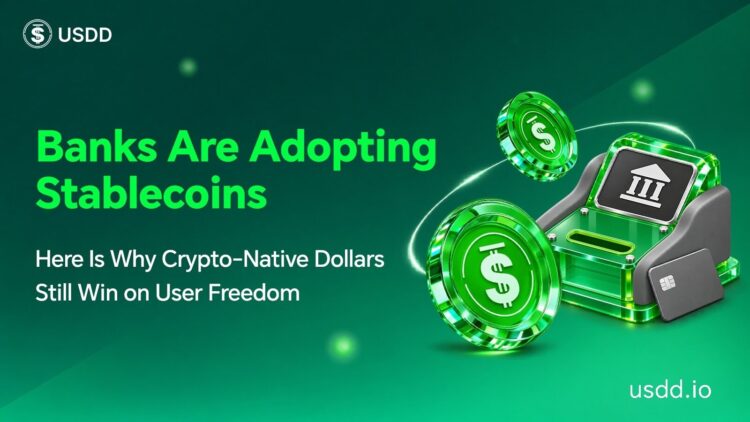
As traditional giants rush into digital dollars, USDD’s Yvonne Chia explains why 24/7 access, self-custody, and transparent yield give decentralized stablecoins an edge banks can’t replicate. 20 November – Road Town, Totorla, British Virgin Islands – Decentralized stablecoin protocol USDD is accelerating its multichain utility across TRON, Ethereum, and BNB Chain—combining automated sUSDD yield via its Smart Allocator with GasFree zero-TRX transfers—as traditional financial giants race to build competing stablecoin rails. In a recent industry interview with instant exchange partner ChangeNOW, USDD Head of Communications Yvonne Chia outlined why self-custody, 24/7 settlement, and transparent onchain reserves give decentralized digital dollars a structural advantage over bank-issued alternatives. 1. Permissionless Access vs. Gatekept Accounts For billions of people globally, opening and maintaining a traditional bank account still involves paperwork, minimum balance requirements, geographic restrictions, and approval delays. Even when banks integrate stablecoin rails behind the scenes, those services remain gated behind legacy compliance walls and intermediary control. Crypto-native stablecoins flip that model on its head. As Yvonne Chia highlighted during the interview: “Compare this to a stablecoin like USDD, where all you need is a phone, a working internet connection, you can immediately start a wallet and you have access to your funds right away.” With USDD, users can access and manage their digital dollars directly through their own wallets, without depending on traditional financial intermediaries. This represents a fundamental shift in financial access: users are no longer limited to the services, operating hours, or account structures of a single institution. Instead, they have the freedom to hold, manage, and transfer their assets on their own terms. Self-custody also gives users greater autonomy over their financial decisions. They can choose which wallets to use, where to transfer their assets, and which supported decentralized applications to interact with, without needing to route every transaction through a centralized financial institution. With USDD, users’ digital dollars can move with them across an open blockchain ecosystem, rather than remaining tied to a particular bank or service provider. 2. 24/7 Global Settlement vs. “Banking Hours” Legacy payment networks still operate on decades-old schedules: weekend cutoffs, bank holidays, and multi-day cross-border settlement delays accompanied by hefty wire fees. Blockchain networks never close. Whether it is a Sunday night or a public holiday, USDD moves globally without depending on traditional banking operating hours or settlement windows. “We are able to have transfers 24/7 and we’re not limited to any traditional banking hours. So I think that in some ways, stablecoins are not just becoming banks, but exceeding what traditional banks can offer to users.” To make everyday transfers even smoother than fintech apps, USDD introduced GasFree integration on TRON, allowing users on supported wallets to pay network fees directly in USDD without needing to hold TRX. This removes another practical barrier to stablecoin adoption: having to acquire and maintain a separate gas token just to transfer digital dollars. With GasFree, eligible users can pay approximately 0.5 USDD per transaction, compared with around 1.5 USDT for a standard USDT transfer under the referenced fee conditions. These improvements matter because the usefulness of a stablecoin is not determined by its peg alone. Low-cost transfers, straightforward wallet experiences, and around-the-clock availability are what make digital dollars practical for everyday payments and global value transfers. 3. Passing Yield Back to Users vs. Bank Spreads Perhaps the sharpest contrast between banks and decentralized stablecoins lies in how yield is distributed. In traditional banking, institutions take customer deposits, deploy them into yield-generating markets, and retain a significant portion of the returns. Everyday depositors may receive relatively low interest rates, while higher-yielding products often come with eligibility requirements, minimum deposits, or fixed maturity periods. Stablecoins introduce another way to participate in digital-dollar opportunities. Rather than keeping capital entirely within a traditional deposit account, users can access onchain yield opportunities through decentralized protocols and transparent investment mechanisms. USDD was built to return that value directly to holders. Through USDD Earn, users can deposit USDD to receive sUSDD, earning automated, competitive yield powered by our Smart Allocator system, with no fixed lock-up periods restricting access to their capital. For users, the distinction is important: USDD Earn provides access to a productive stablecoin while maintaining flexibility, rather than requiring users to commit their capital to a conventional fixed-term product. 4. Onchain Verification vs. Institutional Trust Traditional banks ask customers to trust closed-door balance sheets and periodic regulatory filings—until a crisis proves otherwise. USDD takes a different approach through its “Don’t trust, verify” ethos, emphasizing publicly accessible onchain information and independent verification. Onchain Transparency: Smart contract addresses, collateral reserves, and Smart Allocator deployments are publicly viewable, allowing users to examine relevant information directly on the blockchain. Structured Disclosures: Quarterly Treasury Reports provide additional information about reserve positions, financial performance, and operational developments. Independent Security Reviews: USDD undergoes third-party security audits to assess its smart contracts and identify potential vulnerabilities. Transparency does not eliminate financial or technical risks, but it changes how users can evaluate them. Instead of relying exclusively on an institution’s assurances, users have access to information that can be independently examined and verified. 5. Beyond a Single Network: An Open, Multichain Financial Ecosystem Financial freedom is not just about holding digital dollars. It is also about being able to use them wherever opportunities and applications exist. A stablecoin confined to a single network or limited use case cannot fully realize the potential of open blockchain finance. Following its January 2025 protocol upgrade, USDD expanded natively from TRON onto Ethereum and BNB Chain, extending its reach across multiple blockchain ecosystems. This multichain presence allows USDD to connect with different communities, liquidity environments, and decentralized applications. Its sUSDD product has also expanded into DeFi integrations, including Pendle and Morpho, giving users additional ways to access yield strategies across supported ecosystems. The bigger picture is an interconnected financial ecosystem in which users can move between holding, transferring, exchanging, and deploying their stablecoins according to their own needs. These are not isolated functions. Together, they make stablecoins more useful as everyday financial infrastructure. The Future: Interconnected, Open, and Multichain Banks will undoubtedly continue using stablecoin rails to modernize their back-end settlement. However, true financial freedom comes from open networks where assets flow freely across protocols without intermediaries. For USDD, the opportunity goes beyond offering a dollar-pegged asset. It is about making digital dollars accessible, transferable, and productive across an interconnected financial ecosystem. From self-custody and 24/7 transfers to flexible yield opportunities and multichain DeFi access, these capabilities give users more ways to put their money to work. Banks may be bringing stablecoins into traditional finance. Crypto-native protocols are showing what stablecoins can make possible beyond it.
As traditional giants rush into digital dollars, USDD’s Yvonne Chia explains why 24/7 access, self-custody, and transparent yield...
Strategy reports $35 billion net reserve with all Bitcoin unencumbered
Strategy's unencumbered Bitcoin and cash reserves enhance its financial stability, reducing risk during market downturns and prote...

Hyperliquid Anthropic Volume Explodes Past $1.7B as Hong Kong Issues Warning
Hyperliquid Anthropic trading market has surged to $1.7 billion in daily volume, pushing the contract ahead of Ethereum on the pla...

LIVE – Bitcoin ETF Bleeds: Anthropic’s Record-Breaking IPO Fails to Save the Market
Bitcoin ETF outflows accelerated as Wall Street extended its losing streak, with Asia’s semiconductor markets suffering their wors...

Jesse Pollak Says Tokenized Stocks on Base Have Crossed $1 Billion in Weekly Volume
Tokenized stocks on Base, the Ethereum layer 2 network built by Coinbase, have “just crossed $1 billion of weekly volume” less tha...
The DeFi protocol powering $1.6 billion in Coinbase loans as crypto lending goes mainstream
The New York rollout extends a service that Coinbase offers through its app and lenders fund through Morpho’s markets. Read the fu...