Strategy’s STRC hit another all-time low today
The market capitalization of Strategy’s STRC, the once-$10.5 billion stock that was supposed to pay better than a high-yield bank account or money market, sank to another all-time low beneath $7.2 billion this morning. F...
Archive context
Older archive item. Useful for background and entity history, but not a fresh market-moving signal.

The market capitalization of Strategy’s STRC, the once-$10.5 billion stock that was supposed to pay better than a high-yield bank account or money market, sank to another all-time low beneath $7.2 billion this morning.
For four uninterrupted days, the stock has crashed lower each day. By 9:33am today, it was trading 29% beneath the par value the company advertises.
Indeed, the price of each STRC share is supposed to trade at $100 while Strategy pays shareholders an 11.5% annualized dividend.
Shares were, in fact, trading at $100 as recently as May 14. Well, this morning, they were trading at $71.25.
JUST IN: Strategy's $STRC just hit an all-time low today at $71.76 and now has an effective yield of 16.03%.
It is now 28% off from par pic.twitter.com/jP9hLbcG2I
Strategy is a bitcoin (BTC) acquisition company whose founder Michael Saylor believes BTC is going to rally annually with a compounded annual growth rate (CAGR) near 30%. He even created a calculator to forecast the price of his company’s common stock, MSTR, under the assumption that BTC would never have a down year.
Based on his bullish conviction, Strategy issues a variety of securities that pay far less than Saylor’s forecasted rally in BTC, under the assumption that Strategy’s BTC holdings will eventually rally enough to make up for all of its payouts.
It will come as a surprise to no one that BTC has not rallied that much recently. Over the last five years, the CAGR of BTC is less than 13%.
Embarrassingly, Strategy president Phong Le publicly admitted a few months ago that retail investors hold about 80% of the supply of STRC, meaning that the damage is disproportionately affecting working-class investors who listened to the company’s forecast.
Michael Saylor wants $100 STRC — the market says differentRead more: STRC crashes as Strategy’s unrealized BTC losses exceed $13 billion
According to Saylor, STRC was supposed to be a low-volatility competitor to a high-yield bank account or money market, paying above-market dividends to people who could not afford the downside volatility of BTC itself.
Unfortunately, STRC now has demonstrated plenty of downside and, unlike BTC, has no meaningful upside beyond its $100 par value.
Making today even worse, Strategy’s common stock, MSTR, fell to a fresh 52-week low of $82.33 the same morning. That is about 82% below its 52-week high of $457.22.
STRC is down 24% in one monthAlthough the collapsing value of Strategy’s securities is the most damaging, it is also remarkable how fast the safety margin behind STRC’s payout has evaporated.
STRC has lost one-quarter of its share price within just 30 days.
Strategy has previously touted 71 years of dividend coverage from its BTC reserve as recently as November 2025. By June 17 the company claimed, “We have 32 years of dividend coverage through our BTC Reserve.” Within hours, as bitcoin slid further, even that figure fell to 31.
More than half the cushion vanished in roughly seven months. Today, that number is below 30 years.
As the price of BTC falls, years of supposed dividend coverage by Strategy’s BTC holdings have vanished within weeks.
Despite the bear market, CEO Le has tried to reassure the market that Strategy will not dump most of its holdings anytime soon. He told CNBC that the company would sell BTC only under specific conditions, such as funding the STRC dividend or tax optimization, and only when the move is accretive to BTC per share.
For shareholders, that is less a guarantee than a map of the scenarios under which selling BTC becomes Strategy’s plan.
Saylor pitched STRC as a low-friction way to earn yield, with daily liquidity and no management fees. It was supposed to be a money-market substitute backed by BTC. It is now delivering the opposite experience for shareholders with today’s new all-time low.
Got a tip? Send us an email securely via Protos Leaks. For more informed news and investigations, follow us on X, Bluesky, and Google News, or subscribe to our YouTube channel.
The post Strategy’s STRC hit another all-time low today appeared first on Protos.
Why this matters
Bitcoin is showing up inside the Institutional Adoption theme, so this story is worth tracking for follow-through rather than treating it as a one-off headline.
Original source
Read on ProtosRelated market context
As traditional giants rush into digital dollars, USDD’s Yvonne Chia explains why 24/7 access, self-custody, and transparent yield give decentralized stablecoins an edge banks can’t replicate. 20 November – Road Town, Totorla, British Virgin Islands – Decentralized stablecoin protocol USDD is accelerating its multichain utility across TRON, Ethereum, and BNB Chain—combining automated sUSDD yield via its Smart Allocator with GasFree zero-TRX transfers—as traditional financial giants race to build competing stablecoin rails. In a recent industry interview with instant exchange partner ChangeNOW, USDD Head of Communications Yvonne Chia outlined why self-custody, 24/7 settlement, and transparent onchain reserves give decentralized digital dollars a structural advantage over bank-issued alternatives. 1. Permissionless Access vs. Gatekept Accounts For billions of people globally, opening and maintaining a traditional bank account still involves paperwork, minimum balance requirements, geographic restrictions, and approval delays. Even when banks integrate stablecoin rails behind the scenes, those services remain gated behind legacy compliance walls and intermediary control. Crypto-native stablecoins flip that model on its head. As Yvonne Chia highlighted during the interview: “Compare this to a stablecoin like USDD, where all you need is a phone, a working internet connection, you can immediately start a wallet and you have access to your funds right away.” With USDD, users can access and manage their digital dollars directly through their own wallets, without depending on traditional financial intermediaries. This represents a fundamental shift in financial access: users are no longer limited to the services, operating hours, or account structures of a single institution. Instead, they have the freedom to hold, manage, and transfer their assets on their own terms. Self-custody also gives users greater autonomy over their financial decisions. They can choose which wallets to use, where to transfer their assets, and which supported decentralized applications to interact with, without needing to route every transaction through a centralized financial institution. With USDD, users’ digital dollars can move with them across an open blockchain ecosystem, rather than remaining tied to a particular bank or service provider. 2. 24/7 Global Settlement vs. “Banking Hours” Legacy payment networks still operate on decades-old schedules: weekend cutoffs, bank holidays, and multi-day cross-border settlement delays accompanied by hefty wire fees. Blockchain networks never close. Whether it is a Sunday night or a public holiday, USDD moves globally without depending on traditional banking operating hours or settlement windows. “We are able to have transfers 24/7 and we’re not limited to any traditional banking hours. So I think that in some ways, stablecoins are not just becoming banks, but exceeding what traditional banks can offer to users.” To make everyday transfers even smoother than fintech apps, USDD introduced GasFree integration on TRON, allowing users on supported wallets to pay network fees directly in USDD without needing to hold TRX. This removes another practical barrier to stablecoin adoption: having to acquire and maintain a separate gas token just to transfer digital dollars. With GasFree, eligible users can pay approximately 0.5 USDD per transaction, compared with around 1.5 USDT for a standard USDT transfer under the referenced fee conditions. These improvements matter because the usefulness of a stablecoin is not determined by its peg alone. Low-cost transfers, straightforward wallet experiences, and around-the-clock availability are what make digital dollars practical for everyday payments and global value transfers. 3. Passing Yield Back to Users vs. Bank Spreads Perhaps the sharpest contrast between banks and decentralized stablecoins lies in how yield is distributed. In traditional banking, institutions take customer deposits, deploy them into yield-generating markets, and retain a significant portion of the returns. Everyday depositors may receive relatively low interest rates, while higher-yielding products often come with eligibility requirements, minimum deposits, or fixed maturity periods. Stablecoins introduce another way to participate in digital-dollar opportunities. Rather than keeping capital entirely within a traditional deposit account, users can access onchain yield opportunities through decentralized protocols and transparent investment mechanisms. USDD was built to return that value directly to holders. Through USDD Earn, users can deposit USDD to receive sUSDD, earning automated, competitive yield powered by our Smart Allocator system, with no fixed lock-up periods restricting access to their capital. For users, the distinction is important: USDD Earn provides access to a productive stablecoin while maintaining flexibility, rather than requiring users to commit their capital to a conventional fixed-term product. 4. Onchain Verification vs. Institutional Trust Traditional banks ask customers to trust closed-door balance sheets and periodic regulatory filings—until a crisis proves otherwise. USDD takes a different approach through its “Don’t trust, verify” ethos, emphasizing publicly accessible onchain information and independent verification. Onchain Transparency: Smart contract addresses, collateral reserves, and Smart Allocator deployments are publicly viewable, allowing users to examine relevant information directly on the blockchain. Structured Disclosures: Quarterly Treasury Reports provide additional information about reserve positions, financial performance, and operational developments. Independent Security Reviews: USDD undergoes third-party security audits to assess its smart contracts and identify potential vulnerabilities. Transparency does not eliminate financial or technical risks, but it changes how users can evaluate them. Instead of relying exclusively on an institution’s assurances, users have access to information that can be independently examined and verified. 5. Beyond a Single Network: An Open, Multichain Financial Ecosystem Financial freedom is not just about holding digital dollars. It is also about being able to use them wherever opportunities and applications exist. A stablecoin confined to a single network or limited use case cannot fully realize the potential of open blockchain finance. Following its January 2025 protocol upgrade, USDD expanded natively from TRON onto Ethereum and BNB Chain, extending its reach across multiple blockchain ecosystems. This multichain presence allows USDD to connect with different communities, liquidity environments, and decentralized applications. Its sUSDD product has also expanded into DeFi integrations, including Pendle and Morpho, giving users additional ways to access yield strategies across supported ecosystems. The bigger picture is an interconnected financial ecosystem in which users can move between holding, transferring, exchanging, and deploying their stablecoins according to their own needs. These are not isolated functions. Together, they make stablecoins more useful as everyday financial infrastructure. The Future: Interconnected, Open, and Multichain Banks will undoubtedly continue using stablecoin rails to modernize their back-end settlement. However, true financial freedom comes from open networks where assets flow freely across protocols without intermediaries. For USDD, the opportunity goes beyond offering a dollar-pegged asset. It is about making digital dollars accessible, transferable, and productive across an interconnected financial ecosystem. From self-custody and 24/7 transfers to flexible yield opportunities and multichain DeFi access, these capabilities give users more ways to put their money to work. Banks may be bringing stablecoins into traditional finance. Crypto-native protocols are showing what stablecoins can make possible beyond it.
As traditional giants rush into digital dollars, USDD’s Yvonne Chia explains why 24/7 access, self-custody, and transparent yield...
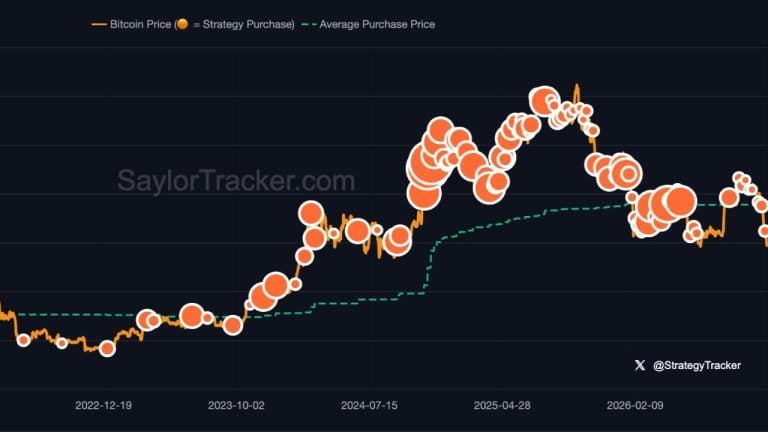
‘The Dots Aren’t Done’: Michael Saylor Hints at Another Strategy Bitcoin Buy
Michael Saylor revived speculation about another Strategy bitcoin purchase as the company’s holdings remained below their acquisit...

Jesse Pollak Says Tokenized Stocks on Base Have Crossed $1 Billion in Weekly Volume
Tokenized stocks on Base, the Ethereum layer 2 network built by Coinbase, have “just crossed $1 billion of weekly volume” less tha...

DeFi Development Corp’s CHAD preferred stock funds another 800-plus SOL
DFDV's strategy exemplifies innovative crypto treasury funding, balancing non-dilutive growth with high dividend obligations and m...

Bitcoin Hits $55,500 following Strategy’s Massive $16.8B Paper Loss
Key Takeaways: The price of Bitcoin sank to $55,500 on November 20, marking the lowest price since September 2024. The amount of B...

Tether Backs SCRYPT to Scale Institutional Stablecoin Payments Across Global Markets
Key Takeaways: Tether has staked money in the Swiss stablecoin platform called SCRYPT. This deal is meant for institutional paymen...