Tether blacklist delay allowed $78M in illicit USDT transfers: Report
Update (May 15 at 3:10 pm UTC): This article has been updated to include comments from Tether. A lag in Tether’s wallet blacklisting process allowed over $78 million in illicit funds to be moved before enforcement action...
Archive context
Older archive item. Useful for background and entity history, but not a fresh market-moving signal.

Update (May 15 at 3:10 pm UTC): This article has been updated to include comments from Tether.
A lag in Tether’s wallet blacklisting process allowed over $78 million in illicit funds to be moved before enforcement actions took effect, according to a new report from blockchain compliance company AMLBot.
Tether’s address blacklisting becomes effective only after a considerable delay from when the process is initiated on Ethereum and Tron, according the report published May 15.
“This delay originates from Tether’s multisignature contract setup on both Tron and Ethereum, transforming what should be an immediate compliance action into a window of opportunity for illicit actors,“ the report reads.
Tether’s blacklisting procedure is a multi-step process with a first transaction effectively warning of the upcoming blacklisting. First, a Tether administrator multisignature transaction submits a pending call to “addBlackList” on the USDT-TRC20 contract.
This results in a public “submission” of the target address as a blacklist candidate. This is followed by a second multisignature transaction confirming the submission, resulting in an “AddedBlackList” emission, making the blacklisting effective.
Related: Tether, Tron and TRM Labs jointly froze $126M USDT in 2024
A warning on incoming blacklistingIn one example shared with Cointelegraph, an onchain transaction submitting a Tron address as a blacklist candidate took place at 11:10:12 UTC. The second transaction that actually enforced the action did not occur until 11:54:51 UTC on the same day, a 44-minute delay.
In practice, this delay can be treated by owners of USDt about to be blacklisted as a notice to move their assets to avoid them being frozen. The report stated:
“This delay between a freeze request and its on-chain execution creates a critical attack window, allowing malicious actors to front-run enforcement and move or launder funds before the freeze takes effect.“Example of USDt blacklisting transactions. Source: AMLBotThe report says that “for blockchain-savvy attackers, these delays are golden.” By tracking Tether’s calls in real time, a fraudster can be instantly alerted that their address is being targeted. When asked by Cointelegraph whether the delay is a technical limitation or just a delay in the actions of a multisignature wallet key holder, AMLBot researchers said that they cannot determine it without knowledge of Tether’s internal procedures.
In a statement to Cointelegraph, a Tether spokesperson explained that “while any delay in enforcement should be examined, the idea that this represents a systemic loophole is both misleading and lacking perspective.” According to the company, it collaborates with law enforcement to freeze addresses on a daily basis. The statement continues:
“Tether operates on public blockchains, where all activity is visible […] This transparency allows Tether, in collaboration with over 255 law enforcement agencies across 55 countries, to track, trace, and freeze illicit funds faster than most realize.“According to Tether, the delay cited in the report stems from its “multisignature governance model," which is said to prevent unilateral freezes and protect the system's integrity. The company admits that the model also introduces a delay on enforcement, noting that “it’s a trade-off for responsible responsiveness to a $100+ billion ecosystem,” with improvements on the way:
“We are actively refining this process to work to eliminate any potential advantage for bad actors. If you think you can use Tether to move illicit funds, think again.“Related: Tether stablecoin issuer and Tron launch financial crime unit
Not just theoreticalAMLBot said its data shows that over $28.5 million in USDT was withdrawn during the delay between the two transactions on the Ethereum blockchain. This amount of freeze avoidance occurred between Nov. 28, 2017, and May 12, 2025. The average amount moved during the delay exceeded $365,000.
Similarly, $49.6 million was reportedly withdrawn during freeze delay windows on the Tron blockchain, resulting in a total on Ethereum and Tron of $78.1 million. Exploiting this delay on Tron is not particularly rare, according to AMLBot:
“170 out of 3,480 wallets (4.88%) on Tron blockchain exploited the lag before getting blacklisted. Each of these wallets made 2–3 transfers during the delay, withdrawing: Average: $291,970.“A Tether spokesperson said that “the $76 million referenced in this report should be put in context of the more than $2.7 billion in USD₮ that Tether has successfully frozen and blocked to date.”
Tether has previously promoted its ability to freeze assets as a compliance feature. In 2024, Tether, Tron, and analytics firm TRM Labs cooperated to freeze over $126 million in USDT linked to illicit activity.
Still, the AMLBot report raises questions about the effectiveness and speed of those enforcement actions.
Magazine: Chinese Tether laundromat, Bhutan enjoys recent Bitcoin boost: Asia Express
Why this matters
This research story adds another data point to the current market tape and is useful when read alongside nearby source coverage.
Original source
Read on CointelegraphRelated market context
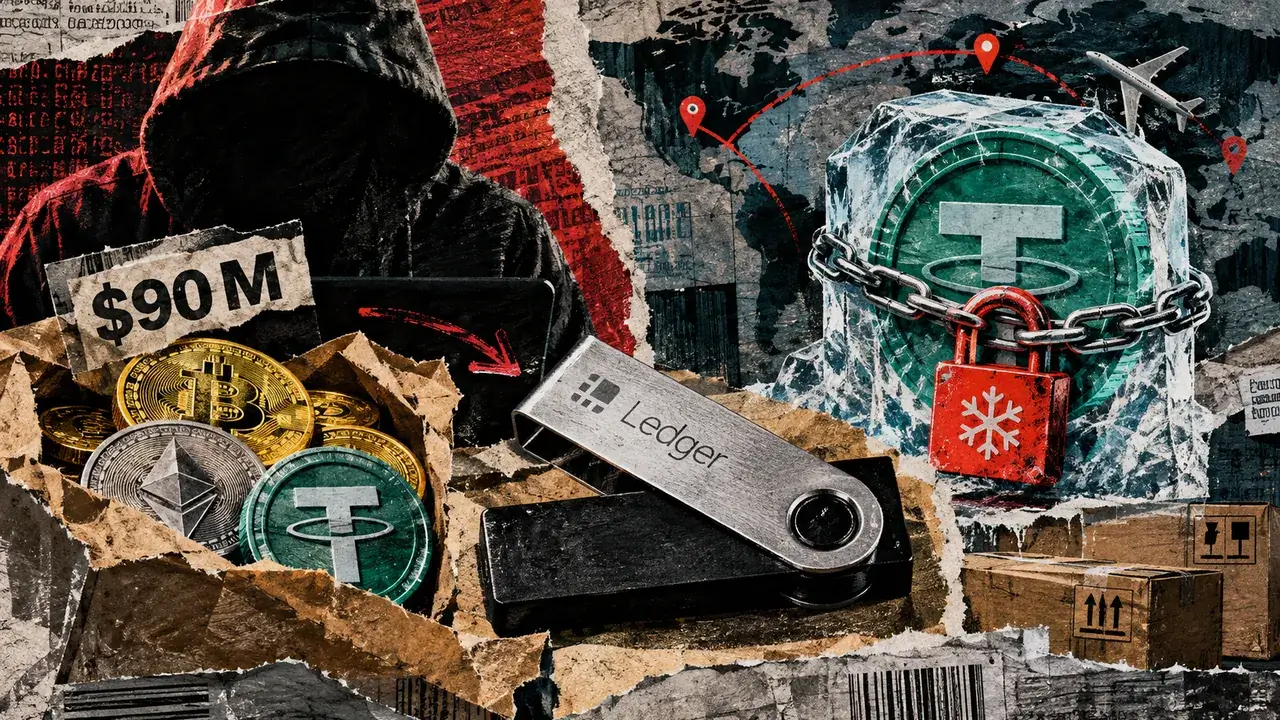
Ledger hack scare nears $90 million as Tether moves to freeze stolen USDT
Suspected Ledger wallet thefts are approaching $90 million as Tether freezes USDT stablecoin linked to the incident, according to...

Tether freezes $1.4M in TRON vaults and THORChain stalls
THORChain's TRON operations were interrupted on Oct. 9 after a USDT vault blocklist, according to reports by its co-founder Chad B...

Tether Unfreezes Four THORChain Vaults Three Hours After Blacklisting 1.45 Million USDT
The four Tron addresses came off the USDT blacklist at 15:30 UTC with their balances intact, and THORChain has restarted Tron trad...
Tether Freezes $1.45M in THORChain USDT Vaults, Then Reverses Blacklist Hours Later
Key Takeaways: The amount of about $1.45 million in USDT was temporarily frozen in THORChain vault addresses. According to THORCha...

Tether freezes USDT linked to Ledger user thefts near $90 million
The freeze highlights the need for robust supply chain security and raises concerns about the limitations of centralized control i...

Ledger theft-linked funds shift from USDT to USDD to dodge Tether freezes
The shift from USDT to USDD underscores vulnerabilities in stablecoin freeze mechanisms, prompting scrutiny on regulatory and secu...