Tether is pushing USDT into a cracking $3 trillion Wall Street debt machine as defaults hit five-year highs at major funds
Tether is pushing USDT into the private-credit market as defaults and withdrawals strain the $3 trillion industry. On Sept. 9, the stablecoin issuer and London-based Fasanara Capital launched StableFund with $400 million...
Archive context
Older archive item. Useful for background and entity history, but not a fresh market-moving signal.
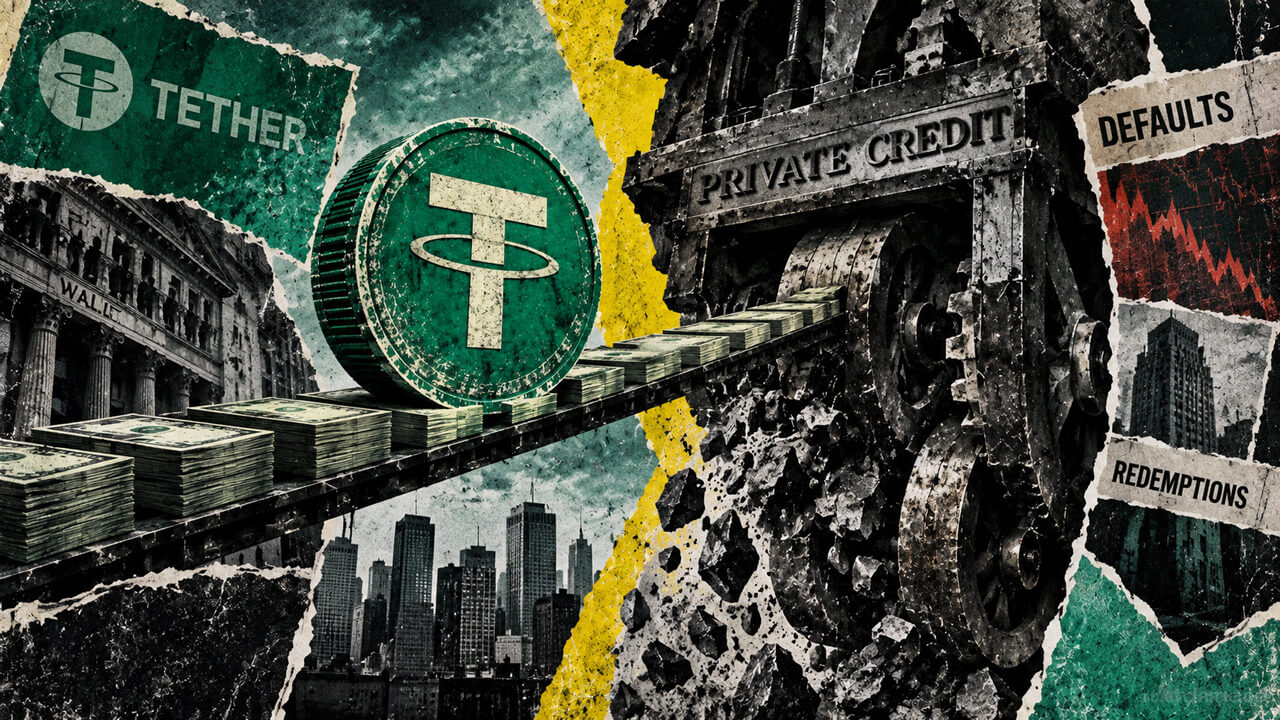
Tether is pushing USDT into the private-credit market as defaults and withdrawals strain the $3 trillion industry.
On Sept. 9, the stablecoin issuer and London-based Fasanara Capital launched StableFund with $400 million in combined sponsor capital and plans to raise up to $3 billion more from institutional investors.
Fasanara will manage the portfolio, while Tether will help originate USDT-linked financing opportunities and provide settlement and treasury infrastructure.
The expansion takes Tether beyond a crypto lending market it already dominates and closer to financing businesses and consumers in the real economy. Galaxy Research estimates that Tether controlled around 60% of the $23 billion centralized crypto-lending market at the end of June, giving it roughly $13.5 billion of outstanding secured loans.
Related Reading Crypto lending turns to Wall Street credit rules to win back institutional trust after 2022 collapseStableFund therefore represents an attempt to extend Tether’s existing credit operation into a much larger asset class, at a time when regulators and investors are scrutinizing private credit more closely
Private credit's boom is running into a tougher testStableFund arrives after years of rapid growth turned private lending into one of Wall Street's most sought-after businesses, but the credit cycle is becoming less forgiving.
An August Wall Street Journal analysis found worsening loan health and investor returns across publicly traded funds overseen by Ares Management, Blackstone, Blue Owl Capital and Golub Capital. Defaults at those vehicles reached their highest levels since at least 2021, while Blue Owl's default rate rose to 2.8% in the second quarter, its highest in at least five years.
Large managers have pushed back against suggestions that the deterioration signals a broader crisis, arguing that portfolio credit quality remains resilient. Default rates also remain below levels reached during more severe episodes such as the Covid-19 shock.
Still, the deterioration comes alongside redemption pressure from investors and concern about heavily indebted borrowers, including software companies facing possible disruption from artificial intelligence.
That makes the timing notable for Tether, which is entering the market with ambitions to draw billions of dollars from the same institutional capital base increasingly focused on credit quality and liquidity.
In May, the Financial Stability Board (FSB) warned that private credit has yet to be tested through a prolonged economic downturn and highlighted weaker borrower quality, high leverage, opaque valuations and growing links between private funds, banks and insurers as potential vulnerabilities. It also pointed to the rising use of payment-in-kind arrangements and rising defaults as evidence of borrower stress.
The watchdog specifically flagged the growth of funds offering redemption options, saying liquidity pressures could amplify stress when investors seek their money back.
StableFund is structured as an evergreen vehicle, allowing it to continue raising and deploying capital rather than winding down at a predetermined maturity, though Tether and Fasanara have not publicly detailed its redemption terms.
That does not mean StableFund carries the same risks already emerging elsewhere in private credit. Its strategy differs from much of the corporate direct lending highlighted in recent stress reports.
Fasanara, which manages more than $6 billion, plans to deploy the fund into short-duration, asset-backed loans across a fintech network spanning more than 60 countries. The portfolio will include financing for small and medium-sized businesses and consumers, as well as trade receivables and supply-chain credit.
Tether's share of the downside remains unclearWhat separates StableFund from a conventional Fasanara vehicle is Tether's position near the front of the financing pipeline.
The USDT issuer will act as co-sponsor, originator, and adviser, sourcing opportunities linked to its stablecoin network while supplying on- and off-ramp connectivity and treasury rails.
That extends Tether beyond providing a token borrowers and lenders can use for settlement and gives it a role in identifying where capital could be deployed.
Fasanara, however, remains the investment manager with responsibility for deploying the portfolio. The announcement does not say Tether will make final underwriting decisions, nor does it establish that USDT will serve as loan principal, collateral, or the fund's denomination.
Therefore, the bigger unanswered question is how much financial risk Tether is assuming alongside that operational role.
The companies described the $400 million anchor as a joint commitment but did not divide it between the sponsors. They also did not disclose fund leverage, fees, or whether either sponsor's capital will absorb losses before money raised from third-party institutions.
Those terms become more consequential if defaults continue rising across private markets. A large junior commitment from Tether would create a different risk profile than a smaller investment alongside outside institutions on equal terms.
The post Tether is pushing USDT into a cracking $3 trillion Wall Street debt machine as defaults hit five-year highs at major funds appeared first on CryptoSlate.
Why this matters
Tether is showing up inside the Stablecoins theme, so this story is worth tracking for follow-through rather than treating it as a one-off headline.
Original source
Read on CryptoSlateRelated market context

Stablecoin issuers have replaced 40% of China’s lost US Treasury demand
Stablecoin issuers are emerging as a new source of demand for US government debt as foreign official holdings lose ground. Tether...

Binance will hold some Brazil crypto deposits until users explain where the money came from
Binance will require Brazilian users to provide additional information for cross-border crypto transfers starting Nov. 1. The exch...

S&P Global Targets $10B Blockchain Lending Market With New Risk Tool
S&P Global Ratings launched its Vault Risk Assessment (VRA), offering a forward-looking assessment of six risks that could impair...

Centrifuge brings tokenized Treasury and credit funds to Arc
Arc's integration of tokenized funds could attract more institutional capital on-chain, setting a precedent for future financial i...

Kraken operator Payward and Singapore Gulf Bank platform for 24/7 institutional crypto settlement
The two firms will initially roll out the digital assets settlement service to select institutional clients in Asia and the Gulf r...
eToro Joins European Crypto Firms Pushing Traders Toward a Euro Stablecoin
eToro has joined 10 European crypto firms in a push to get more people using a euro-pegged stablecoin, the members said today (Mon...