The People’s Bank Of China’s Report On Blockchain Tech And Their Upcoming CBDC
Apparently, the People’s Bank Of China is considering using blockchain technology to power the Digital Yuan CBDC. The coin, also known as Digital renminbi or digital RMB, has been in beta-testing for a while now. However...
Archive context
Older archive item. Useful for background and entity history, but not a fresh market-moving signal.

Apparently, the People’s Bank Of China is considering using blockchain technology to power the Digital Yuan CBDC. The coin, also known as Digital renminbi or digital RMB, has been in beta-testing for a while now. However, Di Gang, deputy director of the Digital Currency Institute of the People’s Bank of China, recently presented an extensive report on blockchain technology. It was at “the 18th annual global meeting of the International Finance Forum (IFF) on Dec. 5,” and Chinese journalist Colin Wu translated the main points for us to analyze.
Related Reading | How Samsung Will Help The Bank Of Korea With CBDC Development
Before we do that, let’s consider this. Their CBDC is a completely centralized affair. Why would the People’s Bank Of China use a blockchain? In other words, why would China need a blockchain for its CBDC if its aim is not decentralization or censorship resistance? A centralized database is orders of magnitude more efficient than a blockchain. And it doesn’t need mining to validate transactions, nor PoW or PoS to reach consensus. Let’s dive into the report and see if we can find answers to these questions.
What Does The People’s Bank Of China Think About Blockchain Tech?The report begins with stats and a survey’s results:
“According to Di Gang, 2021, the results of blockchain research conducted by relevant consulting organizations for ten countries, including the United States, the United Kingdom, Singapore, Germany, China and Japan, show that 81% of the institutions surveyed believe that blockchain technology is widely scalable and is being adopted by the mainstream, with the percentage of financial institutions agreeing with it being as high as 84%, and all the global financial institutions surveyed have made blockchain an an imperative strategic priority.”
Notice that they talk about belief and about making blockchain a priority, but not about actual usage among traditional financial institutions. The report does go on to say that “A research institute in September 2021, research on the use of blockchain by the global TOP 100 listed institutions shows that 81 institutions are using blockchain technology,” but no source is given. Where are those projects? Are they still in development?
Then, Di Gang claims:
“Blockchain landing achievements are increasing and playing more and more value advantages; on the other hand, blockchain technology has realized landing in cross-border payment, supply chain finance, agricultural finance, trade finance, inclusive finance, social city, “three rural areas”, people’s livelihood, etc.”
Are these crypto-projects, government-related, or traditional finance projects? The report doesn’t specify, so we can’t know their characteristics. Then, Di Gang says “Some large international financial institutions are also actively expanding blockchain application scenarios, including trade finance, information sharing, foreign exchange trading, equity trading, etc.” Why do those institutions need a blockchain to do all that?
Does The Digital RMB Or Digital Yuan Need a Blockchain?Apparently, it does. And the Numerical Research Institute is already working on an implementation:
“First, a unified distributed ledger was built in the digital RMB system based on blockchain technology. The central bank acts as a trusted institution to upload the transaction data onto the chain to guarantee the authenticity and reliability of the data, and the operating institutions can conduct cross-institutional reconciliation, collective maintenance of the ledger, multi-point backup, etc.”
The Institute wants to build a “blockchain platform for trade finance, with the goal of penetratable information, transferable trust and shareable credit, and to complete the construction of a blockchain-based trade finance ecosystem.”
Relationship betwwen the US Dollar and the Chinese Yuan via FXCM | Source: USD/CNH on TradingView.com Technical Challenges In Blockchain TechnologyThe People’s Bank Of China identified the following difficulties with blockchain technology:
- Problems with performance and scalability.
- Not Enough privacy protection. “Innovation from the theoretical level is still needed, as well as from engineering technology,” Di Gang said.
- It needs to “further strengthen security technology innovation.”
- “In terms of regulatory auditing, Di Gang believes that there are still many nodes inside the blockchain that are anonymized and dense, which are difficult to supervise by decentralization.”
- There’s technical friction between blockchain technology and traditional technologies.
- Someone needs to build an interoperability standard system.
So, essentially the same problems every crypto company already identified plus one, “regulatory auditing” which is “difficult to supervise by decentralization.” Is it fair to say that this is what this report is really about?
Related Reading | Central Bank of France Tests Blockchain-Backed CBDC Targeting Debt Market
The People’s Bank Of China Will Release Their CBDC For The Winter Olympic GamesApparently, the PBOC’s plan to further test the Digital RMB during the Winter Olympic Games is still a go. Di Gang said:
“The digital RMB has been piloted since the end of 2019 and is now being piloted in 10 regions and the 2022 Beijing Winter Olympic Games scenario, and in July this year, the PBoC released the White Paper on the Progress of R&D of China’s Digital RMB, and as an important part of the digital RMB R&D pilot and the Winter Olympic Games preparation, the pilot of the digital RMB Beijing Winter Olympic Games scenario is also is advancing in a steady and orderly manner.”
And that’s where China currently stands regarding blockchain technology and their CBDC.
Featured Image: glaborde7 on Pixabay | Charts by TradingViewWhy this matters
This research story adds another data point to the current market tape and is useful when read alongside nearby source coverage.
Original source
Read on NewsBTCRelated market context

South Africa’s Absa Becomes First Bank on the Continent to Custody Bitcoin: Report
Bitcoin Magazine South Africa’s Absa Becomes First Bank on the Continent to Custody Bitcoin: Report South African bank Absa has be...

$4.2B crypto bank Anchorage Digital cuts 17% of workforce: Report
The reported cuts come as Anchorage expands its institutional footprint, including stablecoin issuance and a $100 million investme...

Stablecoin issuers have replaced 40% of China’s lost US Treasury demand
Stablecoin issuers are emerging as a new source of demand for US government debt as foreign official holdings lose ground. Tether...

Fiserv Puts Stablecoin Banking Platform Live With North Dakota Roughrider Coin
TL;DR Fiserv says its digital-asset platform is now live with financial-institution clients. Bank of North Dakota’s dollar-backed...
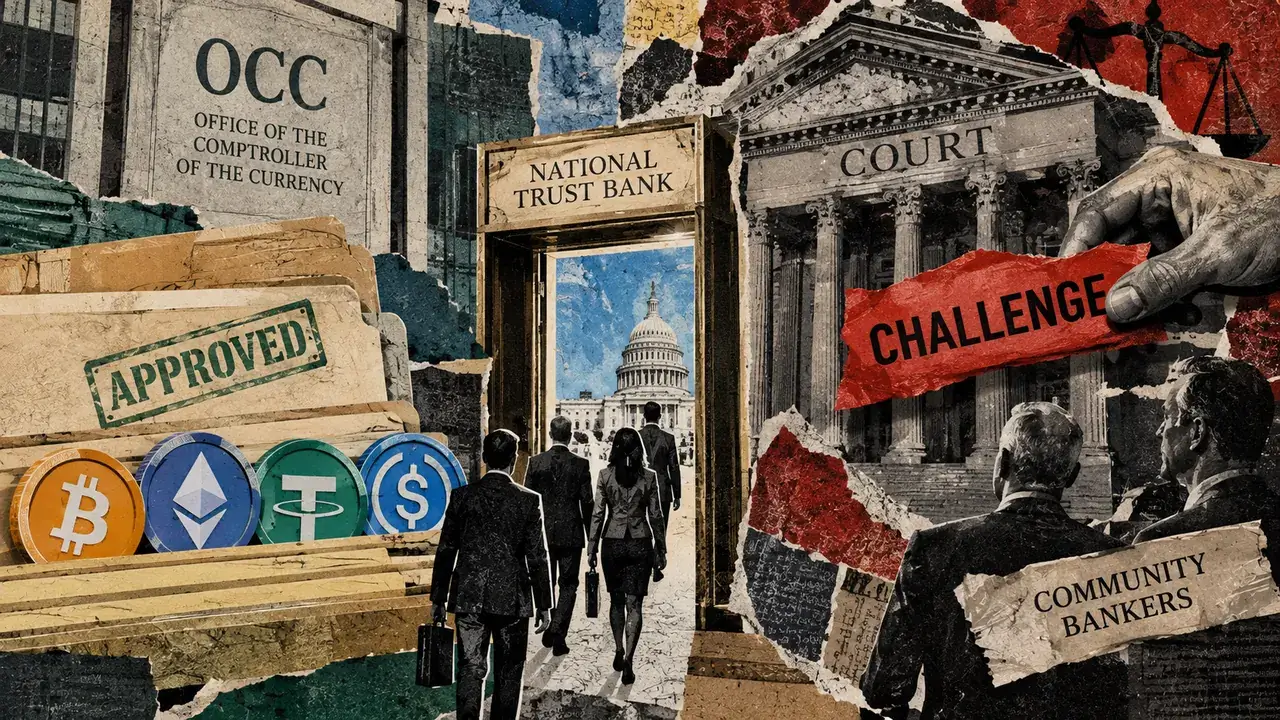
Bankers sue to overturn OCC trust-bank rule used by crypto firms
The Independent Community Bankers of America sued the OCC in federal court in Washington on Oct. 2, two weeks after the agency app...

India’s local crypto exchanges get just 0.7% of inflows, Chainalysis reports
India’s crypto users send substantial value to centralized exchanges, but domestic platforms receive just 0.7% of exchange value i...