US Crypto Index ETFs Face Lukewarm Reception After Launch – What’s Holding Them Back?
Key Takeaways: Initial investor interest in new crypto index ETFs has been significantly lower compared to spot Bitcoin ETFs. The limited scope of assets (currently only Bitcoin and Ether) is hindering diversification an...
Archive context
Older archive item. Useful for background and entity history, but not a fresh market-moving signal.
Key Takeaways:
- Initial investor interest in new crypto index ETFs has been significantly lower compared to spot Bitcoin ETFs.
- The limited scope of assets (currently only Bitcoin and Ether) is hindering diversification and overall appeal.
- Future regulatory approvals for ETFs holding a broader range of cryptocurrencies are highly anticipated.
The launch of U.S. cryptocurrency index Exchange Traded Funds (ETFs), which are designed to offer investors a diversified crypto portfolio, has received a surprisingly muted response. According to data, such funds, which hold Bitcoin (BTC) and Ether (ETH), have attracted much less capital than the earlier rush for spot Bitcoin exchange-traded funds.
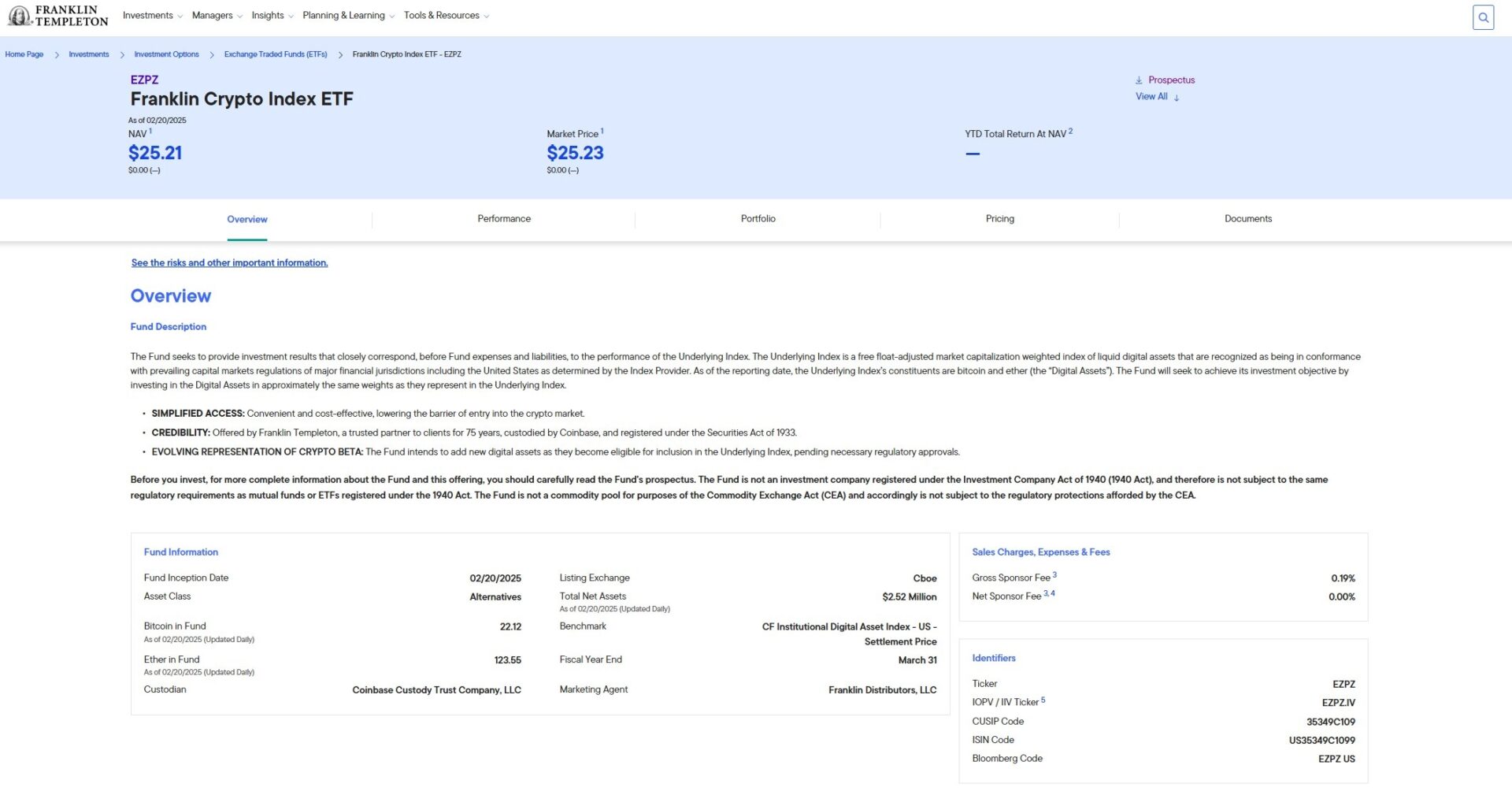
A Slow Start for Crypto Index ETFsThe Franklin Crypto Index ETF (EZPZ), a new fund sponsored by Franklin Templeton, has garnered roughly $2.5 million in net assets since its inception on Feb. 20, according to the fund’s website. Meanwhile, the Hashdex Nasdaq Crypto Index US ETF (NCIQ) has attracted only slightly over $1 million since its launch on February 14, according to Hashdex’s website.
This performance is nowhere near the enthusiasm surrounding the earlier launch of spot Bitcoin ETFs this year. In comparison, Franklin Templeton’s own Franklin Bitcoin ETF (EZBC) brought in around $50 million in net inflows on its opening day of trading in January 2024, data from Statista shows. Likewise, the Bitwise Bitcoin ETF (BITB) experienced an astounding $240 million pour into its coffers on its inaugural day.
Single-asset spot Ether ETFs, while less explosive than Bitcoin ETFs, still managed to attract around $100 million in net inflows on their first trading day, demonstrating a stronger initial demand than these newer index funds.
Franklin Crypto Index ETF launched on Feb 20. Source: Franklin Templeton
Why the Lackluster Performance?A number of factors have likely contributed to the tepid investor interest. One key reason is that these index ETFs, as they currently stand, provide very little diversification.
Inability to Diversify Due to Limited ScopeAlthough these funds aim to track a diversified index of crypto assets, providing U.S. investors with a “one-stop-shop” crypto portfolio, their utility remains restricted due to regulatory hurdles. EZPZ and NCIQ both track indexes of crypto assets based on their respective market capitalizations. This leads, naturally, to a Bitcoin-dominant portfolio; Bitcoin has a market cap of about $1.9 trillion (Google Finance, February 21). Ether, the second-largest crypto, accounts for most of the other assets.
The ETFs are currently limited to holding just Bitcoin and Ether. Their long-term aim is to offer a more diverse portfolio of crypto assets, pending future regulatory green lights. For investors looking for broad exposure to the space, this limitation reduces the attractiveness of these ETFs relative to what available funds could do if they held a wider range of assets.
The Appeal of Diversification and the Regulatory BarrierThis is because a diversified crypto ETF will be an investment vehicle that captures the growth potential in the wider crypto ecosystem, rather than relying on the performance of Bitcoin and Ether alone. This can provide a means for diversification and also help reduce risks while giving some exposure to different projects and new trends in the crypto world.
As an illustration, think of an investor who comes across two cryptocurrencies, Solana (SOL) or XRP, both of which may have very different usages and market situations. As of now, these index ETFs do not have any exposure to such assets. That leaves investors with the choice to buy these cryptocurrencies outright or wait for ETFs that can hold them.
In fact, the Securities and Exchange Commission (SEC) has seen ETF applications for a more extensive range of altcoins. In October, securities exchange NYSE Arca applied to list a Grayscale ETF that would hold a broader variety of spot cryptocurrencies. The Grayscale Digital Large Cap Fund, launched in 2018, is not yet publicly traded and holds a crypto index portfolio comprising Bitcoin, Ether, Solana, and XRP, among others.
More News: SEC Acknowledges Grayscale’s XRP & Dogecoin ETF Filings: A Game Changer or Regulatory Roadblock?
What to Expect for Crypto ETFs in the FutureThe SEC’s response to these applications hints at an increasing tolerance for crypto-investment vehicles. Analysts expect that even more crypto ETFs holding the likes of SOL and XRP could see the greenlight as soon as 2025. This would create a drastically wider array of options for investors to gain diversified exposure to the crypto market.
Just imagine, if there were an ETF that could hold a curated basket of the top 10 or 20 cryptocurrencies by market capitalization. This would provide investors with immediate diversification and access to a wide range of projects from decentralized finance (DeFi) protocols to layer-2 scaling solutions. Such a product might well generate substantial new flows of capital into the crypto market.
Regulatory Environment: A Major ConsiderationThe future of crypto index ETFs largely depends on how the regulatory landscape evolves. Now that regulators have a better grip on the crypto asset class, we should start to see more diverse ETF options approved, meaning more choices and more diversification for investors. The approval of spot Bitcoin ETFs was also a landmark, but the approval of ETFs holding altcoins would be another leap.
The post US Crypto Index ETFs Face Lukewarm Reception After Launch – What’s Holding Them Back? appeared first on CryptoNinjas.
Why this matters
This research story adds another data point to the current market tape and is useful when read alongside nearby source coverage.
Original source
Read on CryptoNinjasRelated market context

Ether ETFs extend outflow streak to nine days as Solana funds snap record 14-week inflow run
Spot bitcoin, solana, and ether ETFs all logged weekly outflows following last week's trading, a notable shift for some of the fun...

Bitcoin ETFs Shed $729M in Two Days as Investors Reverse Course
Bitcoin Magazine Bitcoin ETFs Shed $729M in Two Days as Investors Reverse Course U.S. investors this week reversed course, cashing...
Franklin Templeton Explores SEC Relief for Tokenized Fund Trades
Franklin Templeton is exploring whether regulatory exemptions could allow tokenized money market funds and ETFs to trade through b...

Ledger theft-linked funds shift from USDT to USDD to dodge Tether freezes
The shift from USDT to USDD underscores vulnerabilities in stablecoin freeze mechanisms, prompting scrutiny on regulatory and secu...

What Is Crypto Spot Trading?
For example, a token can be up 70% and still be a terrible trade if you have no idea when to take profits. Likewise, a 30% dip can...

Being right about Bitcoin won’t save your 3x leveraged ETF position
Bitcoin's next recovery could vindicate your investment thesis but leave your leveraged fund deep in the red, because the fund's d...