A layer-1 blockchain froze for 4 hours to stop a $4.9 million hack, then claimed it was just an upgrade
Injective, a layer-1 blockchain network, produced no new block for nearly four hours during an emergency response to an exploit that researchers traced into core modules. On Sept.1, the foundation said the blockchain was...
Archive context
Older archive item. Useful for background and entity history, but not a fresh market-moving signal.
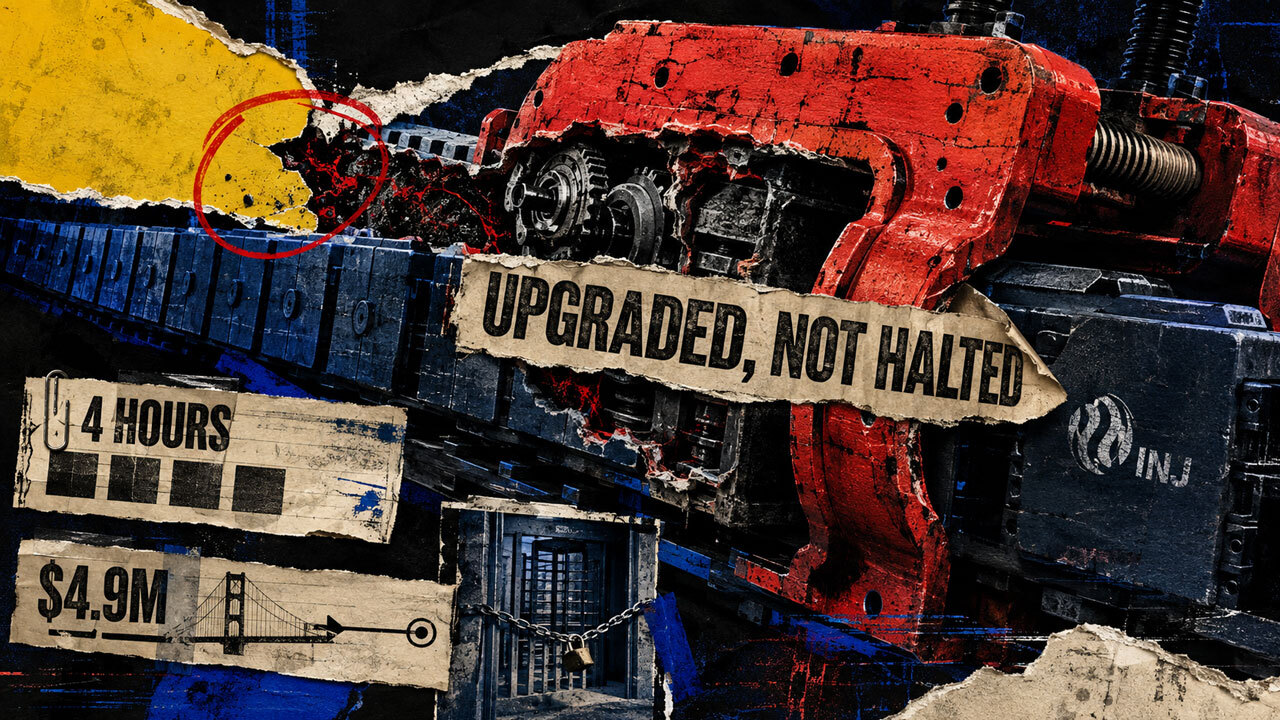
Injective, a layer-1 blockchain network, produced no new block for nearly four hours during an emergency response to an exploit that researchers traced into core modules.
On Sept.1, the foundation said the blockchain was “upgraded, not halted” and that its consensus, native INJ, and staked assets were never compromised. It described the attack as affecting a small number of ecosystem applications using binary-options markets.
On-chain researcher Earthling Paddy challenged both characterizations, while crediting Injective for containing the exploit and keeping staked funds safe.
The ledger shows block 181027005 at 16:09:59 UTC on Aug. 31 before block production stopped for roughly four hours. Paddy said one earlier block alone took about 37 minutes, while infrastructure provider QuickNode also reported a stalled block height during the incident.
Injective said the accelerated upgrade took longer than expected as validators and ecosystem infrastructure moved to the emergency release. Some validators were temporarily jailed after missing the required upgrade window, while exchanges including Coinbase and Coins.ph temporarily restricted transfers.
Data from CryptoSlate shows INJ trading around $4.80 as of press time, down roughly 3% over the previous 24 hours.
Researcher disputes where the vulnerability satPaddy also questioned Injective’s description of the exploit as isolated to ecosystem applications.
He said the attack used messages from Injective’s native exchange and insurance modules, while the emergency v1.20.3-safeharbor.1 release patched the chain’s core code by adding an insurance-fund denomination check and disabling binary-options settlement on mainnet.
That would place the vulnerable logic inside a protocol module used by applications rather than solely within application code.
Related Reading MANTRA Chain is back online, but silent code changes spark developer concernsInjective has not yet published a full technical postmortem. Its statement said the relevant attack vector had been contained and patched and that the foundation was adding stronger invariants, real-time monitoring, and other safeguards.
Researchers estimate about $4.9 million was bridged to Ethereum during the exploit. Paddy said roughly that amount remained in the attacker-linked wallet and had not moved.
The final loss allocation remains unclear. Injective has not disclosed how much was ultimately drained, which party absorbed any shortfall, or whether an ecosystem pool that now appears replenished was restored by the foundation, developers, or another participant.
Instead, the blockchain has maintained that its users weren't affected. In an X post, Injective CEO Eric Chen said:
“Injective users aren’t affected and we’ve been helping the team on recovery. Always sad to see exploits happening in the ecosystem but we’re glad that the incident was contained before further harm was done.”
Nonetheless, the incident therefore leaves two separate findings intact. Injective’s consensus and staked INJ were not compromised, while its emergency response still coincided with a multi-hour interruption in block production and required a core-code patch.
The post A layer-1 blockchain froze for 4 hours to stop a $4.9 million hack, then claimed it was just an upgrade appeared first on CryptoSlate.
Why this matters
Ethereum is showing up inside the Security Incidents theme, so this story is worth tracking for follow-through rather than treating it as a one-off headline.
Original source
Read on CryptoSlateRelated market context

Safe launches Safenet Aegis security network on Ethereum, Gnosis, and Arbitrum
Safenet Aegis' launch could redefine blockchain security, balancing user costs with enhanced transaction safety and governance-dri...

Starknet explores move from Ethereum Layer 2 to standalone Layer 1 blockchain
Starknet's potential shift to Layer 1 could destabilize Ethereum's ecosystem, affecting market confidence and price predictions. T...

Taiwan blocks Coinbase and Kalshi websites over election betting concerns
Taiwan's action highlights the tension between innovation in prediction markets and regulatory frameworks prioritizing election in...

SEC Crypto: What do the Coinbase and MARA Binary Options Mean?
In SEC crypto news, the commission has reportedly approved standardized binary options that pay a predetermined cash amount if a s...

Ethereum Price Prediction: ETH Bears Take Over in Latest Liquidation Bloodbath
Ethereum traded at $2,350, losing 6.5% of its market cap over 24 hours, after a liquidation-driven sell-off exposed how quickly le...

Starknet opens vote on potential Ethereum L2 exit over quantum risks
Starknet is asking STRK holders whether to explore becoming an independent layer-1 blockchain to reduce its dependence on Ethereum...