Analysts Consider US National Security Policy a Pretext to Establish Trade Sanctions Against Other Countries
International analysts have called out the supposed use of the national security policy of the U.S. as a tool to justify the establishment of blockades and economic sanctions against countries like China and Russia. Whil...
Archive context
Older archive item. Useful for background and entity history, but not a fresh market-moving signal.
International analysts have called out the supposed use of the national security policy of the U.S. as a tool to justify the establishment of blockades and economic sanctions against countries like China and Russia. While U.S. Treasury Secretary Janet Yellen has recognized that a decoupling of the economies of the U.S. and China would be “disastrous,” the U.S. government is said to be putting its security policies over this concern.
U.S. Using National Security Policy as Abusive Tool, Analysts WarnSeveral analysts have referred to the usage of the U.S. national security policy as a pretext to establish economic sanctions and take unjustified measures against other countries. While on April 20, U.S. Treasury Secretary Janet Yellen stated that the U.S. was seeking a “constructive and fair economic relationship with China,” but that it would use its tools to protect its national security with no interest in gaining an economic advantage as a consequence, these policies are indeed hurting the global economy and disrupting supply chains, per the analysts statements.
Lewis Ndichu, from the Nairobi-based think tank Africa Policy Institute, told Xinhua this policy of putting national security over other important issues was “putting the cart ahead of the horse.”
American analysts are also voicing their concerns. Gary Hufbauer, senior fellow at the Washington-based Peterson Institute for International Economics (PIIE), explained that these measures went “beyond the reasonable scope of national security.” Hufbauer criticized the existent tariffs on aluminum and steel, and how the government wants to link other articles to national security. He stated:
Advanced semiconductors and some AI and telecom have security implications, but not commodity chips (the bulk of the market) or services like TikTok.
Politicization of TradeOther analysts intended to explain these postures by linking them to politicization, with the objective of taking the right of development from other countries. This is the opinion of Chinese Foreign Ministry Spokesperson Wang Wenbin, who recently stated:
The U.S. habitually politicizes technology and trade issues and uses them as a tool and weapon in the name of national security.
Some even comment that this kind of strong-arm policy is used by U.S. presidential candidates to win support from certain groups. Cavince Adhere, a Kenya-based international relations scholar, declared that “candidates running for office often use the rhetoric of being tough on China to win votes. Eventually, such campaign-driven attitudes end up informing U.S. foreign policy toward China.”
What do you think about the measures taken as part of U.S. national security policy? Tell us in the comment section below.
Why this matters
This security story adds another data point to the current market tape and is useful when read alongside nearby source coverage.
Original source
Read on Bitcoin NewsRelated market context
![Hyperliquid Policy Center and trade[XYZ] petition SEC to create regulatory framework for pre-IPO perpetual contracts](https://static.cryptobriefing.com/wp-content/uploads/2026/08/18104012/new-hyperliquid-protocol-goes-full-throttle-with-1-000x-leve-4-400x210.jpeg)
Hyperliquid Policy Center and trade[XYZ] petition SEC to create regulatory framework for pre-IPO perpetual contracts
The push for IPOPs could democratize pre-IPO market access, potentially reshaping investment landscapes and regulatory approaches....

Hyperliquid Policy Center and Douro Labs urge SEC to repeal trade-through rule for onchain markets
Repealing Rule 611 could redefine market dynamics, fostering innovation in decentralized finance while challenging traditional reg...
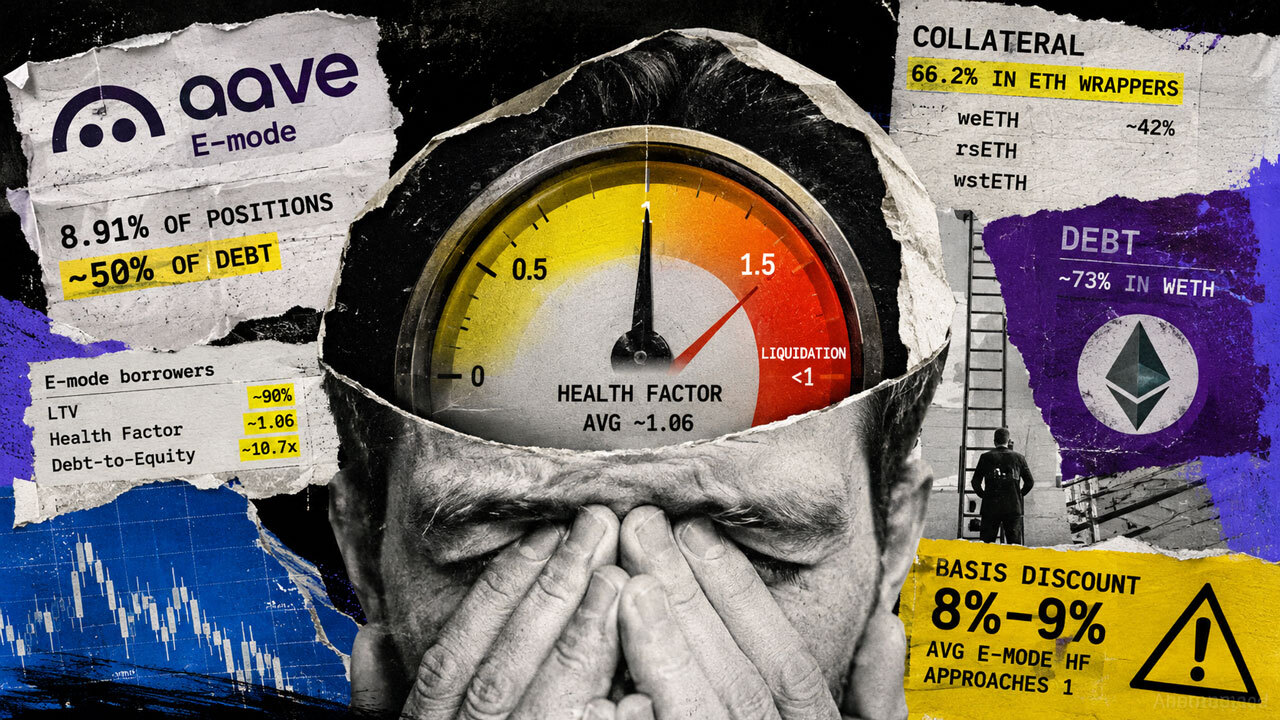
Half of Aave’s debt sits in just 9% of positions built around one Ethereum correlation trade
Galaxy's Aug. 7 snapshot of Aave V3 Core found 19,073 loans on the protocol after applying standard filters. Fewer than 9% of thos...

Trump agencies to develop crypto policy as landmark bill stalls in Senate
The reliance on agency-level crypto regulations introduces uncertainty, impacting investor confidence and market stability amid le...

Trader places $129M bet against VanEck Semiconductor ETF in largest options trade of the session
A significant bearish options trade on SMH could signal broader market skepticism about the semiconductor sector's near-term prosp...
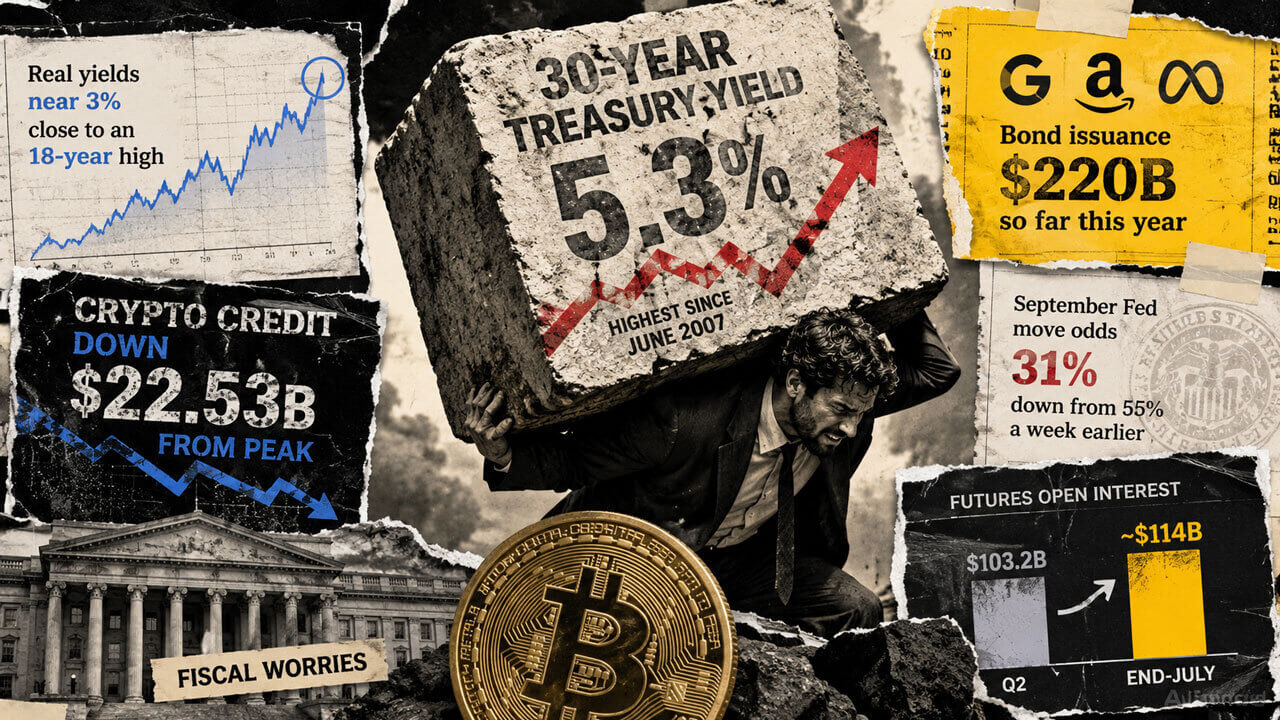
Bitcoin faces its highest Treasury hurdle since 2007 with $22.5B less crypto credit to unwind
The US 30-year Treasury yield crossed 5.3% on Aug. 17 for the first time since June 2007, the same day Galaxy published a report s...