Ascendex Hacked — Exchange Loses $77 Million in ERC20, BSC, Polygon Tokens
Ascendex, a cryptocurrency exchange, suffered a security breach that allowed hackers to take control of some of the wallets of the exchange. The attack focused on hot wallets, where funds are kept as a buffer to tend to...
Archive context
Older archive item. Useful for background and entity history, but not a fresh market-moving signal.

Ascendex, a cryptocurrency exchange, suffered a security breach that allowed hackers to take control of some of the wallets of the exchange. The attack focused on hot wallets, where funds are kept as a buffer to tend to customers’ withdrawals. The company announced that it would reimburse these funds to any affected user. Peckshield, a security and auditing company estimated losses of around $77 million.
Ascendex Hot Wallets RansackedYesterday, Ascendex, a cryptocurrency exchange, reported a security breach caused by a hack attack that focused on the hot wallets of the exchange. The company acknowledged the attack quickly and ran a series of security procedures to safeguard its cold wallets. While the exchange has not released numbers on the attack, Peckshield, a security and blockchain auditing company, examined the hack and estimated the losses at around $77 million.
The hack targeted hot wallets of the Ethereum, BSC, and Polygon networks, with the most value being withdrawn in ERC20 tokens. $60 million worth of these tokens were stolen in the hack, followed by $9.2 million in BSC tokens and $8.5 million in Polygon tokens. Peckshield provided a detailed report of which tokens were stolen and how much was stolen in each token.
Ascendex ResponseAscendex issued a statement on the event and informed the public about the actions it will take after the hack. First and foremost, Ascendex will reimburse all of the funds stolen for the affected users, as it declared that “the impacted assets are a relatively small percentage of total exchange assets.” The exchange transferred the nonimpacted assets to its cold wallets and has since suspended withdrawals for its customers.
The second part of its response to this hack has to do with the investigation of how this happened and who might be the party behind it. In this sense, the company informed it is already working with blockchain forensic firms and law enforcement to ascertain what really happened and to block the stolen funds from being freely transferred between exchanges.
Ascendex also reported that small projects have been affected by this hack, and that some of them are studying to reissue tokens to holders. This affects low liquidity and new projects that were listed on the exchange. This is the second high-profile hack that centralized exchanges suffer in December. Bitmart, another cryptocurrency exchange, lost $200 million in an attack performer on December 6.
What do you think about Ascendex’s $77 million hack? Tell us in the comments section below.
Why this matters
This security story adds another data point to the current market tape and is useful when read alongside nearby source coverage.
Original source
Read on Bitcoin NewsRelated market context

Swell Freezes swETH and rswETH Withdrawals Until It Corrects Their Exchange Rates
Holders of Swell‘s swETH and rswETH cannot deposit or withdraw through the protocol after the team said at 2:39 a.m. ET Friday it...
Irish Central Bank Fines Coinbase Unit €3.25 Million Over Customer Fund Safeguards
TL;DR: Ireland’s central bank imposed a €3.25 million penalty on Coinbase Ireland over electronic-money safeguarding and outsourci...

XRP Wallets Hit Record 8.24 Million as Network Growth Accelerates
XRP Ledger’s wallet count has reached 8.24 million, extending its climb through months of price volatility. Santiment paired the m...
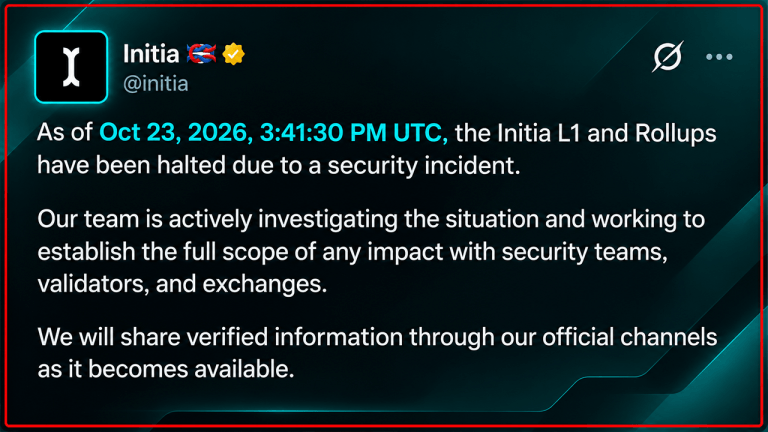
Hacker Prints $2.7M in Crypto as Initia Blockchain Grinds to a Halt
Modular blockchain platform Initia halted its network Friday after the team confirmed “a security incident” that compromised its o...
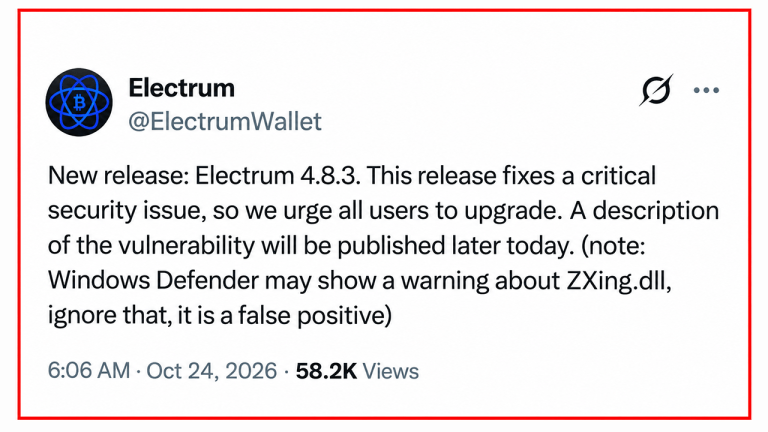
Electrum Wallet Attack Hid Bitcoin Theft Behind a Fee Increase
A malicious bitcoin wallet server could quietly swap a legitimate payment for a thief’s transaction, then wait for its owner to ap...
Bybit Wins Dubai VARA Approval For Spot Crypto Exchange Services
TL;DR: Bybit says its Dubai entity has secured a VARA virtual-asset service provider licence covering spot exchange activity; deri...