Australian Crypto Laundering Crackdown: ASIC Charges Four Over $35M Fake Bond Scam
Four Australian men, including former barrister Dimitrios Podaridis, are facing money laundering charges for allegedly facilitating sophisticated investment scams that converted victim funds into crypto between January a...
Archive context
Older archive item. Useful for background and entity history, but not a fresh market-moving signal.

Four Australian men, including former barrister Dimitrios Podaridis, are facing money laundering charges for allegedly facilitating sophisticated investment scams that converted victim funds into crypto between January and July 2021.
The Australian Securities and Investments Commission alleges the defendants operated fake investment comparison websites and Facebook advertisements to attract investors with fraudulent bonds offering fixed returns between 4.5% and 9.5% annually.
Professional Documentation Masks Crypto Conversion SchemeASIC charged Podaridis alongside Peter Delis, Bassilios Floropoulos, and Harry Tsalikidis for recklessly dealing with proceeds of crime while not directly operating the investment scams.
The scheme allegedly used high-quality fake prospectuses mimicking major financial services providers to convince victims to deposit funds into Australian bank accounts before transferring money to offshore accounts and crypto exchanges.
These latest charges come as Australia intensifies its crackdown on cryptocurrency-related financial crimes, with authorities recently shutting down massive criminal operations and implementing enhanced oversight of crypto exchanges.
ASIC has disabled over 10,000 malicious websites while processing 1,500 victim claims totaling $35.8 million in losses across 14 countries.
Australian authorities have charged four individuals over a scheme that allegedly laundered $123 million through businesses and crypto.#Australia #amlhttps://t.co/uV1errA8TV
— Cryptonews.com (@cryptonews) June 9, 2025Recent enforcement actions also include restraining $123 million in assets from a Gold Coast security company’s money-laundering network and charging operators who converted cash into cryptocurrency through complex banking arrangements.
Regarding these latest charges, the Commonwealth Director of Public Prosecutions will handle the prosecution following ASIC’s referral, with committal proceedings scheduled for October 30, 2025.
ASIC Targets Investment Scam Network Using Professional DocumentationThe alleged investment scam utilized sophisticated marketing techniques, including fictitious comparison websites and targeted social media advertising, to reach potential victims.
Scammers contacted interested investors through telephone and email, providing professionally crafted documentation that closely resembled legitimate financial services materials.
The fraudulent investment offerings ranged from one to ten years, with attractive fixed returns designed to appeal to conservative investors seeking stable income.
ASIC alleges the defendants controlled Australian bank accounts that received victims’ deposits before quickly transferring funds internationally to avoid detection.
The investigation began after ASIC received multiple complaints from both consumers and corporate entities who had been defrauded.
The regulator’s analysis revealed patterns of fund movement from domestic accounts to offshore locations and cryptocurrency platforms, establishing the money-laundering network’s operational structure.
Tsalikidis allegedly aided and abetted the other three defendants while not directly controlling bank accounts used in the scheme.
The defendants also allegedly exploited trust in traditional financial institutions by copying authentic documentation and branding to legitimize their fraudulent offerings.
Crypto Crime Enforcement Accelerates Across Multiple AgenciesAustralian authorities have dramatically expanded cryptocurrency crime enforcement through coordinated multi-agency operations targeting money laundering networks.
The Queensland Joint Organised Crime Taskforce executed 14 search warrants and restrained $21 million in assets from a security company laundering operation that processed $190 million in illicit funds.
ASIC has shuttered an average of 130 scam websites weekly while deregistering 95 companies linked to international “pig butchering” schemes.
The Federal Court approved winding-up orders after finding that companies were registered using false information to provide legitimacy to fraudulent investment platforms.
Similarly, in April, AUSTRAC enhanced oversight of crypto exchanges by warning that inactive platforms face deregistration while launching a publicly searchable registry for consumer verification.
The agency contacted dormant registered exchanges among 427 businesses to prevent criminal exploitation of legitimate registrations.
These large-scale scams are not limited to Australia alone. Recent phishing attacks have cost individual investors millions, including a $3.05 million Tether loss and $900,000 approval transaction exploit.
A crypto investor has fallen victim to a phishing scam, losing $3.05 million in USDT after signing a malicious blockchain transaction. #Scam #Cryptohttps://t.co/CnB0GNgIo4
— Cryptonews.com (@cryptonews) August 6, 2025CertiK recently reported $2.2 billion in crypto losses during the first half of 2025, with wallet breaches causing $1.7 billion across 34 incidents and phishing scams accounting for $410 million through 132 attacks.
Most recently, YouTube account hijacking schemes promoted fake crypto trading bots that drained investor funds once users deposited minimum amounts of Ethereum.
Attackers collected over $939,000 through multiple wallet addresses while using AI-generated videos and managed comment sections to create false legitimacy.
While Australia is cautious about crypto, the country has recently started its wholesale CBDC testing through Project Acacia, where 24 industry participants will conduct real-money transactions across multiple digital asset platforms.
ASIC granted regulatory relief to facilitate the six-month pilot program examining tokenized assets and central bank digital currency applications.
The post Australian Crypto Laundering Crackdown: ASIC Charges Four Over $35M Fake Bond Scam appeared first on Cryptonews.
Why this matters
This security story adds another data point to the current market tape and is useful when read alongside nearby source coverage.
Original source
Read on CryptonewsRelated market context

US Charges Man After Crypto Scam Wallets Received More Than $53M
TL;DR U.S. prosecutors have charged a Vietnamese national with money laundering tied to alleged cryptocurrency “pig butchering” sc...

Bitcoin ATM Scam Takes $4,900 After Fake Jury Duty Threat
A Georgia woman deposited $4,900 into a Bitcoin ATM after being told she had missed jury duty and needed to pay to avoid arrest. H...

An $84 million US asset seizure just sparked a massive question for Tether
Tether has disclosed exposure to EQIBank as the bank fights a US seizure involving payment processor Capstone Limited, raising a q...
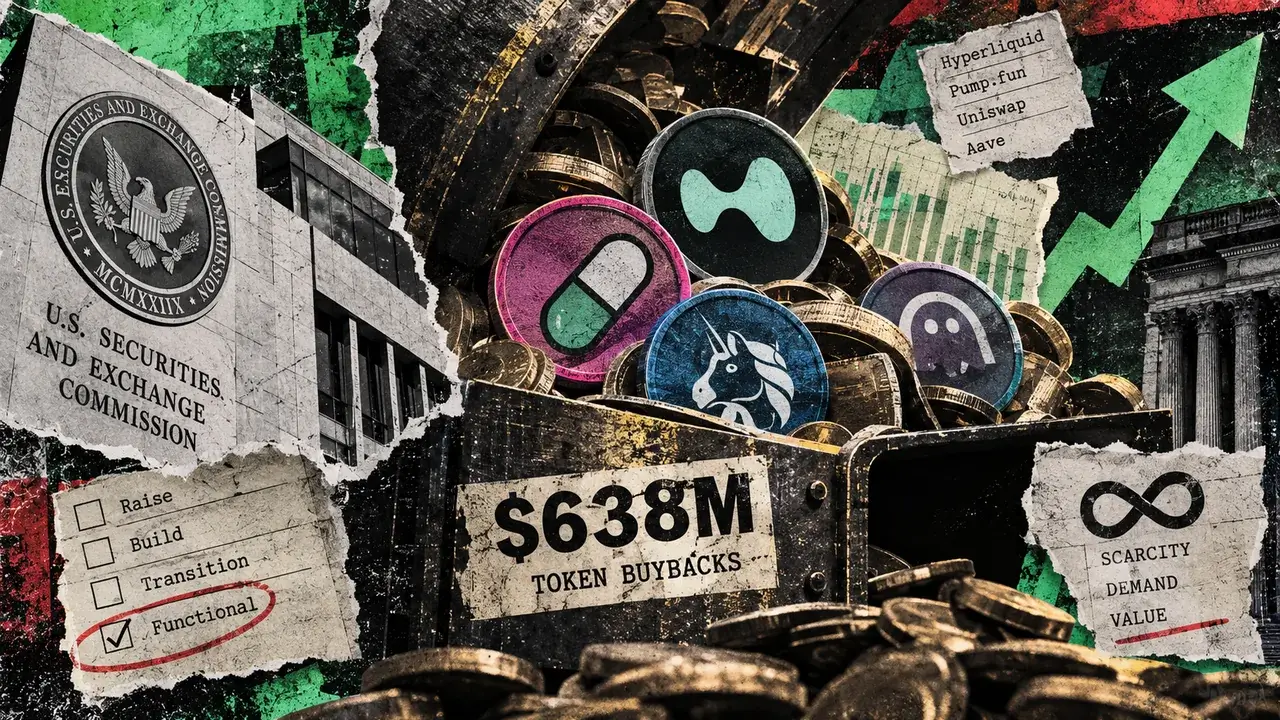
SEC clears regulatory hurdle as crypto token buybacks hit record $638 million
Crypto projects spent about $638 million with token buybacks through late August 2026, according to Allium Labs data. That is alre...

Washington has $114 billion reasons to want Tether around
Not that long ago, Washington fined Tether for misleading people about the dollars behind its tokens. Today, the company's insatia...

Bitget’s hack just got $36 million bigger, and now there’s a bounty on the stolen crypto
Bitget has raised the estimated value of assets taken in its Sept. 24 breach to $387.5 million as exchanges and security firms mob...