Chainalysis Says Haowang Shutdown Fails to Dismantle Crypto Scam Networks
The closure of Haowang Guarantee, once the largest illicit online marketplace for crypto scammers, is far from a final blow to crypto crime, according to a report published Monday by blockchain analytics firm Chainalysis...
Archive context
Older archive item. Useful for background and entity history, but not a fresh market-moving signal.
The closure of Haowang Guarantee, once the largest illicit online marketplace for crypto scammers, is far from a final blow to crypto crime, according to a report published Monday by blockchain analytics firm Chainalysis.
Haowang, previously known as Huione Guarantee, was a Telegram-based marketplace offering money laundering services, stolen data, and scam technology without requiring identity verification.
Its shutdown followed a sweeping crackdown by Telegram after the U.S. Treasury’s FinCEN identified Haowang’s parent, the Cambodian-based Huione Group, as a money laundering operation linked to North Korean cyber actors.
Criminal Ecosystem Behind ‘Guarantee’ Services Proves ResilientTelegram also removed accounts connected to Xinbi Guarantee, the second-largest platform of its kind.
These actions were hailed as progress in disrupting scam networks that had taken root on encrypted messaging platforms. But Chainalysis warned that the victory is more symbolic than structural.
In its report, Chainalysis said the criminal ecosystem around “guarantee” services has proven highly adaptable.
“These services are likely designed for redundancy, speaking to the resilience of criminals and the lucrative nature of their businesses,” the report noted.
Vendors who once operated on Haowang have already moved to new platforms or split across several smaller marketplaces.
The same users, Chainalysis said, quickly adjust to new brokers and communication channels, reducing the impact of isolated takedowns.
“For now, the Huione Group takedown may shift some traffic, scramble broker relationships, or inspire short-term caution,” Chainalysis added, “but the structural enablers of crypto crime unfortunately remain intact.”
Telegram continues to serve as the primary base for these illicit operations due to its ease of access and pseudonymous features.
Despite promises of enforcement, the platform has not disclosed whether further crackdowns will follow.
Chainalysis concluded that while platform removals may draw headlines, lasting progress against crypto scams will depend on more advanced, behavioral-focused monitoring of blockchain transactions.
Rather than solely dismantling platforms, the firm urges efforts to track illicit funds through on-chain movement patterns, where real-time data may expose fraud even when platforms go dark.
Crypto Crime Turns Violent as Illicit Transactions Top $40B in 2024Illicit cryptocurrency activity surged to at least $40.9 billion in 2024, according to Chainalysis, with the number likely to grow as more criminal-linked wallets are identified.
Hacks alone accounted for $2.2 billion in stolen assets—a 21% increase from the previous year.
North Korean-linked groups, including Lazarus and Tradetraitor, were behind over 60% of those thefts, with major incidents like the $300 million hack of Japan’s DMM Bitcoin exchange among their hits.
But the threats go beyond online exploits. Criminal groups are using crypto to fund and conceal a wider range of crimes—from investment scams and AI-enhanced romance frauds to drug trafficking and even physical violence.
In one alarming case on May 13, 2025, the daughter and grandson of Paymium’s CEO were nearly kidnapped in Paris by masked men.
On Tuesday, May 13, 2025, it is alleged that the French cryptocurrency platform Paymium CEO Pierre Noizat's daughter and two-year-old child were targeted in the attempted kidnapping in Paris. There has been no confirmation of the identities of the victims or their relations by… pic.twitter.com/HAbsCU6fg1
— SuperNOVA (@NovaExcitement) May 13, 2025Platforms like Huione Guarantee have played a key role in laundering stolen funds, helping cybercriminals convert digital profits into real-world danger.
The post Chainalysis Says Haowang Shutdown Fails to Dismantle Crypto Scam Networks appeared first on Cryptonews.
Why this matters
This security story adds another data point to the current market tape and is useful when read alongside nearby source coverage.
Original source
Read on CryptonewsRelated market context

Riot Platforms repays $200M credit facility, releases 5,821 BTC from collateral
Riot's debt repayment enhances financial flexibility, enabling strategic Bitcoin management and potential growth in data-center ve...

Best Crypto Staking Platforms for 2026: 7 Options Compared
Staking is the closest thing crypto has to earning interest: you lock up a proof-of-stake asset to help secure its network, and in...

US Charges Man After Crypto Scam Wallets Received More Than $53M
TL;DR U.S. prosecutors have charged a Vietnamese national with money laundering tied to alleged cryptocurrency “pig butchering” sc...

SEC Staff Clear Token Buybacks on Working Networks, With a Warning for Unfinished Ones
More crypto projects are using revenue to buy back their own tokens, the way public companies repurchase stock. Ethena proposed a...
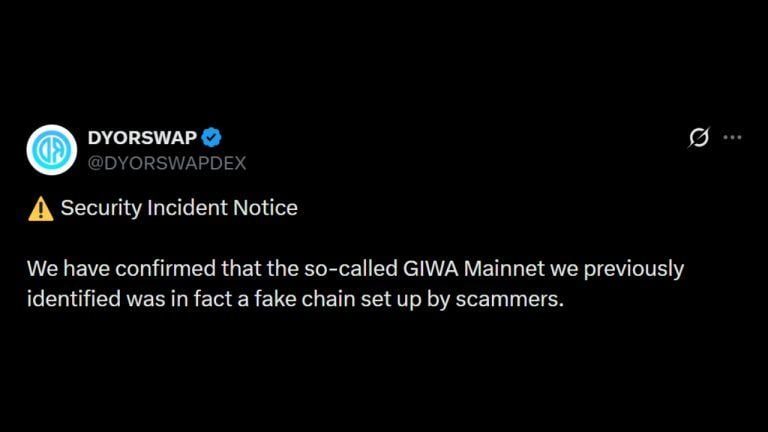
Scammers Launch Fake ETH L2 to Steal $2M From Crypto Traders
An unidentified group of threat actors launched a fake L2 chain impersonating Giwa, a project backed by Upbit, identified by DYORS...

Scammers steal over $2M by creating fake GIWA blockchain
The incident highlights the urgent need for improved blockchain security measures and verification processes to prevent similar sc...