Lobby Finance Vote-Buying on Arbitrum Raises Alarms Over DAO Security and Governance Integrity
Key Takeaways: The use of Lobby Finance to buy votes in Arbitrum DAO elections has shown critical vulnerabilities in token-weighted governance. The incident shows how cheaply vote-buying can distort major decisions, thre...
Archive context
Older archive item. Useful for background and entity history, but not a fresh market-moving signal.

Key Takeaways:
- The use of Lobby Finance to buy votes in Arbitrum DAO elections has shown critical vulnerabilities in token-weighted governance.
- The incident shows how cheaply vote-buying can distort major decisions, threatening the integrity of DAO structures and their foundational principles.
- Arbitrum’s response to this controversy might set a precedent for addressing governance manipulation.
Over the weekend, Arbitrum DAO witnessed an unprecedented shake-up in its governance structure, exposing deeper vulnerabilities in decentralized systems that rely on token-weighted voting.
The controversy centers around hitmonlee.eth, who paid 5 ETH (roughly $10,000) to acquire 19.3 million ARB tokens’ worth of voting power through Lobby Finance.
This platform allows token holders to delegate their votes in return for yield.
The old DAO model is in shambles:
Last weekend, hitmonlee.eth paid 5 ETH (~$10k) on @lobbyfinance to buy 19.3M ARB (~$6.5m) voting power.
That's more votes than experienced DAO delegates like Wintermute or L2Beat have.
All votes were cast for @CupOJoseph for Arbitrum's… pic.twitter.com/QRgeom9Otq
All of these votes were directed toward electing CupOJoseph to Arbitrum’s newly formed Oversight and Transparency (OAT) Committee.
Lobby Finance has been active within Arbitrum’s governance ecosystem for several months.
It functions by enabling vote marketplaces, where idle voting power is auctioned off or sold at a fixed rate, and the yield is returned to token holders.
While the platform initially operated under the radar, the recent transaction has become a tipping point for awareness of its potential to hinder blockchain decentralization.
In another example, a staggering 20.1 million ARB votes were bought for just 0.0652 ETH, showing how dramatically cheap it has become to influence major decisions in DAOs.
For the OAT elections, Lobby Finance charged a flat rate of 5 ETH for an “instant buy” of all voting power in a winner-takes-all system.
Source: Arbitrum DAO ForumThe financial upside of winning the committee seat was also important, as Joseph stands to earn 66 ETH over 12 months, including a potential bonus of 100,000 ARB tokens.
CupOJoseph himself has openly criticized the mechanism, pointing out that it shouldn’t be possible to extract $10,000 worth of value from the DAO by paying just $1,000.
His unease is widely shared, with many now questioning whether vote-buying undermines the fundamental principles of decentralized governance.
Arbitrum Faces Its DAO DilemmaThe Arbitrum Foundation responded swiftly by launching an open forum discussion to address the growing disquiet.
In their post titled “DAO Discussion: Vote Buying Services,” the Foundation acknowledged that vote buying in the OAT elections is a precedent-setting moment.
The DAO claimed that while LobbyFi had been used in smaller, less important proposals, this was the first time a considerable amount of money was spent to influence a major governance decision.
The Foundation further attempted to justify its prior silence by stating that it waited until the OAT election concluded to avoid influencing the outcome.
Source: Arbitrum DAO ForumThe DAO’s summary of the statement was based on the logic behind LobbyFi’s pricing.
It stated that since the Foundation had already vetted the OAT candidates through a KYC and conflict-of-interest screening process, the election was deemed secure enough to allow vote-buying.
However, while this vetting process is thorough in terms of legality and transparency, the DAO claimed it does not guarantee that elected individuals are ideal stewards of DAO governance.
That judgment was left to the open market of token holders, which has now been demonstrably distorted.
In response, some members have proposed mechanisms to defend the DAO from vote manipulation.
These include disqualifying purchased votes from the final tally and requiring funds to be routed through trusted multisigs that can withhold payment if manipulation is detected.
Still, each solution introduces trade-offs between decentralization, security, and fairness.
Ultimately, the decision now rests with the Arbitrum DAO. The Foundation has made it clear that it will not unilaterally ban vote-buying but is instead calling on the community to lead the discussion.
The path forward must be carefully considered, whether through new rules in the code of conduct, temperature checks via Snapshot, or updated governance mechanisms.
We have sold 10% of our SIMD-0228 vote for 19.2 SOL ($2.4K). These are now distributed to sSOL holders pro rata, boosting this epoch's APY to 14.1%.
Thanks to all buyers and @solblaze_org!
Tx: https://t.co/2p5dgqIIZh https://t.co/sA7dRF517W
Either way, the controversy surrounding Lobby Finance has forced the crypto community to confront uncomfortable truths about decentralized governance.
The post Lobby Finance Vote-Buying on Arbitrum Raises Alarms Over DAO Security and Governance Integrity appeared first on Cryptonews.
Why this matters
This security story adds another data point to the current market tape and is useful when read alongside nearby source coverage.
Original source
Read on CryptonewsRelated market context
Strategy Seeks Shareholder Vote to Pay Daily Dividends on STRC and Three Other Preferreds
Strategy is asking its shareholders to approve daily dividends on its four U.S.-listed preferred stocks, STRF, STRC, STRK and STRD...

Jumper to Launch JUMP Token Sale on Legion as it Spins Out to Build the Super-App for Onchain Finance
With more than $40 billion in lifetime volume and over 100,000 monthly active users, Jumper is entering its next phase of growth a...

Solana News: Ex-Binance and Polygon Execs Join the Solana Foundation
In Solana news, the Solana Foundation recently announced the hiring of Rachel Conlan, former Chief Marketing Officer at Binance, a...
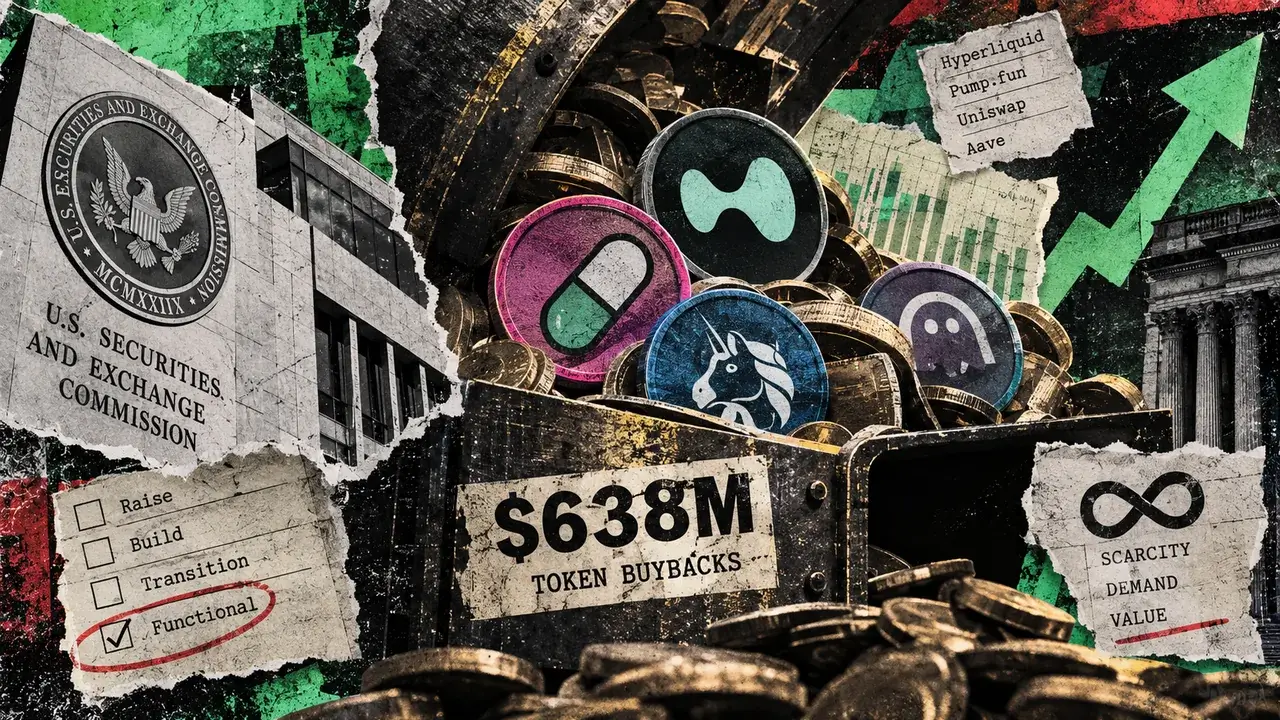
SEC clears regulatory hurdle as crypto token buybacks hit record $638 million
Crypto projects spent about $638 million with token buybacks through late August 2026, according to Allium Labs data. That is alre...

Solana Foundation Hires Former Binance CMO For Institutional Push
The Solana Foundation has appointed former Binance global CMO Rachel Conlan as chief strategy officer. Former Polygon Labs executi...

Arbitrum becomes first blockchain to reach 7,000 real-world assets
Arbitrum's milestone highlights blockchain's growing role in finance, yet regulatory clarity and liquidity challenges remain criti...