The Security Budget Flaw That Proof-Of-Stake Introduces
The proof-of-work mechanism in Bitcoin provides security which Ethereum has sacrificed for short-term narrative benefits.This is an opinion editorial by Mickey Koss, a West Point graduate with a degree in economics. He s...
Archive context
Older archive item. Useful for background and entity history, but not a fresh market-moving signal.

The proof-of-work mechanism in Bitcoin provides security which Ethereum has sacrificed for short-term narrative benefits.
This is an opinion editorial by Mickey Koss, a West Point graduate with a degree in economics. He spent four years in the infantry before transitioning to the Finance Corps.
Ethereum founder Vitalik Buterin recently voiced concerns about Bitcoins long term security citing relative security budgets based on network fee structures.
These concerns are unfounded and structured upon a false comparison between the two systems. Here’s why:
First, Ethereum’s proof-of-stake hardware and monetary requirements incentivize staking centralization into service providers like the big exchanges. Outsourcing poses a multitude of risks to include the co-opting of the network at the stroke of a pen by the jurisdictional government in which those entities exist.
Furthermore, in a world of limitless fiat currencies, central banks and governments could also quietly amass a trove of ethereum and slowly stake their way to complete and legitimate control of the network. Security budgets that consist of only monetary limitations do not matter in a world without physical scarcity.
Bitcoin is fundamentally different. Mining requires hardware and energy inputs, both inherently scarce to begin with. Co-opting a network of scarce technology and energy inputs makes the task infinitely more difficult to perform, especially in a covert manner.
In addition to this, proponents of this particular line of FUD completely ignore the positive externalities that energy demand on demand, or bitcoin mining, provide. I’ve already written about this extensively in previous articles such as “Who Says Bitcoin Mining Needs to be Profitable.” TLDR: Bitcoin mining does not need to be profitable in the traditional sense because of the incentives that different use cases produce; sometimes anything is better than nothing, especially if your energy was set to be wasted.
All in all, these concerns to me show a lack of creativity and foresight that are indicative of a status quo or fiat mindset. Proof-of-work is the innovation; Energy consumption is not only a feature, but an incentive, not a flaw in the system. Integration of proof-of-work technology and the energy industry is a natural fit and will only spur more adoption and more abundance for a better future for humanity.
The widely touted 99% reduction in energy consumption that ETH will experience I think will ultimately lead to its undoing. Proof-of-work maintains ties to the real world where incentives are stronger than coercion. Proof-of-stake chooses to cut those ties and incentivizes nothing but HODLing.
Energy innovation and integration will out-compete and out-incentivize counterparty risk free yield in the long run. The need for innovation in the energy sector becomes more and more obvious every day. Bitcoin and proof-of-work will inevitably shine in the coming years, helping to bring cheap and abundant energy to the masses. Gradually, then suddenly; a low time preference is all that is required.
This is a guest post by Mickey Koss. Opinions expressed are entirely their own and do not necessarily reflect those of BTC Inc. or Bitcoin Magazine.
Why this matters
This security story adds another data point to the current market tape and is useful when read alongside nearby source coverage.
Original source
Read on Bitcoin MagazineRelated market context
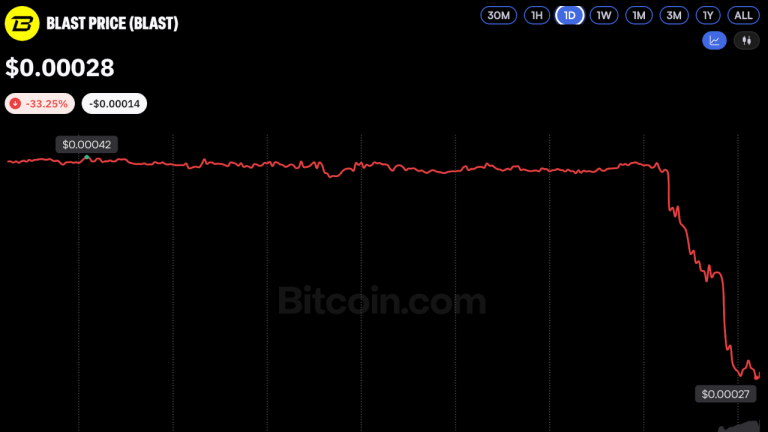
Ethereum Layer 2 Network Blast to Shut Down After Revenue Collapse
Blast, a once-buzzy Ethereum Layer 2 network, is set to shut down later this month after a dramatic decline in activity left the s...

Authors Withdraw Ethereum Staking Reward Burn Plan From Hegota Upgrade, Seek Separate Process
A proposal to burn a growing share of Ethereum staking rewards will not be part of the network’s Hegota upgrade. Ethereum France p...

Frank Holmes: They Will Print $100 Trillion – Why to Buy Bitcoin & Gold
Bitcoin Magazine Frank Holmes: They Will Print $100 Trillion – Why to Buy Bitcoin & Gold Bitcoin miners already have the power, th...

Ethereum Layer 2 Blast Is Shutting Down, Saying Costs Now Exceed What the Chain Earns
Blast, the Ethereum layer 2 network created by Blur founder Tieshun “Pacman” Roquerre, is shutting down, its team announced on X o...

Cardano’s DeFi has shrunk by more than half and RealFi is betting credit can revive it
Cardano’s “bank the unbanked” push went live with RealFi, putting real-world credit behind a new dollar-token system. On Oct. 1, R...

Ethereum Foundation Launches Privacy Tool That Cuts the Link Between AI Prompts and Payers
The Ethereum Foundation has launched zkAPI, a system for paying for AI models and other metered online services without that usage...