Trump-backed $4 billion USD1 stablecoin has wallet powers its own GitHub does not show
Justin Sun escalated his public fight with Donald Trump-backed World Liberty Financial on Friday, accusing its USD1 stablecoin of carrying administrative powers that allow privileged operators to move funds from frozen w...
Archive context
Older archive item. Useful for background and entity history, but not a fresh market-moving signal.
Justin Sun escalated his public fight with Donald Trump-backed World Liberty Financial on Friday, accusing its USD1 stablecoin of carrying administrative powers that allow privileged operators to move funds from frozen wallets without holder consent.
On Aug. 21, the Tron founder alleged that World Liberty’s published source code does not match the contract currently running on-chain, arguing that the discrepancy amounts to evidence of deceptive deployment and comparing it with techniques used in rug pulls.
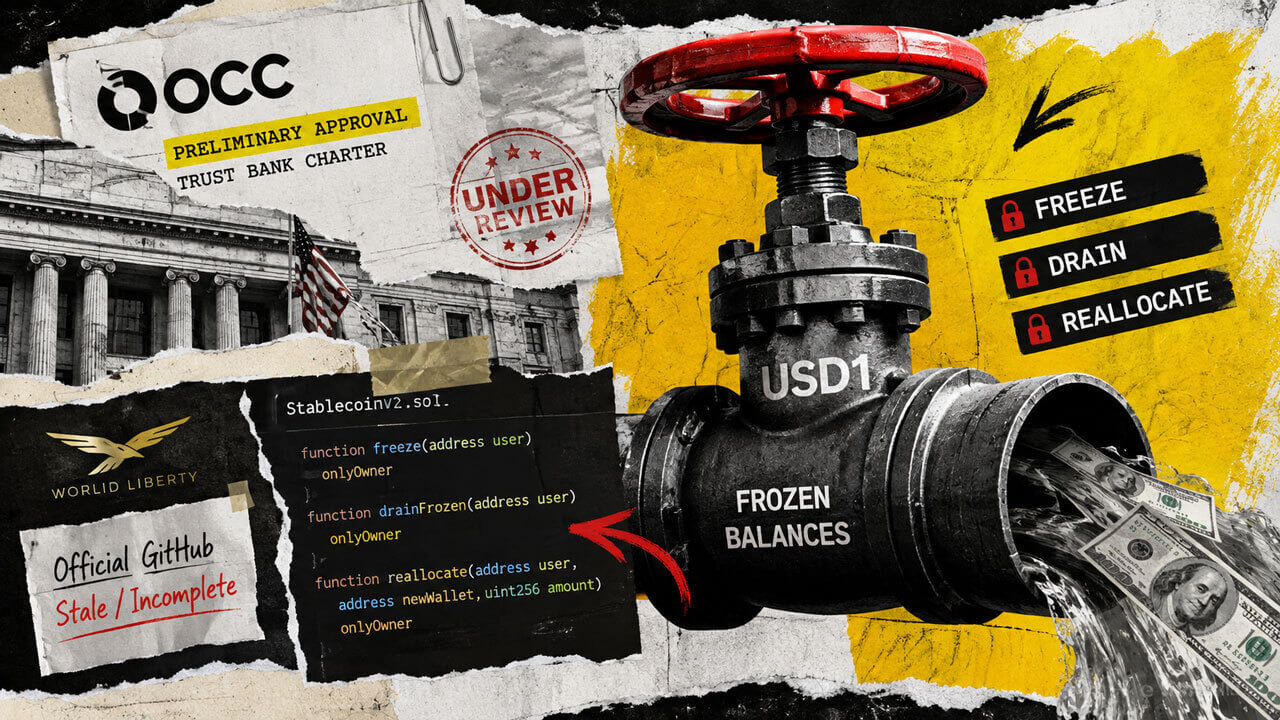
Sun said the live USD1 implementation can drain or reallocate balances after an address has been frozen, meaning cold storage or multisignature custody would not prevent intervention at the token-contract level. He also claimed similar privileged functions were added to the WLFI token after the fact.
According to him:
“USD1's highest-level permissions allow the issuer to move USD1 out of YOUR account into its own wallet — or anyone else's — without your consent. Cold wallet? Multisig? Doesn't matter. The authority operates at the token contract level. Nothing you do can stop it.”
What USD1’s live code actually allowsUSD1 operates through an upgradeable proxy that moved to its current StablecoinV2 implementation on April 5.
That version contains drain and reallocate functions that apply to frozen accounts. A technical review of the contract found that drain transfers a frozen address’s full balance to the contract owner, while reallocate can move a specified amount from a frozen address to another address.
Neither action requires approval from the affected holder.
That means Sun is correct that a user’s own custody setup cannot override contract-level controls once an address has been frozen.
The functions do not, however, give arbitrary users access to someone else’s USD1 or allow unrestricted transfers from any wallet at any time. They sit behind privileged permissions and operate on frozen balances.
The more difficult issue is the gap between the deployed contract and World Liberty’s own published repository.
The project’s GitHub code includes minting, burning, freezing, and pausing functions, but does not show the drain, reallocate or V2 initializer functions present in the live implementation. The deployed code itself is publicly visible through verified blockchain explorers, so the functions are not hidden from anyone inspecting the active contract directly.
Still, a developer or investor relying on World Liberty’s own repository would not see the full set of administrative powers governing USD1 today.
That distinction is significant because centralized stablecoins routinely retain intervention rights. USDT and USDC issuers can freeze or blacklist addresses, while BitGo, USD1’s current issuer and technical provider, says in its terms that it may freeze or upgrade USD1 and, in some legal or compliance circumstances, render assets permanently unusable.
Those disclosures make the existence of centralized controls less unusual. However, they do not explain why World Liberty’s public repository has not kept pace with its deployed contract.
Sun escalates attack as World Liberty awaits final bank approvalThe allegations deepen a dispute between Sun and World Liberty that has been building for months.
Sun was one of the project’s early investors, committing $45 million to WLFI. Their relationship later deteriorated after World Liberty restricted his access to the tokens, accused him of improperly moving assets and participating in activity intended to pressure WLFI’s price, and sued him for defamation. Sun denies the allegations.
The legal fight intensified again on Aug. 20, when Sun claimed he had won a procedural victory that would keep his personal claims against World Liberty in federal court.
A day later, he broadened the dispute to USD1, arguing that the mismatch between World Liberty’s published code and the live contract amounted to evidence of fraudulent deployment.
“Anyone in crypto knows exactly what that pattern is,” Sun said, comparing the discrepancy with techniques used in rug pulls and alleging that World Liberty had previously taken a similar approach with WLFI.
The available evidence does not establish that World Liberty deliberately kept its repository outdated to mislead users or auditors. Nor does the code discrepancy indicate a reserve shortfall, impaired backing, or unauthorized movement of USD1 from holder accounts.
The timing nevertheless raises the stakes for World Liberty.
Sun’s attack came seven days after the Office of the Comptroller of the Currency (OCC) granted preliminary conditional approval to World Liberty Trust Company, a proposed national trust bank that plans to assume USD1 issuance, redemption, and reserve management from BitGo.
The approval remains subject to pre-opening requirements and does not yet authorize the bank to begin operations.
USD1 is also approaching that transition with a smaller supply base. Circulating supply has fallen by more than $1.3 billion from a February peak above $5.3 billion to $4 billion, according to DeFiLlama data.
USD1 Stablecoin Supply (Source: DeFiLlama)The decline began before Sun’s latest allegations and does not show that holders are redeeming because of the contract dispute. It does, however, leave World Liberty pursuing final bank approval while its flagship stablecoin is below its recent peak.
World Liberty has also challenged Sun’s description of the court fight. Chief Executive Officer Zach Witkoff said Sun’s account of the recent arbitration hearing was “riddled with falsehoods,” arguing that the court had made no ruling and that some claims brought by Sun’s companies belong in arbitration. World Liberty is separately seeking dismissal of Sun’s personal claims.
Related Reading Why has Trump’s World Liberty Finance (WLFI) now filed a lawsuit against Tron's Justin Sun?The dispute therefore leaves a narrower technical issue than Sun’s rhetoric suggests. He has not established that USD1 is a rug pull or that it added its administrative controls for fraudulent purposes.
What remains harder to dismiss is the disclosure gap: USD1’s live contract contains powers that World Liberty’s own public repository does not fully reflect, just as the company seeks final approval for a regulated trust bank that would eventually oversee the stablecoin.
The post Trump-backed $4 billion USD1 stablecoin has wallet powers its own GitHub does not show appeared first on CryptoSlate.
Why this matters
TRON is showing up inside the Stablecoins theme, so this story is worth tracking for follow-through rather than treating it as a one-off headline.
Original source
Read on CryptoSlateRelated market context

Chainalysis: USDC-led stablecoins take 44% of Canadian dollar crypto volume
The rise in stablecoin use in Canada highlights a shift towards utility-driven crypto demand, potentially impacting domestic finan...
Mastercard unveils Stablecoin Security tool for fraud screening
Mastercard's tool could enhance trust in stablecoin transactions, potentially accelerating their adoption and integration into mai...

Mastercard Unveils Stablecoin Security to Police Digital Payments
Mastercard is extending its reach into stablecoin payments with a new security system designed to spot fraud, scams, and sanctions...
Mastercard expands crypto team as stablecoins, not Bitcoin, take center stage
Mastercard's focus on stablecoins over Bitcoin highlights a shift towards integrating blockchain with traditional finance, impacti...
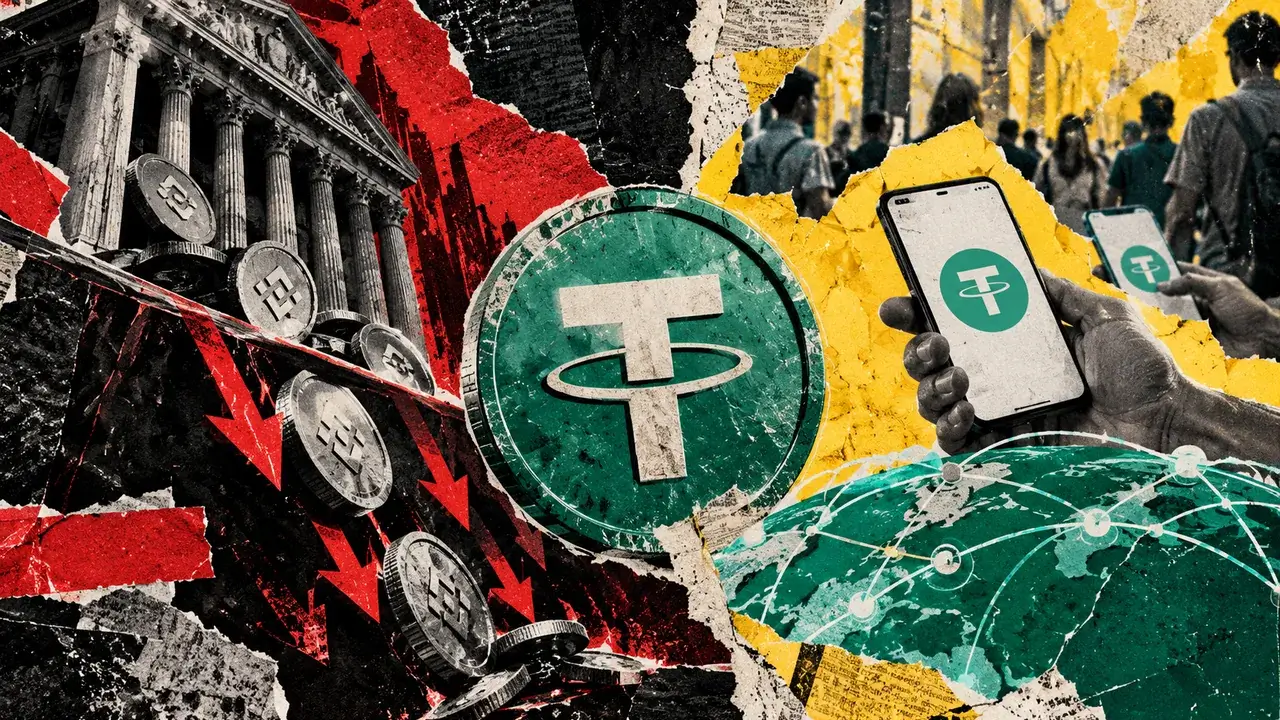
Tether loses nearly $5 billion across crypto exchanges as USDC and RLUSD rivals pay to win liquidity
Crystal’s selected cohort cut USDT balances in Q3, while Allium assigns it 84% of January–September 2026 classified payment value....

El Salvador’s National Bitcoin Office Hosts Five November Events Led by Herbert and Keiser
Bitcoin Magazine El Salvador’s National Bitcoin Office Hosts Five November Events Led by Herbert and Keiser El Salvador’s National...