Curious About What The CLARITY Act Says About XRP? Here Are The Parts To Focus ON
With the US Digital Asset CLARITY Act inching closer to becoming law, many investors and supporters are eager to know how it could shake things up for XRP. A crypto analyst has broken down the specific sections of the bi...
Archive context
Older archive item. Useful for background and entity history, but not a fresh market-moving signal.

With the US Digital Asset CLARITY Act inching closer to becoming law, many investors and supporters are eager to know how it could shake things up for XRP. A crypto analyst has broken down the specific sections of the bill that could directly impact XRP, Ripple, and its stablecoin RLUSD. These key parts touch on XRP’s status as a commodity, its role in banking infrastructure, and potential yield opportunities for investors.
What The CLARITY Act Means For XRPIn a recent X post, pseudonymous crypto analyst @Whiplash437 outlined the exact sections of the CLARITY Act that could have the biggest impact on XRP. He started with Section 105, which defines digital assets and supports classifying blockchain-based cryptocurrencies as commodities.
According to the analyst, this section matters because it could pull cryptocurrencies out from under the tight, strict grip of the Securities and Exchange Commission (SEC) and place them firmly under the jurisdiction of the Commodity Futures Trading Commission (CFTC). @Whiplash437 noted that Section 105 could build a legal shield around XRP by turning Judge Analisa Torres’ earlier ruling, that XRP’s secondary market sales are not securities, into permanent federal law.
He then moved on to Section 110, which requires digital commodity exchanges, dealers, and brokers to register for Anti-Money Laundering (AML) purposes and comply with the Bank Secrecy Act (BSA). The section also introduces the concept of “mature blockchains,” a classification that would fall under CFTC oversight.
@Whiplash437 described this part of the bill as a test, noting that the XRP Ledger (XRPL) has already passed the mature blockchain criteria. He touted the blockchain’s growth, noting that XRPL has had 13 years of zero downtime, executed over 90 million transitions, and boasts globally placed decentralized validators. The analyst also said that this section would officially qualify XRP as a digital commodity under the CFTC.
How The Bill Could Affect Ripple And RLUSDBeyond XRP, @Whiplash437 also highlighted sections of the CLARITY Act that could be a big win for Ripple and RLUSD once the bill is passed. He pointed to Section 401, which focuses on how financial institutions handle digital assets.
Under this section, the analyst said US banks, credit unions, and financial holding companies would be allowed to use digital assets for payments, custody, clearing, and settlement. He also noted that this part of the bill will effectively unlock the entire American banking sector to Ripple’s infrastructure and the XRP Ledger.
Finally, @Whiplash437 also flagged Section 404, which bans yield payments on just holding stablecoins. The analyst stated that despite the restriction, the bill still allows crypto users to earn activity-based rewards through staking, governance, and loyalty programs. He believes this policy will play a key role in shaping how RLUSD is offered across the US markets.
Why this matters
XRP is showing up inside the Stablecoins theme, so this story is worth tracking for follow-through rather than treating it as a one-off headline.
Original source
Read on NewsBTCRelated market context

Ripple’s RLUSD stablecoin hits record supply as XRP slips below $1
Ripple's RLUSD growth highlights the potential for stablecoins to thrive independently, raising questions about XRP's future utili...

China finalizes blockchain digital identity rules, effective March 1, 2027
China published final regulations on a national blockchain-based digital identity system on November 27, 2026, with the rules taki...

China Unveils Blockchain Identity Rules, Paving the Way for Digital Yuan Integration
Key Takeaways: China’s blockchain identity regulations will go into effect on 1st March 2027. The framework encourages integration...
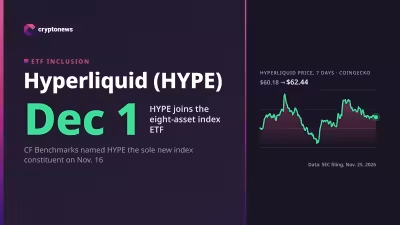
Franklin Templeton to add Hyperliquid’s HYPE to its crypto index ETF from Dec. 1
Franklin Templeton will add Hyperliquid’s HYPE token to its Franklin Crypto Index ETF (EZPZ) on or around December 1, a prospectus...

New York court orders NovaTech founders to pay $1.3 billion over crypto Ponzi scheme
A New York court ordered NovaTech founders Cynthia and Eddy Petion on November 24, 2026 to pay over $1.3 billion for a crypto Ponz...

Bank of Japan explores blockchain integration with stablecoins, tokenized finance
Japan's blockchain exploration may reshape its banking sector, aligning with global digital finance trends and influencing market...