Bitcoin breaks $66,000 but 4 key signals show this rally is far from normal
Bitcoin surged past $66,000 for the first time since early June, extending a recovery that is beginning to repair some of the losses left by the market’s recent downturn. The rebound comes from a much weaker starting poi...
Archive context
Older archive item. Useful for background and entity history, but not a fresh market-moving signal.

Bitcoin surged past $66,000 for the first time since early June, extending a recovery that is beginning to repair some of the losses left by the market’s recent downturn.
The rebound comes from a much weaker starting point than the price alone suggests.
VanEck data showed that investors who sold Bitcoin over the past month were realizing substantially more losses than gains, while unrealized losses across the network were equivalent to roughly 16% of Bitcoin’s market value.
Only 53% of Bitcoin’s circulating supply was sitting in profit, well below its four-year average of 76%.
The move above $66,000 is now testing whether rising prices can begin to reverse that damage.
However, spot-market activity remains unusually thin, and derivatives traders are still paying heavily for protection against another decline, even as long-term holders refuse to sell and demand from US exchange-traded funds begins to recover.
Related Reading As Bitcoin breaches $66K its latest bottom signal trapped buyers in a 20% loss Options skew at 11.4 points and positive funding show leverage rebuilding before Bitcoin confirms a durable bottom. Jul 22, 2026 · Gino Matos Buyers have yet to fully follow Bitcoin higherBitcoin’s breakout has so far arrived without the broad increase in spot trading that would give the recovery stronger support.
Average daily spot volume over the past 30 days stood near $5.1 billion, about 29% below the $7.2 billion average recorded since 2019, VanEck data showed.
At the same time, the trades that are taking place have also remained tilted toward sellers.
Market orders from sellers exceeded comparable buying by an average of about $70 million per day over the past month. That imbalance eased to $59 million over the latest week but remained well above the historical average of about $21 million.
Part of the slowdown may reflect the seasonal drop in trading activity that often accompanies the summer months. The continued seller-heavy flow, however, shows that Bitcoin began recovering before buyers decisively returned to the market.
That leaves the next stage of the rally dependent on whether the break above $66,000 can attract investors who had remained on the sidelines.
A sustained pickup in buying would give the move broader support. If trading remains thin, relatively modest changes in demand or selling pressure could continue to have an outsized effect on prices.
Traders are still paying to protect against another dropThe hesitation in the spot market is also showing up in derivatives, where traders remain willing to spend heavily to insure themselves against another decline.
Over the latest month, premiums paid for put options, which gain value when Bitcoin falls, were nearly 50% higher than those paid for calls, which benefit from rising prices.
That pushed the put-to-call premium ratio to 1.49, a level reached only about 10% of the time since 2021.
Bitcoin Options Premium (Source: VanEck)The cost of short-term downside protection has also remained unusually high relative to bets on further gains, another sign that traders have not fully embraced the recovery.
Futures positioning tells a similar story.
Average open interest in perpetual futures fell to about $29.4 billion from $35.7 billion two months earlier. Funding rates remained positive, meaning traders were still paying slightly more to maintain bullish positions, but those rates stayed below historical averages.
The cautious positioning cuts both ways. Traders have yet to aggressively chase Bitcoin higher, but lower leverage also leaves the market less exposed to the forced liquidations that can turn an ordinary pullback into a much sharper sell-off.
Long-term holders are keeping supply tightDespite the caution among active traders, most of Bitcoin’s older supply has stayed put as prices recover.
About 12.2 million BTC, or 60.8% of circulating supply, had not moved for more than a year. That share was 59.1% six months earlier.
Percentage of Unmoved Bitcoin Supply in The Past Year (Source: VanEck)Another 3.55 million BTC had remained untouched for between six and 12 months, meaning roughly 78.5% of Bitcoin’s supply had not moved for at least half a year.
That restraint limits how much older Bitcoin is returning to the market even as prices rise.
However, there are signs of some holders becoming more willing to sell. Exchange balances increased by 26,674 BTC over the latest month, making more coins readily available for trading, while some Bitcoin held for three to 10 years also began moving.
Those shifts have so far been too small to reverse the broader trend toward an aging supply.
Historically, periods when more than 60% of Bitcoin had remained untouched for at least a year while that share was still rising were followed by stronger-than-average returns, VanEck found.
While past performance offers no guarantee that the pattern will repeat, the continued reluctance of long-term holders to sell provides a counterweight to the weak spot activity and defensive positioning surrounding the latest rally.
ETF buyers are starting to returnThat limited supply is now meeting an early improvement in one of Bitcoin’s most important sources of demand.
US spot Bitcoin ETFs recently recorded six consecutive days of net inflows totaling more than $930 million, their longest positive streak since early May.
Related Reading Bitcoin ETF inflows return, but $2.3 billion stablecoin liquidity drain leaves $57,000 exposed The split between improving Wall Street demand and weakening trading liquidity leaves $57,000 in view if support fails. Jul 20, 2026 · Oluwapelumi AdejumoThe change follows a much weaker stretch where the US investment products shed about 40,010 BTC, worth roughly $2.4 billion, during the previous 30 days.
Bitcoin ETPs and Miners Flow (Source: VanEck)Other large buyers did little to offset those withdrawals. Corporate treasuries like Michael Saylor's Strategy added about 2,343 BTC over the same period, while miners retained another 1,204 BTC.
Still, the recent ETF inflows remain modest compared with the scale of the earlier withdrawals. However, their timing gives Bitcoin a fresh source of demand just as the amount of readily moving supply remains constrained.
That combination helps explain how Bitcoin has been able to push above $66,000 even though several parts of the market are still behaving cautiously.
Ultimately, the next market signal will come from whether ordinary spot buyers begin joining the move.
If that happens, a sustained increase in BTC trading and buying would give the breakout the participation it has so far lacked and could encourage derivatives traders to reduce some of their downside protection.
The post Bitcoin breaks $66,000 but 4 key signals show this rally is far from normal appeared first on CryptoSlate.
Why this matters
Bitcoin is showing up inside the Mining theme, so this story is worth tracking for follow-through rather than treating it as a one-off headline.
Original source
Read on CryptoSlateRelated market context

What Is Crypto Spot Trading?
For example, a token can be up 70% and still be a terrible trade if you have no idea when to take profits. Likewise, a 30% dip can...
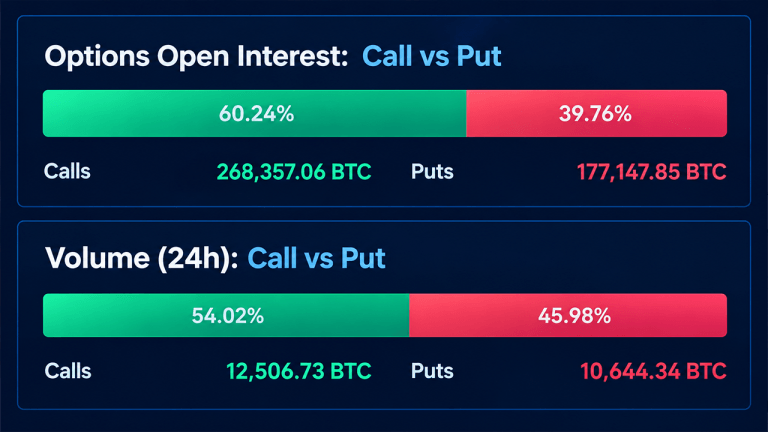
Bitcoin Traders Stack $4.5 Billion in Calls as $95K Bets Take Shape
Bitcoin’s options market is sending a curious message. With bitcoin trading above $82,000, calls account for 60.24% of outstanding...

Bitcoin’s $19 billion crash still shapes crypto risk a year later
The 10/10 crash highlighted crypto's vulnerability to external shocks, prompting calls for better risk management and transparency...

What happens when crypto trades stocks while Wall Street sleeps?
Wall Street closes at 4 p.m., but apparently that's becoming more of a suggestion than a rule. You can now spend the evening watch...

Luxor’s reported 6–13% annualized Bitcoin yield depends on mining delivery
Luxor, a Bitcoin mining derivatives provider, reported a 6–13% annualized Bitcoin financing spread in its September lookback, publ...

XRP Price Prediction: Elliott Wave Setup Points to $3 as XRP Nears a Potential $2 Breakout
XRP Price Prediction: Elliott Wave Setup Points to $3 as XRP Nears a Potential $2 Breakout XRP is approaching a critical technical...