Bitcoin drops below $76,000 as Senate rejects CLARITY Act motion
The US Senate failed on Sept. 15 to advance the Digital Asset Market Clarity Act, stalling efforts to create a federal framework for crypto markets as Bitcoin fell sharply below $76,000. The cloture vote on the motion to...
Watchlist
Archive context. The story has cross-source confirmation.
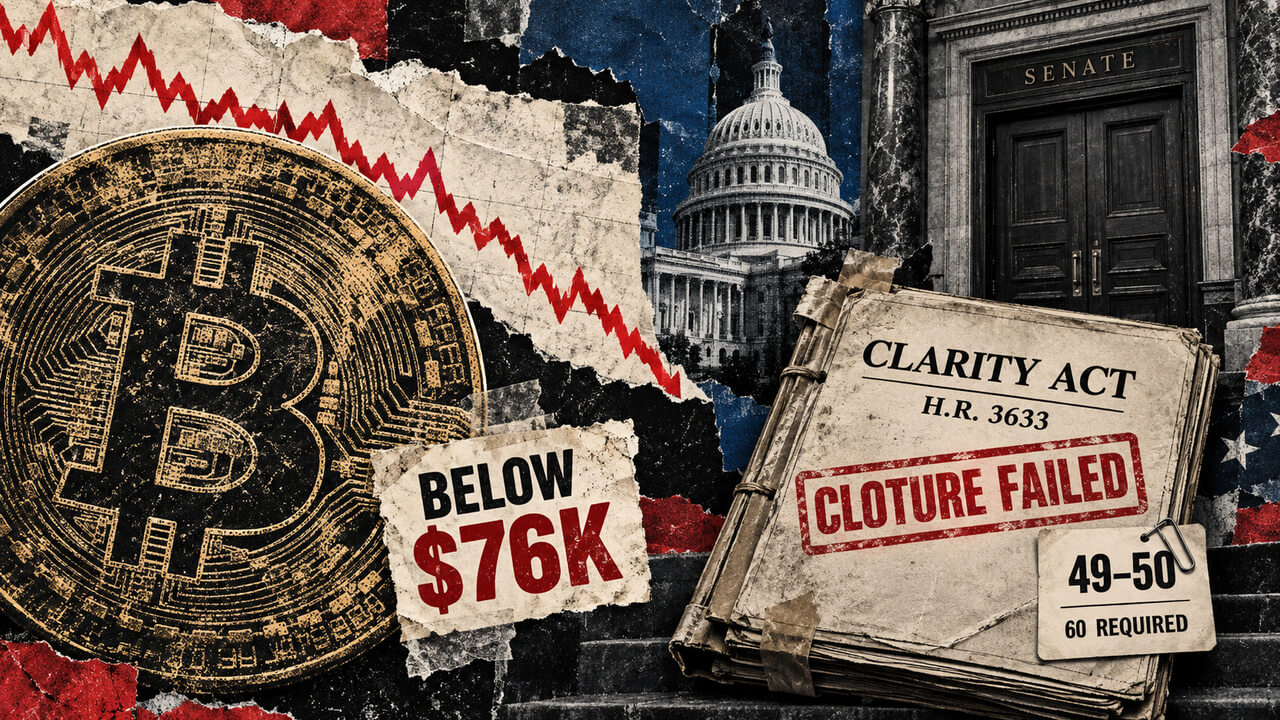
The US Senate failed on Sept. 15 to advance the Digital Asset Market Clarity Act, stalling efforts to create a federal framework for crypto markets as Bitcoin fell sharply below $76,000.
The cloture vote on the motion to proceed failed 49-50, and the measure needed 60 votes to move to debate, so the result was a procedural defeat.
The bill was designed to replace the industry’s fragmented regulatory environment with uniform federal rules for issuing, trading and selling digital assets. Its failure to advance leaves that wider market-structure push unresolved and denies supporters an immediate path to floor debate.
The Senate’s official schedule had set the vote for approximately 2:15 p.m. ET. The outcome fell well short of the required supermajority, turning a closely watched policy test into a new source of uncertainty for crypto businesses and investors.
Bitcoin’s decline started before the tallyBitcoin hit an intraday low of $74,967.97 on Sept. 15, after already falling below $76,000 before the vote. The altcoin market cap tumbled 3.6% in the same period, but managed to stay above $1.15 trillion.
Traders were also preparing for a Federal Reserve decision, adding another source of pressure across risk assets.
Related Reading Fed Chair Kevin Warsh triggers a $488 million crypto liquidation cascade as rate-hike expectations riseThe chronology shows that political disappointment arrived in a market already moving lower. It supports describing the vote as one factor in the afternoon weakness, but not as the origin of the full-day decline.
Infographic traces crypto liquidations and Bitcoin declines before and after the Senate’s failed Sept. 15 CLARITY Act cloture vote.Leverage was also being unwound before senators voted. CoinGlass registered over $300 million in liquidations 20 minutes after the vote, with the 24-hour reading surpassing $665 million at the same mark.
For the crypto industry, the immediate consequence is legislative delay: the CLARITY Act did not secure the votes needed to begin debate. For Bitcoin, the next signal is whether selling steadies once traders absorb both the policy setback and the separate monetary-policy risk already weighing on the market.
The post Bitcoin drops below $76,000 as Senate rejects CLARITY Act motion appeared first on CryptoSlate.
Why this matters
Bitcoin is showing up inside the Regulation theme, so this story is worth tracking for follow-through rather than treating it as a one-off headline.
Original source
Read on CryptoSlateRelated market context

Texas Voted to Pause New Data Centers. Which Bitcoin Miners Are Already Past the Freeze?
Bitcoin miners that turned into AI landlords have been valued on how many megawatts of power they control and how much of it sits...

Exchanges Rush to Prove Cold-Storage Reserves as Binance Hack Fallout Deepens and Bitcoin Slides Below $76,000
Exchanges publish cold-storage proof after Binance's $6.36bn hack, Bitcoin falls below $76,000 with $850m liquidated, and France r...

Bitcoin Faces CPI Test After AI Stock Sell-Off
Bitcoin faces a fresh inflation test on November 10 after an AI-led sell-off exposed how quickly pressure in technology stocks can...
US Adds 165,000 Jobs in October: Why Bitcoin Traders Are Watching the Fed
TL;DR: The US economy added 165,000 payroll jobs in October while unemployment stood at 4.1%, according to the Bureau of Labor Sta...

TeraWulf Says AI Leasing Now Generates 83% of Revenue as Bitcoin Mining Recedes
TL;DR: TeraWulf’s November 6 earnings release shows $63 million in third-quarter high-performance-computing lease revenue, around...

Bitcoin vs. Gold: Peter Schiff Highlights Strategy’s $75.5K Cost Basis and Missed 30% Return Target
The gold advocate used the development to question Michael Saylor’s six-year Bitcoin investment strategy, arguing that gold delive...