Bitcoin ETF Options Set To Supercharge Price Volatility, Expert Warns
The Bitcoin price volatility is likely to surge in both directions following the recent approval of options for spot Bitcoin ETFs, according to Jeff Park, head of Alpha Strategies at Bitwise Investments. In an interview...
Archive context
Older archive item. Useful for background and entity history, but not a fresh market-moving signal.

The Bitcoin price volatility is likely to surge in both directions following the recent approval of options for spot Bitcoin ETFs, according to Jeff Park, head of Alpha Strategies at Bitwise Investments. In an interview with Anthony Pompliano, Park explained how these newly available options differ from existing crypto derivatives and why they could significantly impact the Bitcoin market dynamics.
Why Bitcoin ETF Options Are A Game ChangerPark outlined a comprehensive thesis in the interview, noting, “Volatility is not just a static measure of past performance; it reflects the distribution of potential outcomes and the severity of those outcomes.” He emphasized that the introduction of Bitcoin ETF options will bring new dimensions to how traders interact with Bitcoin, potentially amplifying both price rises and falls. This volatility, he argued, stems from the unique characteristics of options as financial instruments.
While Bitcoin options are not entirely new—offshore platforms like Deribit and LedgerX already offer similar instruments—ETF options introduce a regulated market overseen by US authorities like the CFTC and SEC. This makes a profound difference, according to Park, because “removal of counterparty risk is something that crypto has not fully solved offshore.” He noted that the clearing mechanisms provided by the Options Clearing Corporation (OCC) bring added security to these trades, which institutional investors have long demanded.
More importantly, Park highlighted the advantage of cross-collateralization, which is not available on existing platforms that cater exclusively to crypto. “Cross-collateralization allows traders to use non-correlated assets, such as gold ETFs, as collateral in Bitcoin trades,” he explained. This flexibility increases liquidity and efficiency in the market. “You can’t do this on Deribit or any purely crypto-focused platform,” Park emphasized, calling it a “huge unlock” for the Bitcoin derivatives market.
Park anticipates that the introduction of these options will magnify Bitcoin’s price swings. “For any well-functioning and liquid market, you need organic buyers and sellers to create natural demand and supply,” he explained. However, the real impact comes from how dealers hedge their positions, especially when they are “short gamma,” a condition where their hedging activities can intensify price movements.
In practical terms, Park said, “Dealers who are short gamma must buy more Bitcoin as prices rise and sell more as prices fall, thereby adding to the volatility.” This dynamic is crucial to understanding how ETF options could push Bitcoin’s price to extremes in both directions. He also pointed out that, historically, most Bitcoin options activity has been driven by speculation, rather than risk management strategies like covered calls, which tend to reduce volatility.
One of Park’s key points was the dramatic growth potential for Bitcoin’s derivatives market. In traditional markets like equities, the derivatives market is often 10 times larger than the underlying spot market. In contrast, Bitcoin’s open interest in derivatives currently represents just 3% of its spot market value, according to Park’s figures. “The introduction of ETF options could lead to a 300x increase in Bitcoin’s derivatives market size,” Park predicted.
This growth would bring substantial new liquidity but would likely also drive volatility higher, due to the larger volume of speculative trades and the structural leverage introduced by options. “That’s an astronomical number for which there’s going to be new flows and liquidity coming into this market which will likely therefore add volatility,” Park stated.
“In the global economy, derivatives markets are far larger than the spot markets,” he added, pointing to the fact that in traditional asset classes like equities and commodities, derivatives play a critical role in risk management and speculation. “Bitcoin is moving toward a similar structure, and that’s where we’ll see the most significant price movements and liquidity,” Park concluded.
At press time, BTC traded at $62,334.
Why this matters
This bitcoin story adds another data point to the current market tape and is useful when read alongside nearby source coverage.
Original source
Read on NewsBTCRelated market context

Bitcoin survived 5% yields but crypto’s cheap-money era did not
The US 10-year Treasury yield touched 5.34% on Oct. 1, its highest since 2002, capping a third quarter in which it climbed almost...
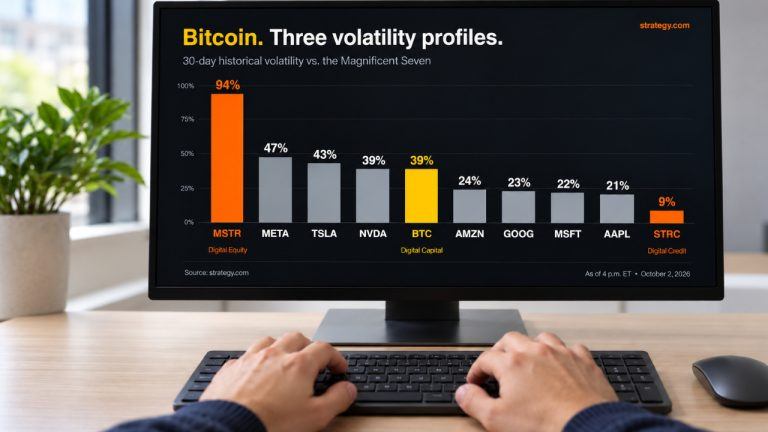
Saylor Maps Three Bitcoin Paths With 94%, 39%, and 9% Volatility
Bitcoin can serve investors who want direct ownership, amplified market exposure, or dollar income, according to Michael Saylor. H...

Ether's bitcoin-beating Q3 rally came with a catch. Liquidity thinned.
Ether beat bitcoin in the third quarter, but its market liquidity got thinner, according to Coingecko.

Ethereum liquidity drops below 50% of Bitcoin’s level
Ethereum's reduced liquidity compared to Bitcoin may lead to increased trading costs and volatility, impacting institutional tradi...

XRP Price Prediction: Ripple Range-Bound at $1.50, Breakout Soon?
XRP price prediction shows Ripple entering October still trading within a broad range. XRP is currently around $1.50, with key res...

XRP Price Prediction: Ripple’s $700M Escrow Return Puts $1.59 Resistance in the Spotlight
The setup comes shortly after Ripple returned 700 million XRP, worth more than $1 billion, to escrow following its scheduled Octob...