Can Strategy Survive A 90% Bitcoin Crash? Saylor Says Yes
Michael Saylor is explicitly telling markets that Strategy (MSTR) has been built to withstand a Bitcoin crash that would wipe out almost every other leveraged player in the ecosystem. In an interview with Grant Cardone s...
Archive context
Older archive item. Useful for background and entity history, but not a fresh market-moving signal.

Michael Saylor is explicitly telling markets that Strategy (MSTR) has been built to withstand a Bitcoin crash that would wipe out almost every other leveraged player in the ecosystem.
In an interview with Grant Cardone streamed live on November 14 , the Strategy executive chairman drew a clear theoretical stress line for the company’s balance sheet and stated that even a catastrophic move lower in BTC would not force him to liquidate the core position.
Strategy Can Eat A 90% Bitcoin CollapseAsked how far Bitcoin would have to fall before MicroStrategy faces real danger, Saylor answered with balance-sheet math rather than rhetoric. He pointed to roughly eight billion dollars of debt and tens of billions in equity value tied to Bitcoin, and then set the threshold: Bitcoin, he said, “would have to fall 90% from here for us to be sort of collateralized, to be one-on-one.”
Even at that point, his first response would not be to sell BTC into a collapsing market. Instead, he described equity holders as the primary buffer. “We probably would dilute the equity, and so it would be bad for the equity,” he told Cardone, before stating the hierarchy even more bluntly: “The equity is going to be a loser.”
By contrast, he framed liquidation as essentially off the table in any realistic bear market scenario. When Cardone pressed him on whether Strategy could be forced to unwind its Bitcoin position, Saylor answered flatly: “We’re not going to liquidate.”
The bond side only enters the conversation in an almost total-loss scenario. “If Bitcoin fell to zero tomorrow forever, then the bonds would default,” Saylor said. He then compressed the entire risk profile into a single line: “If you think Bitcoin is going to go to $10,000, I think we’re good. If you think Bitcoin’s going to a dollar tomorrow forever, then yeah, the bonds would default.”
That framing makes the structure very clear. Equity is a highly levered, high-beta claim on Bitcoin that can be diluted if necessary. Bondholders and holders of MicroStrategy’s various credit-like instruments only face real danger if Bitcoin essentially dies as an asset class.
The 4-Year Cycle Is DeadSaylor also used the interview to distance himself from one of the core narratives many Bitcoin traders still live by: the four-year halving cycle. His view is that the mechanical supply cut may have helped shape earlier phases of Bitcoin’s monetization, but it is no longer the dominant driver of price in a market now intertwined with global macro and institutional flows.
“I don’t believe in four-year cycles anyway,” Saylor said. “I never believed in the— I think that they might have had some credence in the first 12 years.” He then shifted straight to scale and order of magnitude. After [the last] halving, the reduction in new supply is on the order of a couple hundred BTC a day. In his translation, “225 Bitcoin a day get taken out of the supply after the next halving, that’s twenty million dollars or twenty-two million dollars of buying.”
Against a spot and derivatives complex that can see tens or even hundreds of billions of dollars in notional volume in a single session, that number, he argued, is marginal. “Trust me, twenty million dollars of buying… is not even a third-order issue at this point,” he said.
What matters now? “The dynamics in the market are much more that Jerome Powell thinks he wants to hold interest rates higher for longer. It’s macroeconomics. It’s political. It’s structural. When IBIT’s derivatives market went from $10 billion to $50 billion, it did that in four weeks. […] It’s the actions of the mega finance actors that are determining the future of Bitcoin right now, Saylor said.
At press time, Bitcoin traded at $95,624.
Why this matters
This bitcoin story adds another data point to the current market tape and is useful when read alongside nearby source coverage.
Original source
Read on NewsBTCRelated market context

NY Seeks $1.37 Billion Judgment Against Operators of NovaTech Crypto Ponzi Scheme
Bitcoin Magazine NY Seeks $1.37 Billion Judgment Against Operators of NovaTech Crypto Ponzi Scheme New York Attorney General Letit...

CME Posts Record Q3 Revenue As Crypto Derivatives Push Continues
TL;DR: CME reported record third-quarter revenue of about $1.74 billion on October 21. The results provide a fresh look at a major...
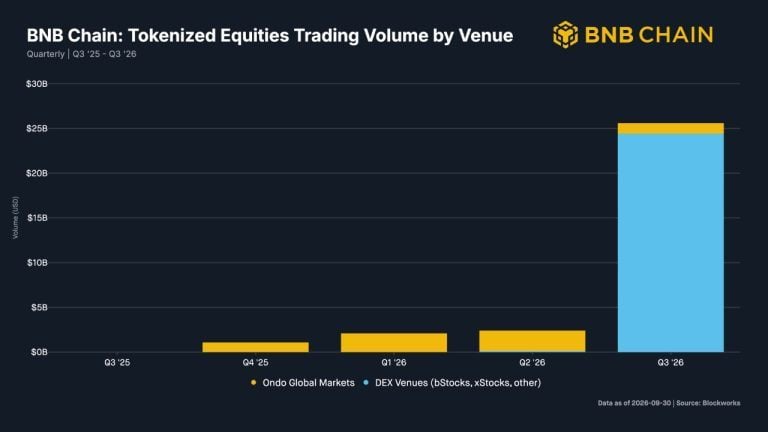
BNB Chain Tops Solana, Robinhood as Equity Volume Jumps 11x to $25.6B
BNB Chain emerged as the leading blockchain for tokenized equities in the third quarter, with trading volume surging to about $25....

Grayscale Tracks 580% Crypto Winner Targeting AI Computing Revenue
Grayscale is highlighting three crypto projects addressing artificial intelligence (AI) training data, hardware financing, and com...

Pump.fun surpasses Hyperliquid in daily revenue with $2M in 24 hours
Pump.fun's revenue surge underscores memecoin sector's growing influence, potentially reshaping decentralized finance dynamics and...
New York Seeks $1.3 Billion From NovaTech Founders In Crypto Fraud Case
TL;DR: New York’s attorney general is seeking $1.3 billion in monetary relief in the NovaTech case and has announced nearly $6 mil...