Following The Decade-Long IMF Playbook
Alarmingly, G7 governments appear to be following a playbook designed to cap interest rates and let inflation run hot.The below is from a recent edition of the Deep Dive, Bitcoin Magazine's premium markets newsletter. To...
Archive context
Older archive item. Useful for background and entity history, but not a fresh market-moving signal.
Alarmingly, G7 governments appear to be following a playbook designed to cap interest rates and let inflation run hot.
The below is from a recent edition of the Deep Dive, Bitcoin Magazine's premium markets newsletter. To be among the first to receive these insights and other on-chain bitcoin market analysis straight to your inbox, subscribe now.
The subject of today's Daily Dive will be the playbook that is seemingly being followed by G7 governments and global central banks. While some may be skeptical that there is a coordinated campaign or playbook, the following paper released by the International Monetary Fund (IMF) in March 2011 may persuade you otherwise.
The paper, “The Liquidation of Government Debt,” outlined how governments and central banks could go about reducing public and private debts. Below is the abstract of the paper.
Abstract“Historically, periods of high indebtedness have been associated with a rising incidence of default or restructuring of public and private debts. A subtle type of debt restructuring takes the form of “financial repression.” Financial repression includes directed lending to government by captive domestic audiences (such as pension funds), explicit or implicit caps on interest rates, regulation of cross-border capital movements, and (generally) a tighter connection between government and banks. In the heavily regulated financial markets of the Bretton Woods system, several restrictions facilitated a sharp and rapid reduction in public debt/GDP ratios from the late 1940s to the 1970s. Low nominal interest rates help reduce debt servicing costs while a high incidence of negative real interest rates liquidates or erodes the real value of government debt. Thus, financial repression is most successful in liquidating debts when accompanied by a steady dose of inflation. Inflation need not take market participants entirely by surprise and, in effect, it need not be very high (by historic standards). For the advanced economies in our sample, real interest rates were negative roughly ½ of the time during 1945-1980. For the United States and the United Kingdom our estimates of the annual liquidation of debt via negative real interest rates amounted on average from 3 to 4 percent of GDP a year. For Australia and Italy, which recorded higher inflation rates, the liquidation effect was larger (around 5 percent per annum). We describe some of the regulatory measures and policy actions that characterized the heyday of the financial repression era.”
The most alarming aspect of the paper is the fact that the playbook laid out a decade ago seems to be being followed to a tee. Most specifically, financial repression by capping interest rates while letting inflation run hot.
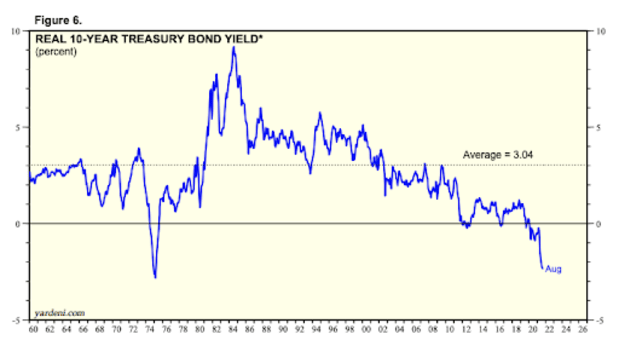
With the consumer price index (CPI) continuing to run far above the Federal Reserve funds rate, real yields are negative across the treasury yield curve. In other words, bond holders are getting their interest payments while their principal decays in value (refer to abstract: “financial repression includes directed lending to government by captive domestic audiences [such as pension funds]”).
Source: YardeniWhy this matters
This bitcoin story adds another data point to the current market tape and is useful when read alongside nearby source coverage.
Original source
Read on Bitcoin MagazineRelated market context

Bitcoin ETFs Lose Over $635M In One Day Following Oil Price Spike
Bitcoin Magazine Bitcoin ETFs Lose Over $635M In One Day Following Oil Price Spike U.S. investors quickly reversed course on Thurs...
Dune Adds Real-Time Spot And Perpetual Trade Feeds Across On-Chain Markets
TL;DR: Dune has launched normalized real-time feeds for spot and perpetual DEX trades, designed to help institutional desks compar...

Calle launches BitNotes, a multi-mint Cashu wallet that prints ecash on paper
BitNotes could revolutionize financial access in underbanked regions, but trust in mints and security audits remain critical for w...

XRP Wallets Hit Record 8.24 Million as Network Growth Accelerates
XRP Ledger’s wallet count has reached 8.24 million, extending its climb through months of price volatility. Santiment paired the m...

OpenAI faces financial scrutiny amid reduced valuation and discounting strategy
OpenAI's financial strategies and valuation adjustments may signal deeper liquidity issues, raising concerns about its long-term v...
Grayscale Warns Crypto Token Inflation Can Wipe Out Holder Rewards
Crypto applications can generate earnings, yet growing token supplies can reduce the benefits reaching holders. Grayscale’s new an...