Grayscale Confidentially Files for Potential IPO as Bitcoin Hits Record Highs
The largest crypto asset manager in the United States, Grayscale Investments, has confidentially filed a draft registration statement with the Securities and Exchange Commission on July 14, 2025, signaling its intent to...
Archive context
Older archive item. Useful for background and entity history, but not a fresh market-moving signal.

The largest crypto asset manager in the United States, Grayscale Investments, has confidentially filed a draft registration statement with the Securities and Exchange Commission on July 14, 2025, signaling its intent to become a publicly traded company.
The timing couldn’t be better for crypto companies looking to go public. Circle’s spectacular IPO debut in June saw its stock surge over 500% since its NYSE listing, proving there’s major investor appetite for crypto-related public companies. Apparently, Grayscale wants to follow that success story.
What This IPO Filing MeansGrayscale’s confidential filing allows the company to work with SEC regulators privately before making any public announcements. This strategy helps keep competitive details under wraps while getting regulatory feedback. The company hasn’t revealed how many shares it plans to offer or what price range it’s considering.
Founded in 2013, Grayscale currently manages over $33 billion in crypto assets across more than 30 different investment products. The company launched the first publicly traded Bitcoin fund in the U.S. and was a major player in getting Bitcoin ETFs approved. Its flagship Grayscale Bitcoin Trust (GBTC) remains one of the largest Bitcoin ETFs, though it faces tough competition from lower-fee alternatives like BlackRock’s iShares Bitcoin Trust (IBIT).
The IPO would transform Grayscale from a trust-based business model to a traditional public corporation. This change could help the company raise more capital, attract new investors, and expand beyond its current crypto-focused products.
Perfect Market TimingThe crypto market is on fire right now. Bitcoin broke through $120,000 for the first time on Monday, marking a 28% gain for the year. The surge comes as institutions pour money into Bitcoin ETFs, withThursday the 10th seeing the biggest single-day inflow of 2025 at $1.18 billion.
Corporate America is also embracing Bitcoin. Companies are adding Bitcoin to their balance sheets as a treasury asset, treating it like digital gold during uncertain economic times. This institutional adoption provides a solid foundation for crypto companies going public.
Circle’s Success Paves the WayCircle’s IPO success story shows what’s possible for crypto companies in today’s market. The stablecoin issuer priced its shares at $31 and watched them soar to over $100 within days. Circle now has a market cap of around $42 billion, proving investors are willing to pay premium prices for quality crypto businesses.
Circle’s success wasn’t just lucky timing. The company has strong fundamentals – it’s profitable, has clear revenue streams, and provides essential infrastructure for the crypto economy. Grayscale shares some of these advantages with its established brand, regulatory track record, and diversified product lineup.
Congressional Support BuildingThe filing comes during “Crypto Week” in Congress, where lawmakers are debating three major bills that could reshape crypto regulation. The House is considering the CLARITY Act, GENIUS Act, and Anti-CBDC Surveillance State Act – legislation that could provide the regulatory clarity the industry has been seeking for years.
These bills aim to establish clear rules for which agencies oversee different types of crypto assets, legalize stablecoins under federal frameworks, and prevent the Federal Reserve from creating a digital dollar. If passed, this legislation could remove major regulatory uncertainties that have held back institutional adoption.
President Trump has positioned himself as the “crypto president” and expressed strong support for making America the global leader in digital assets. This political backing creates a favorable environment for crypto companies looking to go public.
Competitive Challenges AheadDespite the positive market conditions, Grayscale faces real competitive pressures. Its Bitcoin ETF charges a 1.5% annual fee while competitors like BlackRock charge just 0.25%. BlackRock’s Bitcoin ETF has already surpassed Grayscale in total assets, showing how fee competition can quickly shift market share.
Going public could help Grayscale address these challenges by providing capital to develop new products, improve technology, and potentially lower fees. Public company status also brings greater transparency and credibility, which could help attract institutional investors who prefer working with publicly traded firms.
However, being public also means quarterly earnings pressure and heightened scrutiny from regulators and investors. Grayscale will need to prove it can grow market share while maintaining profitability in an increasingly competitive landscape.
Why this matters
This bitcoin story adds another data point to the current market tape and is useful when read alongside nearby source coverage.
Original source
Read on Brave New CoinRelated market context

Grayscale’s Zcash ETF surpasses $915M in assets as ZEC price nearly doubles since launch
Grayscale's Zcash ETF growth highlights increasing investor interest in privacy coins, potentially influencing future crypto inves...

CFTC Staff Let Futures Brokers Invest Customer Funds in Tokenized Assets, Keep Records Onchain
Futures brokers and clearinghouses regulated by the Commodity Futures Trading Commission can invest customer money in tokenized ve...
Circle Takes FX Onchain With 24/7 Stablecoin Settlement On Arc
TL;DR Circle has launched StableFX on Arc, giving approved institutions 24/7 access to stablecoin-based foreign exchange settlemen...

NYSE is assembling the pipes for a $5.5 trillion tokenized asset market
NYSE is adding Blockchain.com as a prospective gateway to its planned round-the-clock market for tokenized US stocks. Blockchain.c...
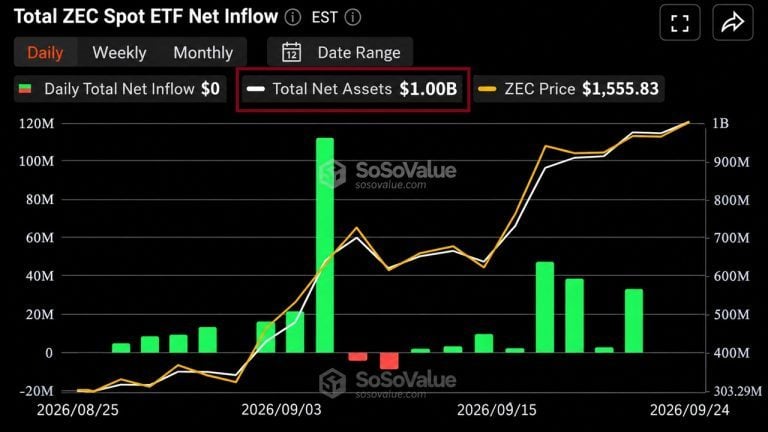
Grayscale’s Zcash ETF Hits $1 Billion but Most of It Isn’t New Money
Grayscale says its Zcash exchange-traded fund (ETF) has passed $1 billion in assets one month after listing, but its flow data sho...

Institutions Held Their Bitcoin Through Crash — and Some Bought More: Report
Bitcoin Magazine Institutions Held Their Bitcoin Through Crash — and Some Bought More: Report When crypto prices were cut in half...