Mississippi, Missouri Lawmakers Introduce Bills To Protect The Rights To Mine Bitcoin And Run A Node
Committees from both states will soon vote on bills that would provide a variety of protections for Bitcoin mining operations and node runners.Lawmakers from the U.S. states of Mississippi and Missouri have introduced bi...
Archive context
Older archive item. Useful for background and entity history, but not a fresh market-moving signal.
Committees from both states will soon vote on bills that would provide a variety of protections for Bitcoin mining operations and node runners.
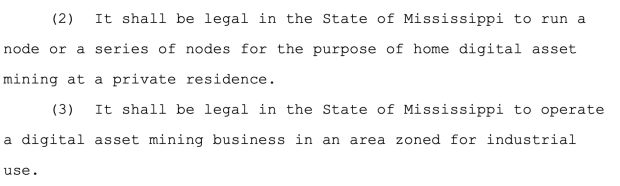
Lawmakers from the U.S. states of Mississippi and Missouri have introduced bills that seek to legally protect their citizens’ rights to run a Bitcoin node and to mine BTC.
Excerpt of Mississippi’s billExcerpt of Missouri’s Bill
Bills have been submitted to both the Houses and Senates of the respective states, with Senator Josh Harkins (R) and Representative Jody Steverson (R) leading the movement within Mississippi. Representative Phil Christofanelli (R) of Missouri submitted its respective bill to the House. Both states’ bills utilize language from the Satoshi Action Fund. Amongst the explicit rights for nodes and mining, the bills also have language prohibiting:
- Political subdivisions of the state creating requirements which are not in line with other data center requirements, and changing the zoning of bitcoin miners without proper notice.
- Outlawing of discriminatory energy rates directed at bitcoin miners.
- Sound ordinances directed at mining facilities that are not in-line with other sound ordinances within the community.
- Operating nodes or miners being considered the act of money transmitting.
Just yesterday, a New Hampshire commission recommended that the state Department of Energy investigate how bitcoin mining could be integrated into energy grids statewide. In addition to this recommendation, a report released in November 2022 directed at members of the Texas legislature recommended making bitcoin an authorized investment for the state, while giving tax incentives to local BTC miners.
“I see an opportunity for states that were left out of the tech boom to have a real shot at taking part in the Bitcoin boom,” Dennis Porter, CEO and founder of the Satoshi Action Fund commented. “Mining facilities often get built in rural parts of America. We hope that Missouri and Mississippi see this potential and begin opening up their states to Bitcoin mining businesses.”
The reports all signify growing interest from states across America on how they can benefit from adopting bitcoin and utilizing bitcoin mining within their energy networks. Continued political action from the likes of Bitcoin Policy Institute and Satoshi Action Fund greatly contribute to the education of lawmakers.
“Now that these bills have been drafted and introduced, we must continue the education process for the elected leaders of the state of Mississippi,” Porter stated.
In regards to concerns voiced by Bitcoiners about the consolidation of hash rate in North American jurisdictions, Porter said that, “Consolidation of mining is a concern, but it is much less of a concern than consolidation of nodes. The nodes and the users of the Bitcoin network are the ones in control, the Blocksize Wars proved this. However, extreme consolidation of mining could become a risk. We at Satoshi Action strongly support the growth of hash rate outside the USA and North America.”
Eric Peterson, director of policy at the Satoshi Act Fund has also been working to advise Mississippi. He explains how “Because of its unique characteristics, Bitcoin miners are looking to expand their footprint in the state. Legislators can see the opportunities these miners bring, especially in terms of creating jobs in rural areas.”
If the bills are enacted, they could contribute to mounting interest from state governments, something that Peterson is seemingly leaning in on. “The most important concept for legislators to understand is that Bitcoin is not going away anytime soon,” he said. “Even if states don't get behind the industry they need to have a working regulatory structure for it and ensure that businesses who operate in this state can do so long term in their state.”
Why this matters
This bitcoin story adds another data point to the current market tape and is useful when read alongside nearby source coverage.
Original source
Read on Bitcoin MagazineRelated market context

Bitcoin Is Busier Than Ever, but Bitcoin Mining Isn’t Getting Paid More
Bitcoin is processing more transactions than ever before on an annual basis, but the growing activity is doing little to improve o...
SEC Examiners Set Sights on Tokenization at Clearing Agencies for Fiscal 2027
The SEC’s Division of Examinations has named tokenization among the “high-risk areas” its staff will focus on when examining clear...
CMCC Global Plans Tokenized Bitcoin Funds With Tether And Bitfinex Securities
TL;DR: CMCC Global is bringing two existing fund strategies into tokenized securities issued through Tether’s Hadron infrastructur...
JPMorgan Expands Tokenized Money Market Funds To Solana
TL;DR: J.P. Morgan Asset Management says qualified U.S. investors can now access MONY and JLTXX tokenized money market funds on So...
Irish Central Bank Fines Coinbase Unit €3.25 Million Over Customer Fund Safeguards
TL;DR: Ireland’s central bank imposed a €3.25 million penalty on Coinbase Ireland over electronic-money safeguarding and outsourci...
How Far Should Crypto Firms Trace a Transaction? FCA Says Risk Should Decide
Brokers and trading platforms handling cryptoassets should be able to explain why their monitoring systems flag a transaction and...