The Lightning Network Privacy Big Picture: Don't Forget the NSA
One of the secondary benefits of how the Lightning Network works as a scaling solution is privacy. It’s by no means perfect or undefeatable privacy, but it is a better than naive use of the base layer blockchain itself....
Archive context
Older archive item. Useful for background and entity history, but not a fresh market-moving signal.

One of the secondary benefits of how the Lightning Network works as a scaling solution is privacy. It’s by no means perfect or undefeatable privacy, but it is a better than naive use of the base layer blockchain itself. It’s also not perfectly balanced. The sender learns a good many details about the receiver, but the receiver learns nothing about the sender.
For casual payments it is a big improvement for consumers over on-chain payments. It does have one big problem though, something not unique to Lightning, but a problem for all onion routed systems.
Global Passive Adversaries. That means an actor who is able to passively monitor all the internet connections between everyone involved in a network like Lightning, or Tor. When a message crosses the network, the adversary can see a message move from one node to a second node, and also see that a message went from the second node to a third right after it received one from the first.
If a global adversary exists, then while they cannot see the specific details of a message across the network, they can see where it originated from and where it arrived. That is plenty enough information to deanonymize a payment system like Lightning, where the chief matter of importance is after all who is paying who.
This is the true fundamental shortcoming, Lightning can be very private for senders from their merchants, and soon with coming improvements for receivers from the person paying them, but it is very weak against a truly powerful global adversary.
This can be mitigated however. Payments stand out to a global adversary because that is the majority of traffic nodes will send, and the timing relationship from A to B to C to D, etc. These heuristics can be broken by nodes sending fake traffic to each other regularly.
Fake traffic could take the form of a constant barrage of fake packets, simply replacing fake ones with real messages when payments are routed. This would make it impossible to correlate anything. Other options would be to add decoy messages that continue on after the completion of a payment, or opportunistically make payments when such decoy messages reach you.
Different strategies would have different degrees of success in creating privacy, but something needs to be done. Multiple improvements have been made, or are coming down the pipeline, in the form of BOLT 12 and blinded path invoices, but the larger picture is still the same as it was: totally transparent to a powerful adversary.
Given the scale of importance Bitcoin has rapidly grown to, maybe it’s time to reconsider the larger picture of privacy and not just incremental local improvements.
This article is a Take. Opinions expressed are entirely the author's and do not necessarily reflect those of BTC Inc or Bitcoin Magazine.
Why this matters
This bitcoin story adds another data point to the current market tape and is useful when read alongside nearby source coverage.
Original source
Read on Bitcoin MagazineRelated market context

Aztec Labs launches Nyx privacy wallet on upgraded Aztec Network
Aztec Labs' Nyx wallet and network upgrade could significantly enhance privacy and efficiency in DeFi, influencing Ethereum's priv...

Ethereum Price Prediction: Could Aztec’s zk.money Drive ETH Higher as Zcash Fuels Privacy Narrative?
Ethereum is trading at $2,665, flat over 24 hours, leaving it below the $2,700–$2,735 resistance band as our recent price predicti...

Aztec Revives Its Private Payments Wallet, Capping Every Transfer Below $2,500
Aztec Labs relaunched zk.money on Tuesday, bringing back its self-custodial wallet for private stablecoin payments on Aztec Networ...

Ethereum Gets Another Privacy Boost as Aztec Brings Back zk.money
Aztec Labs relaunched its self-custodial zk.money wallet on Aztec Network, letting users make private stablecoin payments using re...
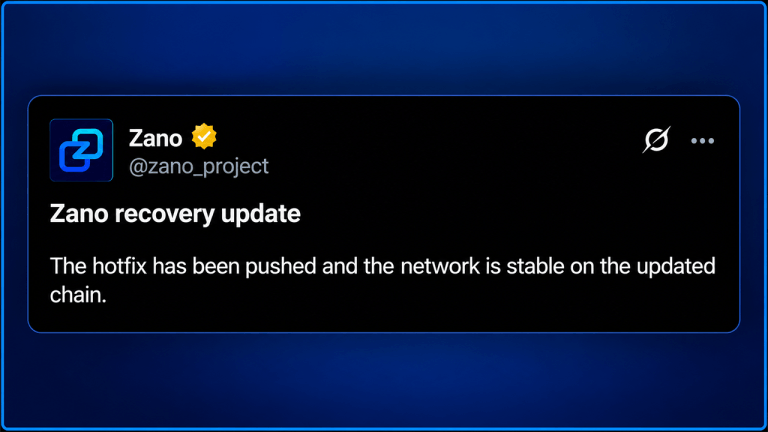
Zano Network Stabilizes After 30-Day Blockchain Rewind
The Zano team announced on Tuesday that a hot fix has been applied and the “network is stable on the updated chain” following the...

Token Spotlight: What is SoFiUSD (SOFID)?
Key takeaways SoFiUSD (SOFID) is a stablecoin, a crypto asset designed to hold a steady value of about one US dollar rather than m...