The same Fed rate hike can help stablecoins and hurt Bitcoin borrowers
When you hold a dollar stablecoin, somebody else may be earning interest on the assets backing your balance, while a company borrowing to buy Bitcoin has to find the money to pay its lenders. Both businesses are crypto-n...
High signal
Published in the last two hours. The story has cross-source confirmation.
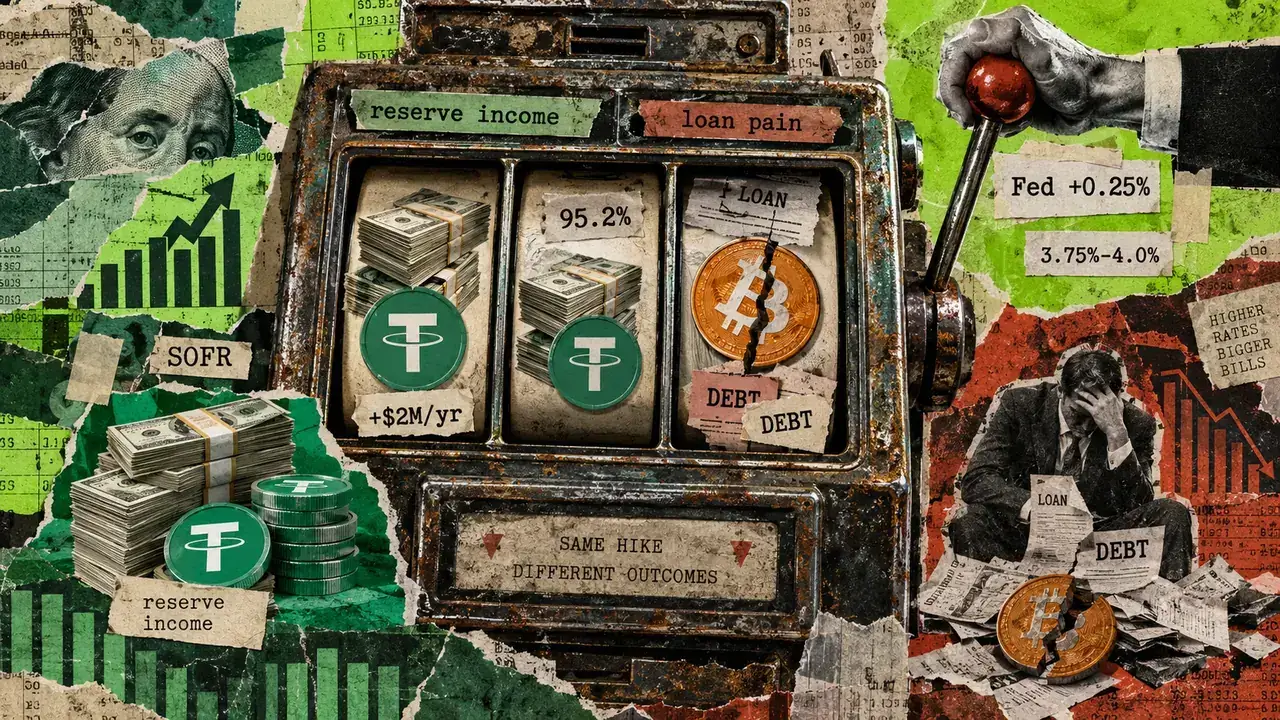
When you hold a dollar stablecoin, somebody else may be earning interest on the assets backing your balance, while a company borrowing to buy Bitcoin has to find the money to pay its lenders.
Both businesses are crypto-native, but a higher interest rate can reward the first and eat into the economics of the second.
That split gets lost when every move in Treasury yields becomes a verdict on whether money is getting easier or harder for the whole industry.
Different rates reach different businesses through their contracts, so a bond-market move that discourages investors from buying speculative assets can also improve the income earned on some crypto reserves.
We can see this in Circle's second-quarter filing: reserve income supplied 95.2% of revenue in the three months ended June 30, 2026. Its reserve returns track close to the prevailing secured overnight financing rate (SOFR), leaving revenue heavily dependent on how many stablecoins are outstanding and what their backing earns.
The rate in that calculation is important because overnight returns and the 10-year Treasury yield can move differently. Treating both as the same price of money can leave you expecting a windfall at an issuer whose reserve income is actually headed in the other direction.
Money has more than one priceThe Fed's Sept. 16 decision to raise its target range by a quarter of a percentage point, to 3.75%-4%, affected that split. Higher overnight rates can boost returns on short-term stablecoin reserves as assets mature or reset, while borrowers whose debt tracks those rates can face larger interest bills.
Short-term rates influence returns on instruments that mature or reset quickly, while a 10-year Treasury yield incorporates expectations about future short rates and compensation for holding a longer bond.
The New York Fed's term-premium research uses a model to separate those components, since the additional compensation itself can't be observed directly.
Investors could demand more compensation for owning long-dated government debt while expecting overnight rates to fall later, leaving long-term financing more expensive even as short-term reserve returns decline.
Under those conditions, a company funding a lengthy construction project and an issuer reinvesting maturing Treasury bills could both end up worse off, for different reasons.
Bitcoin holders have to make another calculation because owning the asset directly doesn't produce contractual interest income. They can profit if its price appreciates, but higher available bond yields give them a larger promised income to compare with a return that depends on what another buyer will pay.
That comparison depends on the investor's circumstances, including inflation, taxes, and how long they can leave the money invested.
Long-term Treasury bonds can lose market value when yields increase, as the SEC explains in its guide to interest-rate risk, so someone who needs to sell next month faces a different proposition from someone holding to maturity.
The relationship between real yields and Bitcoin valuations only describes one part of crypto's exposure. Companies earning interest on reserves can collect more cash when investors find speculative assets less appealing, without either outcome being contradictory.
Your dollars can pay somebody else's interest rate incomeConsider a hypothetical issuer with $10 billion in reserves earning 4% annually, producing $400 million a year before expenses and payments to partners.
If the return falls to 3%, income drops to $300 million, and recovering the original amount would require about $13.33 billion of reserves, roughly a third more.
Those (invented) numbers show why an issuer can bring in more customers and still earn less per dollar provided. More tokens in circulation help, but the extra balances must offset the lower return, while gross reserve income still has to cover distribution and operating costs.
Token holders may receive none of that income unless the product's terms give them a right to it, because what they're buying is usually the ability to hold and move a dollar-linked balance.
That service can be valuable, particularly where access to conventional dollar accounts is limited, but a higher reserve return can increase the issuer's income while increasing the interest its customers forgo elsewhere.
Borrowers face the other side of that math, as a hypothetical company raising $100 million in fresh interest-bearing debt would pay an additional $2 million a year if its borrowing rate increased by two percentage points.
Its business then has to find that money through earnings, further financing, or asset sales, even if the assets it bought haven't become any more productive.
The effect on a company borrowing to accumulate Bitcoin depends on the debt it issued, because existing fixed-rate borrowing doesn't automatically become more expensive when Treasury yields move.
Floating-rate loans can reset sooner, while refinancing brings the borrower back to the market when its old obligations mature, and lenders get another chance to set the terms.
Related Reading Why surging US real yields are quietly forcing Bitcoin under $84,000Convertible debt complicates the comparison further because lenders may accept a lower coupon in exchange for the possibility of receiving equity.
Focusing only on interest payments misses that value and the potential dilution borne by shareholders, so two companies with similar coupons can still have very different financing arrangements.
Miners considering data-center projects face the same need to match financing with future income, but construction spending begins before the completed site earns its intended revenue.
In a project with a narrow expected surplus, a larger interest bill can consume that surplus before the first customer starts paying, although the result depends on construction costs, customer contracts, and the mix of debt and equity.
The company with fixed funding and a credible customer commitment may consequently be in a better position than a rival with cheaper-looking debt that needs refinancing soon.
Understanding that difference requires reading the contracts, because the Treasury yield alone won't tell you which business can afford to finish its project.
DeFi has to explain the extra returnOnchain lending introduces another way to set rates, with Aave's documentation on supplying tokens explaining that supplier returns depend on borrowing utilization and protocol parameters.
Treasury yields influence the alternatives users can choose, but demand inside a lending pool helps determine what the pool actually pays.
When borrowers want a large share of available stablecoins, rates can rise, while weaker demand or more supply can pull them down. Governance settings and incentives can also affect the quoted return, which means the percentage on a dashboard needs an explanation of where the payment comes from.
Imagine a short-term government investment offering 4% and an onchain position advertising 7%.
The extra three percentage points must be considered alongside additional contractual, liquidity, technical, and counterparty risks, because a higher advertised return doesn't mean the investor is being paid enough to bear them.
Users also have different alternatives, since some can't obtain the same government-debt product and others need their tokens available for collateral or payments.
Someone can rationally accept a lower return in exchange for a service they need, which helps explain why yields don't immediately converge across conventional and onchain markets.
Crypto's exposure to rates therefore runs through several decisions happening at the same time, with issuers seeking reserve income, borrowers trying to earn more than their financing costs, and Bitcoin holders weighing appreciation against income elsewhere.
Tracing who gets paid, who owes the interest, and when those terms reset explains how the same bond market can finance one part of the industry while making another part's business harder to sustain.
The post The same Fed rate hike can help stablecoins and hurt Bitcoin borrowers appeared first on CryptoSlate.
Why this matters
Bitcoin is showing up inside the Stablecoins theme, so this story is worth tracking for follow-through rather than treating it as a one-off headline.
Original source
Read on CryptoSlateSame story, other sources
Cross-source coverage
2 sources

Bitcoin Price Is up 13% Since the Rate Hike Trump Says the Fed Got Wrong
President Donald Trump told Time the Federal Reserve should not have raised interest rates, yet...
Related market context

Bitcoin survived 5% yields but crypto’s cheap-money era did not
The US 10-year Treasury yield touched 5.34% on Oct. 1, its highest since 2002, capping a third quarter in which it climbed almost...

American Bankers Sue OCC Over Crypto Bank Charters, Challenging Coinbase and Circle
The lawsuit, filed October 2 in the U.S. District Court for the District of Columbia, puts the growing role of crypto firms within...

Stablecoin issuers have replaced 40% of China’s lost US Treasury demand
Stablecoin issuers are emerging as a new source of demand for US government debt as foreign official holdings lose ground. Tether...

Aave Founder Warns EU MiCA Review Could Restrict DeFi Access
Aave founder Stani Kulechov is criticizing proposals from European regulators that could extend restrictions on stablecoin yield a...
Circle Pushes Back on MiCA's Bank-Deposit Mandate for Stablecoins
The USDC issuer told the European Commission that MiCA's reserve mandates and concentration caps keep the largest global stablecoi...

Cardano’s DeFi has shrunk by more than half and RealFi is betting credit can revive it
Cardano’s “bank the unbanked” push went live with RealFi, putting real-world credit behind a new dollar-token system. On Oct. 1, R...