Cardano’s DeFi has shrunk by more than half and RealFi is betting credit can revive it
Cardano’s “bank the unbanked” push went live with RealFi, putting real-world credit behind a new dollar-token system. On Oct. 1, RealFi launched USDrf and its yield-bearing counterpart, sUSDrf, on Cardano, moving a proje...
Archive context
Older archive item. Useful for background and entity history, but not a fresh market-moving signal.
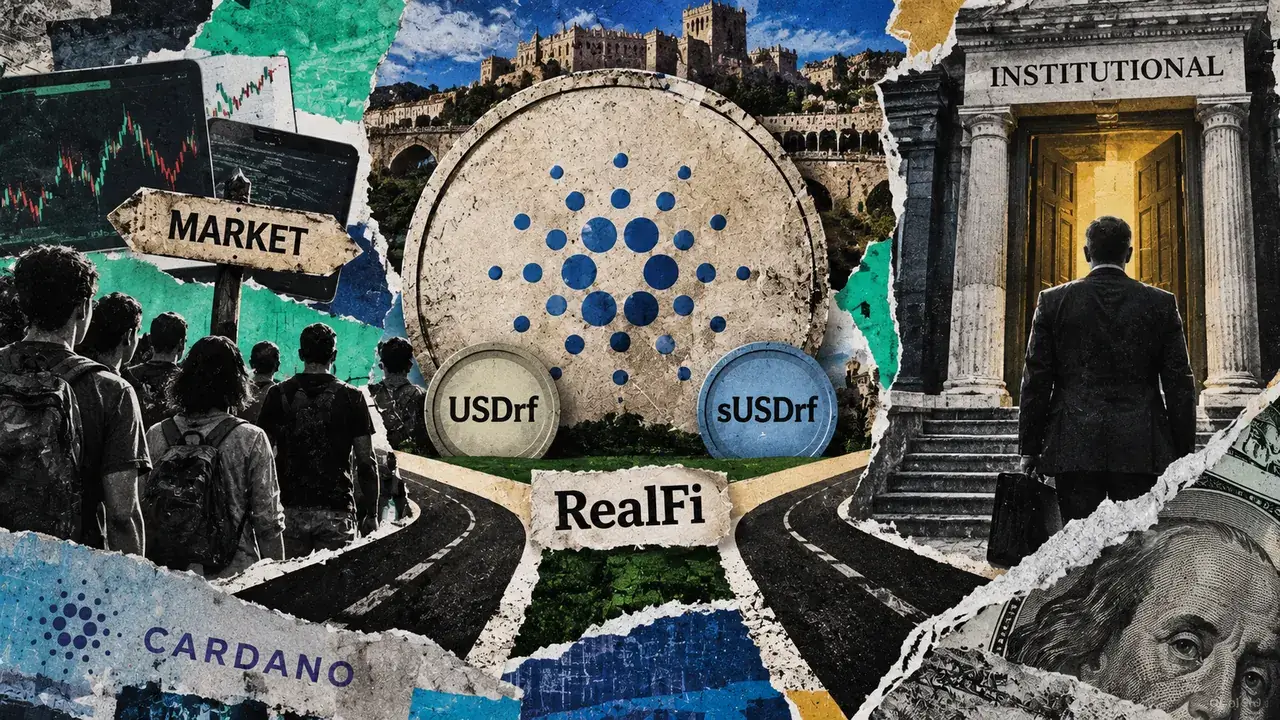
Cardano’s “bank the unbanked” push went live with RealFi, putting real-world credit behind a new dollar-token system.
On Oct. 1, RealFi launched USDrf and its yield-bearing counterpart, sUSDrf, on Cardano, moving a project Cardano's founder Charles Hoskinson has spent years describing as a bridge between blockchain finance and lending in emerging markets into production.
Eligible retail users can acquire USDrf and stake it for sUSDrf, which offers variable returns generated from the underlying portfolio. Direct minting and redemption with the issuer are reserved for verified institutional partners, creating different exit rights depending on who holds the token.
Hoskinson said in July that he had invested several million dollars in RealFi and that the team had serviced loans in Kenya and Uganda while building the platform largely outside public view. He described it as the first part of Cardano’s effort to “bank the unbanked,” with returns generated from lending outside crypto markets rather than primarily through token incentives.
The launch also arrives at a consequential moment for Cardano. Its stablecoin base is expanding toward a record even as capital committed to decentralized-finance applications has contracted sharply.
Cardano needs somewhere for its dollars to goOver the past year, Cardano has moved away from building isolated native solutions for every financial function and toward competing directly for the more sophisticated DeFi flows concentrated on Ethereum, its Layer-2 networks and Solana.
That shift has become more pressing as Cardano’s own DeFi footprint shrinks.
Related Reading Charles Hoskinson says Cardano no longer comes first – its treasury vote explains whyData from DeFiLlama shows that the network has about $67 million in total value locked, down more than 50% from roughly $150 million in May. Ethereum and Solana, by comparison, continue to support DeFi markets measured in the billions of dollars.
Stablecoins tell a different story. Dollar-linked tokens on Cardano are approaching an all-time high near $70 million, leaving the network with almost as much stablecoin liquidity as capital locked across its DeFi applications.
RealFi gives that growing dollar base another potential destination.
USDrf connects stablecoin capital to a portfolio that RealFi says can include direct loans, private-credit funds, public credit, investment-grade collateralized loan obligation ETFs, Treasuries and money-market instruments. Users willing to take additional risk can stake the token into sUSDrf for a share of the income generated by those assets.
That fits Cardano’s broader push to attract financial activity that does not depend solely on trading native tokens. If RealFi can turn stablecoin balances into lending and yield activity, it would add another source of demand to an ecosystem whose DeFi liquidity has been moving in the opposite direction.
But access to the product and access to the issuer’s balance sheet are separate.
Retail gets liquidity while institutions get redemptionEligible retail users can buy USDrf, but they generally cannot redeem it directly with RealFi Reserve for dollars.
Instead, RealFi directs retail holders toward supported decentralized exchanges, making their exit dependent on available liquidity and the market price of USDrf at the time.
Verified institutional entities get a different route. After completing checks and obtaining an approved account and whitelisted address, they can mint USDrf directly and request redemption at a nominal value of $1 per token, or its equivalent in eligible assets, less applicable fees.
Those redemptions are still subject to controls.
RealFi says institutional requests can enter a first-in-first-out queue and face daily or monthly limits. The issuer can suspend minting or redemptions under conditions including reserve or liquidity stress, sanctions concerns, security incidents and wider market disruption.
Stakers face another layer of friction. Leaving sUSDrf requires a seven-day cooldown before holders can claim USDrf, and the conversion amount is not guaranteed to remain one-for-one.
That matters because sUSDrf sits below the base token in RealFi’s loss hierarchy.
Protocol first-loss reserves absorb credit losses initially. If those buffers are exhausted, sUSDrf holders take losses before senior USDrf holders are affected. The number of sUSDrf tokens in a wallet may remain unchanged even as each token becomes redeemable for less USDrf.
RealFi explicitly describes sUSDrf as a junior loss-absorbing instrument whose yield can fall to zero and whose principal can be impaired.
USDrf receives more protection, though it remains neither an insured bank deposit nor a guaranteed dollar exit for retail holders.
The banking pitch now faces a balance-sheet testThe size of those protections remains difficult to quantify from the public information available at launch.
RealFi describes liquid reserves, underwriting controls, a stability fund and other mechanisms designed to support redemptions and absorb portfolio losses. Its public reserve-attestation page names HT Digital, but as of Oct. 1 did not display a dated reserve quantity.
Its disclosures also did not provide enough current figures on first-loss capital and settled staking balances to calculate how much credit deterioration sUSDrf could absorb before USDrf came under pressure.
RealFi currently excludes users from the United States, EU and European Economic Area, United Kingdom, Hong Kong and other restricted jurisdictions. Where local law restricts retail offerings of capital-markets products, sUSDrf is limited to accredited, institutional or other eligible investor categories.
That leaves RealFi’s next phase dependent on more than attracting deposits.
Hoskinson has already outlined a broader roadmap connecting the product with Bitcoin DeFi and privacy platform, Midnight.
Under that vision, users could borrow against Bitcoin-linked assets, deploy the proceeds into RealFi and use privacy-preserving credentials to satisfy identity requirements without relying on a conventional banking relationship.
Those integrations remain ahead.
The nearer-term commercial test will come as RealFi’s credit portfolio seasons, and users begin moving meaningful amounts through the system. Loan repayments, defaults, DEX liquidity, and institutional redemption queues will show whether Cardano’s growing stablecoin base can turn into durable credit activity rather than simply another pool of idle dollars.
The post Cardano’s DeFi has shrunk by more than half and RealFi is betting credit can revive it appeared first on CryptoSlate.
Why this matters
Cardano is showing up inside the Stablecoins theme, so this story is worth tracking for follow-through rather than treating it as a one-off headline.
Original source
Read on CryptoSlateRelated market context

Cardano Pushes Back on EU MiCA Expansion for DeFi, Staking and Crypto Lending
Key Takeaways: The Cardano Foundation advocated against the EU coming up with new rules for DeFi, staking, lending, or protocol-le...

Starknet Moves Toward Post-Quantum Layer 1 as Voters Back Ethereum Split
Starknet is taking its first formal steps toward potentially becoming an independent, quantum-resistant Layer 1 blockchain, follow...
Reflect Money launches Create for custom yield-bearing stablecoins on Solana
Reflect Money's Create tool could revolutionize stablecoin utility on Solana, potentially transforming idle assets into active rev...

Dogecoin Expands Utility as Robinhood Memecoin Boom Reveals Crypto’s Biggest Adoption Engine
The launch of Dogecoin Labs, Shiba Inu’s expansion across blockchain networks, and Robinhood Chain’s memecoin trading activity hig...

Dogecoin Labs Unites 3 Major DOGE Teams to Build Payments, Apps and DeFi at Scale
Key Takeaways: Dogecoin Labs is introducing MyDoge, DogeOS and Such App under one independent organization. The group is targeting...
TRON Settles $2.2T in Q3, Captures 73% of All Stablecoin Volume as First TRX ETF Launches: CoinDesk and Nansen
Geneva, Switzerland, October 22, 2026 — TRON reinforced its position as a leading blockchain network for stablecoin settlement in...