Move is now primed to grow DeFi
Opinion by: Alex Nguyen, CEO at VibrantXThe Move programming language’s origin is not super cypherpunk. Facebook (now Meta) created Move after the Libra/Diem team compared major smart contract languages (Bitcoin Script,...
Archive context
Older archive item. Useful for background and entity history, but not a fresh market-moving signal.

Opinion by: Alex Nguyen, CEO at VibrantX
The Move programming language’s origin is not super cypherpunk. Facebook (now Meta) created Move after the Libra/Diem team compared major smart contract languages (Bitcoin Script, Ethereum Virtual Machine bytecode languages) and decided their formidable in-house tech talent could make a new language built on years of private and public sector research.
The original team, including founders Mo Shaikh, Avery Ching, and their engineering team, left Facebook to continue as a fully independent, open-source project headed up by Aptos Labs and supported by the Aptos Foundation.
Importantly, Meta’s failed Libra experiment left us with a programming language specifically designed for crypto finance. Move on Aptos is now open-source, and the Aptos Foundation is a commercially driven organization that welcomes builders from all backgrounds.
Move is now the best programming language for verifying the absence of bugs and checking for modifications and leaks, which is how most blockchains get hacked.
This verification relies on two key features of Move on Aptos: (1) “backward compatibility” and (2) the concept of an “auditor at runtime.”
Backward compatibility means future-proofingMove on Aptos is fast and cheap, creating a competitive user experience, especially for decentralized finance (DeFi) applications. Aptos aims for a high transaction throughput, with theoretical capabilities reaching up to 160,000 transactions per second (TPS) through its parallel execution engine, Block-STM.
Aptos’ sub-second finality means transactions are confirmed quickly, enhancing the user experience in time-sensitive applications.
To be fair, other chains also have these qualities. Move on Aptos is, however, designed to be “backward-compatible.”
Future upgrades won’t disrupt existing projects. This helps developers feel more confident building long-term solutions without worrying about things breaking because of a Move upgrade.
Move smart contracts are designed to be upgradeable without affecting the user experience, which is essential for mainstream adoption. This enables teams to implement bug fixes and new features with zero disruption.
Recent: Crypto startups can’t just rely on solid tech to win VC funding: OKX
Smart contract flexibility through Move on Aptos’ specific security features results in better and faster product shipping. Being more flexible, Move on Aptos can quickly adapt to support new ecosystems.
“Bytecode” verification prevents leaksSolidity contract hacks have been prevalent over the years. When building Web3 technology for markets worth billions or even trillions of dollars, it’s crucial to have a security system that will protect projects from resource leaks, invalid memory access and other unauthorized modifications.
As it was initially developed for Meta’s Diem project, Move is designed for safety, resource management and performance, making it attractive for developers looking for a secure yet robust language for smart contracts.
When deploying code using Move, the code will be verified across several crucial coding conditions like proper resource management, type correctness and reference safety. No matter what happens to the code, it will be verified first to prevent any faulty or malicious smart contracts from running.
This is the power of Move’s built-in bytecode verification.
Renowned computer science pioneer Edsger Dijkstra noted, “Program testing can be used to show the presence of bugs, but never to show their absence!”
Move’s formal verification capabilities let developers actually prove that there are no bugs in specific code according to preset specifications.
MoveVM is less battle-tested than Ethereum’s virtual machine, but as Rushi Manche, founder of Movement Labs, has explained, Move requires much less code auditing. The MoveVM runtime can act as an “auditor at runtime.”
The verifier inside the MoveVM ensures that the transaction code is not harmful and that it cannot create, duplicate or destroy resources not allowed by the signer(s) of the transaction. In other words, MoveVM is an “auditor at runtime” rather than a human smart contract auditor.
Today, Move on Aptos is more than just a smart contract language. Move on Aptos is the longest-standing, most recognized and widely used version of Move, boasting one of the fastest-growing developer communities and a rapidly growing ecosystem of infrastructure, tooling and projects.
Quickly verifying code before deployment created the conditions for the Move on Aptos ecosystem. From a flawed Web2 beginning, Move is now primed to grow DeFi.
Opinion by: Alex Nguyen, CEO at VibrantX.
This article is for general information purposes and is not intended to be and should not be taken as legal or investment advice. The views, thoughts, and opinions expressed here are the author’s alone and do not necessarily reflect or represent the views and opinions of Cointelegraph.
Why this matters
This blockchain story adds another data point to the current market tape and is useful when read alongside nearby source coverage.
Original source
Read on CointelegraphRelated market context

Audited DeFi protocols lost $885M to attacks that occurred completely outside their audit scopes
In decentralized finance, “audited” is often presented as a verdict on an entire project. In practice, an audit usually covers nam...

Aptos integration with Archax enables movement of 100+ regulated assets onto blockchain
The integration signifies a pivotal shift towards mainstream adoption of blockchain in regulated financial markets, enhancing glob...

Kraken Lets Users Earn DeFi Yield on Nvidia and ETF xStocks
Kraken has launched on-chain yield vaults for three tokenised securities, enabling qualified clients to earn variable rewards from...

The biggest vulnerability in your Bitcoin wallet might be the shipping label
Hardware wallets might be able to protect your keys, but the paperwork from buying them could expose your identity. To buy a hardw...

Kraken brings DeFi yield to tokenized stocks and ETFs
Kraken’s new xStocks vaults let investors earn yield on tokenized versions of Nvidia and major US stock market ETFs by lending the...
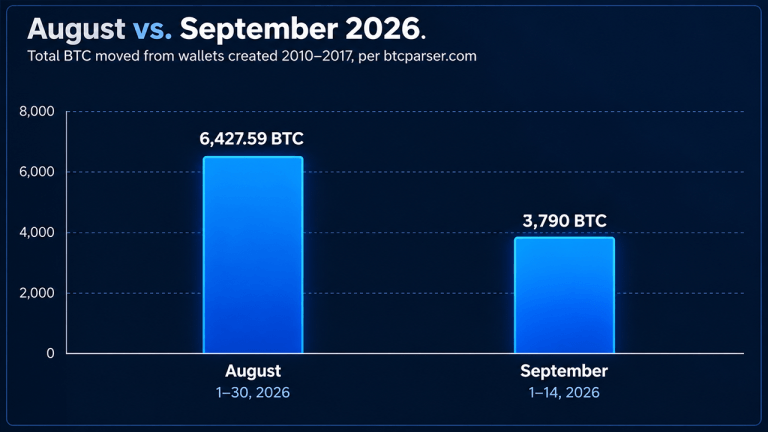
3,790 Sleeping Bitcoin Moved This Month, 62% on Weekends
On Monday, at block height 966937, a bitcoin whale with a wallet first created in 2013 shifted 113 BTC, worth around $8.8 million,...