South Korea Eyes Opening Crypto Market to Foreign Investors Amid AML Challenges
Key Takeaways: South Korea may allow foreign investments in crypto. Whether this happens depends on exchanges strengthening their AML efforts. Changes in policy could revive the local crypto sector. South Korea may open...
Archive context
Older archive item. Useful for background and entity history, but not a fresh market-moving signal.

Key Takeaways:
- South Korea may allow foreign investments in crypto.
- Whether this happens depends on exchanges strengthening their AML efforts.
- Changes in policy could revive the local crypto sector.
South Korea may open its cryptocurrency market to foreign investors if local exchanges meet AML compliance.
Seoul Steps into the Crypto Age: Will It Open Global Accessibility?Kim Sung-jin, head of the FSC’s virtual asset division, supported opening Korea’s crypto exchanges to international investors at a National Assembly seminar. The recent policy shift may be crucial for Korea to remain competitive in the fast-changing global digital asset ecosystem. As digital assets continue to gain popularity, global investors are increasingly looking to expand their portfolios into emerging markets, and South Korea’s robust infrastructure positions it as a potential leader in this space. The commission is currently exploring ways to allow foreign capital into the local market, but this depends on exchanges meeting international AML standards.
South Korea has strict know-your-customer (KYC) guidelines in place, requiring users to verify their identities via real-name bank accounts tied to local banks. This process effectively blocks non-residents from accessing the market. While the rules are intended for the benefit of local users, they are dragging the country’s crypto market down on the international front. Without access to foreign investments, local exchanges face a limited pool of capital, stifling innovation and hindering the growth of blockchain technology within South Korea. Capital controls aim to protect the domestic economy, but they hinder the growth of the increasingly globalized cryptocurrency sector. Lifting these restrictions could bring new liquidity and energy to Korea’s crypto space, unlocking investment potential and establishing South Korea as a global crypto leader.
Korea Ponders Crypto Capital Controls as Global Race Heats UpAs other nations adopt relatively more crypto-friendly structures, South Korea is under pressure to follow suit. The government is now re-evaluating its decades-old capital controls as part of broader efforts to keep up with changes to the global digital asset landscape.
If South Korea does loosen these restrictions, it could trigger meaningful change — more international investment, deeper market liquidity, and the possible end of the so-called “Kimchi Premium.” Pursuing an open market for crypto has tethered South Korea to a stronghold for global crypto trading, attracting not just investors, but also developers for blockchains, as well as startups aligned with crypto, in hopes of an accommodating regime.
The “Kimchi Premium” refers to the price difference between cryptocurrencies on Korean exchanges and the global average, such as Bitcoin trading at a 10–20% premium in Korea in early 2021. The price difference occurs because foreign investors face difficulties accessing the market. Bitcoin traded for a 10–20% premium in Korea, for example, in early 2021.
The premium could disappear if the market opens to international investors, creating a more efficient trading environment. It would create a more effective trading environment as well as reduce the price distortions between Korea and the world.
Korea’s Onboarding Process: An Early Step for Foreign EntryThe consideration comes in spite of optimism that the access tightening will loosen, as regulators worry that domestic exchanges, at least, are not ready for the foreign participation compliance burden. A central problem is the implementation of AML policies — particularly the Travel Rule.
Since March 2022, Seoul has had a similar rule in place, requiring exchanges to collect information identifying senders and receivers of any crypto transaction of ₩1 million (approximately $680) or more. Other regional exchanges took it a step further by extending that limitation to even smaller trades, showing their dedication to adhering to AML.
Korea’s Financial Intelligence Unit (FIU) had earlier this year imposed a fine on Upbit, the country’s biggest exchange, for these facilitating transactions with unregistered foreign platforms. The penalty was temporarily stayed by a Seoul court, but it highlighted the growing scrutiny on local platforms as regulators increase compliance pressure. Upbit responded by upgrading its KYC and AML processes, but the episode illustrates the tension between regulatory caution and innovation. The FSC wants growth, but only if it’s clean.
Korea’s Crypto Industry: High Hopes, High HurdlesSouth Korea is still one of the strongest crypto markets in the world despite regulatory challenges. In March, Upbit alone handled $85 billion monthly trading volume. The activity highlights what’s at stake if foreign investors are allowed through the gates.
More News: South Korea Blocks Foreign Crypto Exchanges on Google Play Amid Regulatory Crackdown
The post South Korea Eyes Opening Crypto Market to Foreign Investors Amid AML Challenges appeared first on CryptoNinjas.
Why this matters
This blockchain story adds another data point to the current market tape and is useful when read alongside nearby source coverage.
Original source
Read on CryptoNinjasRelated market context
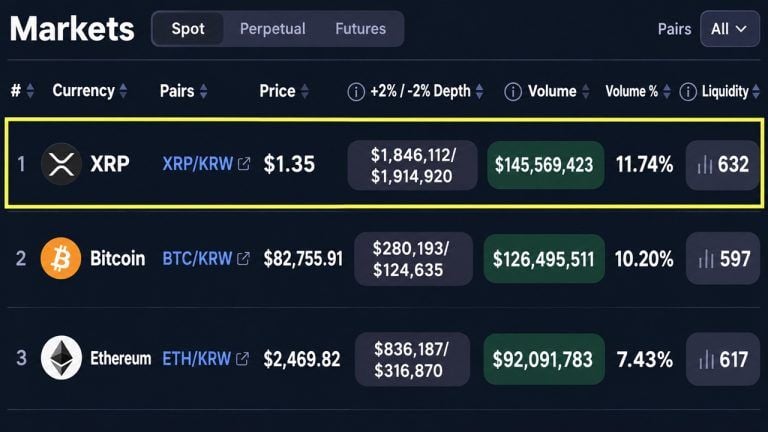
XRP Is Outtrading Bitcoin and Ether on South Korea’s Biggest Exchange
XRP topped Upbit’s spot volume in snapshots taken more than seven hours apart, beating bitcoin and ether in won trading even as it...
Canton Enters South Korea as Meritz Eyes Tokenized Finance Deals
South Korean investment firm Meritz Securities has struck a partnership with the Canton Foundation to explore bringing tokenized K...
XRP spot volume surpasses Bitcoin and Ethereum on South Korea’s Upbit
XRP's dominance on Upbit highlights the potential impact of local regulatory shifts on global crypto liquidity and market dynamics...
Binance Eyes Hong Kong, South Korea, Taiwan, Brazil Stocks in Global Push
Binance is exploring ways to give users exposure to leading stocks in markets including Hong Kong, South Korea, Taiwan, and Brazil...

Grayscale Opens 3 Crypto Funds on Republic With $2,500 Minimum for Eligible Investors
Key Takeaways: Grayscale has introduced three crypto-investment products to Republic. A minimum investment of $2,500 is required f...

MEXC AI Trading Report Reveals 85% of Crypto Traders Use AI, But Most Limit Its Control Over Funds
Mutsamudu, Comoros, October 16, 2026 — MEXC, a global cryptocurrency exchange, released its AI Trading Report, based on a survey o...