AI has a trust problem — Decentralized privacy-preserving tech can fix it
Opinion by: Felix Xu, co-founder of ARPA Network and Bella ProtocolAI has been a dominant narrative since 2024, but users and companies still cannot completely trust it. Whether it’s finances, personal data or healthcare...
Archive context
Older archive item. Useful for background and entity history, but not a fresh market-moving signal.

Opinion by: Felix Xu, co-founder of ARPA Network and Bella Protocol
AI has been a dominant narrative since 2024, but users and companies still cannot completely trust it. Whether it’s finances, personal data or healthcare decisions, hesitation around AI’s reliability and integrity remains high.
This growing AI trust deficit is now one of the most significant barriers to widespread adoption. Decentralized, privacy-preserving technologies are quickly being recognized as viable solutions that offer verifiability, transparency and stronger data protection without compromising AI’s growth.
The pervasive AI trust deficitAI was the second most popular category occupying crypto mindshare in 2024, with over 16% investor interest. Startups and multinational companies have allocated considerable resources to AI to expand the technology to people’s finances, health, and every other aspect.
For example, the emerging DeFi x AI (DeFAI) sector shipped more than 7,000 projects with a peak market cap of $7 billion in early 2025 before the markets crashed. DeFAI has demonstrated the transformative potential of AI to make decentralized finance (DeFi) more user-friendly with natural language commands, execute complex multi-step operations, and conduct complex market research.
Innovation alone hasn’t, however, solved AI’s core vulnerabilities: hallucinations, manipulation and privacy concerns.
In November 2024, a user convinced an AI agent on Base to send $47,000 despite being programmed never to do so. While the scenario was part of a game, it raised real concerns: Can AI agents be trusted with autonomy over financial operations?
Audits, bug bounties and red teams help but don’t eliminate the risk of prompt injection, logic flaws or unauthorized data use. According to KPMG (2023), 61% of people still hesitate to trust AI, and even industry professionals share that concern. A Forrester survey cited in Harvard Business Review found that 25% of analysts named trust as AI’s biggest obstacle.
That skepticism remains strong. A poll conducted at The Wall Street Journal’s CIO Network Summit found that 61% of America’s top IT leaders are still experimenting with AI agents. The rest were still experimenting or avoiding them altogether, citing lack of reliability, cybersecurity risks and data privacy as top concerns.
Industries like healthcare feel these risks most acutely. Sharing electronic health records (EHR) with LLMs to improve outcomes is promising, but it is also legally and ethically risky without airtight privacy protections.
For example, the healthcare industry suffers adversely from data privacy breaches. This problem compounds when hospitals share EHR data to train AI algorithms without protecting patient privacy.
Decentralized, privacy-preserving infrastructureJ.M. Barrie wrote in Peter Pan, “All the world is made of faith, and trust, and pixie dust.” Trust isn’t just a nice to have in AI — it’s foundational. AI’s projected economic boon of $15.7 trillion by 2030 may never materialize without it.
Enter decentralized cryptographic systems like zero-knowledge succinct non-interactive arguments of knowledge (ZK-SNARKs). These technologies offer a new path: allowing users to verify AI decisions without revealing personal data or the model’s inner workings.
By applying privacy-preserving cryptography to machine learning infrastructure, AI can be auditable, trustworthy and privacy-respecting, especially in sectors like finance and healthcare.
Recent: Blockchain’s next big breakthroughs: What to watch
ZK-SNARKs rely on advanced cryptographic proof systems that let one party prove something is true without revealing how. For AI, this enables models to be verified for correctness without disclosing their training data, input values or proprietary logic.
Imagine a decentralized AI lending agent. Instead of reviewing full financial records, it checks encrypted credit score proofs to make autonomous loan decisions without accessing sensitive data. This protects both user privacy and institutional risk.
ZK technology also addresses the black-box nature of LLMs. By using dynamic proofs, it’s possible to verify AI outputs while shielding both data integrity and model architecture. That’s a win for users and companies — one no longer fears data misuse, while the other safeguards its IP.
Decentralized AIWe’re entering a new phase of AI where better models aren’t enough. Users demand transparency; enterprises need resilience; regulators expect accountability.
Decentralized, verifiable cryptography delivers all three.
Technologies like ZK-SNARKs, threshold multiparty computation, and BLS-based verification systems aren’t just “crypto tools” — they’re becoming the foundation of trustworthy AI. Combined with blockchain’s transparency, they create a powerful new stack for privacy-preserving, auditable and reliable AI systems.
Gartner predicted that 80% of companies will be using AI by 2026. Adoption won’t be driven by hype or resources alone. It will hinge on building AI that people and companies can actually trust.
And that starts with decentralization.
Opinion by: Felix Xu, co-founder of ARPA Network and Bella Protocol.
This article is for general information purposes and is not intended to be and should not be taken as legal or investment advice. The views, thoughts, and opinions expressed here are the author’s alone and do not necessarily reflect or represent the views and opinions of Cointelegraph.
Why this matters
This cryptocurrency story adds another data point to the current market tape and is useful when read alongside nearby source coverage.
Original source
Read on CointelegraphRelated market context
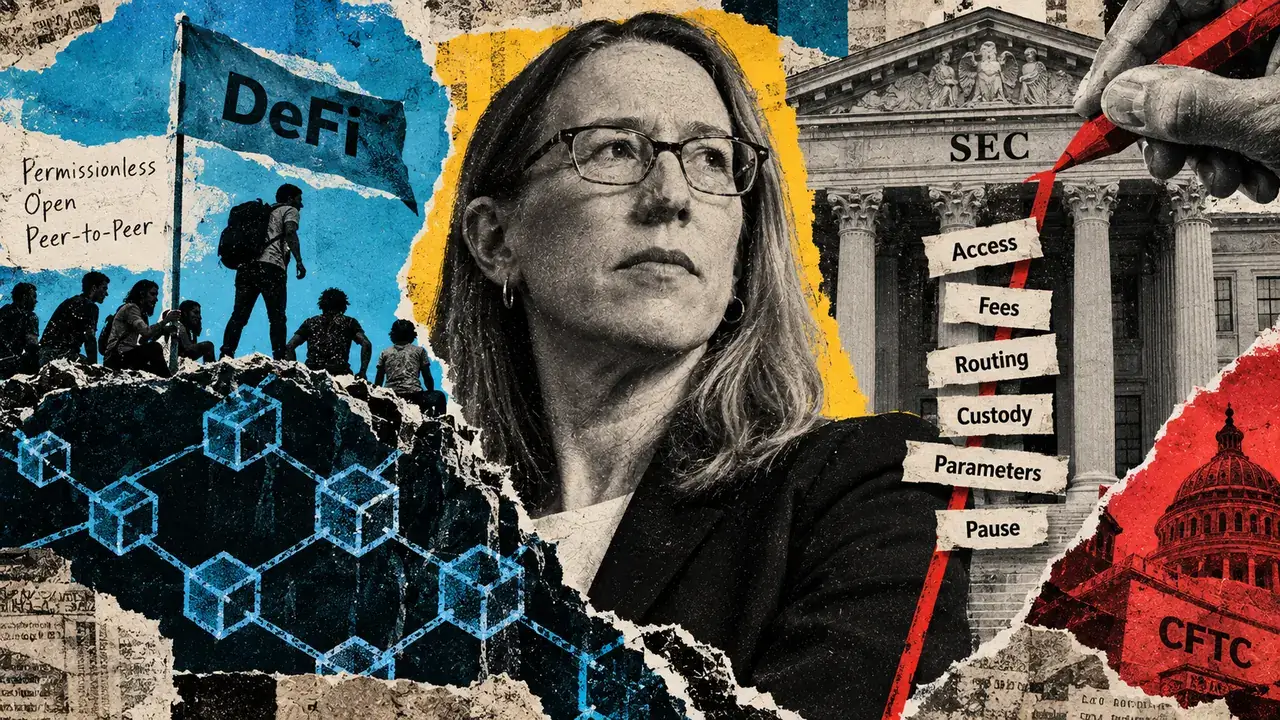
Why truly decentralized DeFi needs no legal exemption according to SEC Commissioner Hester Peirce
SEC Commissioner Hester Peirce drew a sharp line around decentralized finance on Sept. 17. She said investors need no exemption to...

NOWPayments Releases Cross-Chain Payout Data Revealing Key Performance Benchmarks Across TRON, BNB Chain, and Solana
Tallinn, Estonia, September 21st, 2026, Chainwire NOWPayments today published new empirical data analyzing six months of enterpris...

Will proposed faster block times really fix Ethereum’s biggest market losses?
Ethereum developers are weighing Ethereum Quick Slots for Hegotá, a proposed faster block rhythm that would reduce waiting without...

Perplexity AI Predicts Weak XRP Price by 2027: Bull Run Canceled?
The Silicon Valley-based Perplexity AI predicts XRP could have a tame Q4, saying it believes the token will only hit $3.25 by Janu...
Robinhood Crypto Chain’s $146M Tokenized-Stock Bet Faces Its First Fee Test
Robinhood crypto chain had attracted $146 million in tradeable tokenized stocks, just weeks before the free-gas promotion that hel...

Grok AI Predicts Bitcoin to Hit $150,000 in Q4
Elon Musk’s Grok AI predicts that in a full-blown bull market, Bitcoin could hit $150,000 before January 1, 2027. The bullish rang...