Australian regulator asks High Court to allow appeal in Block Earner case
Australia’s financial regulator will seek the High Court’s permission to appeal a lower court’s ruling favoring fintech firm Block Earner, which found the company’s crypto-linked fixed-yield earning service is not a fina...
Archive context
Older archive item. Useful for background and entity history, but not a fresh market-moving signal.

Australia’s financial regulator will seek the High Court’s permission to appeal a lower court’s ruling favoring fintech firm Block Earner, which found the company’s crypto-linked fixed-yield earning service is not a financial product.
The Australian Securities and Investment Commission said on May 21 that it wants to ask the High Court of Australia to clarify what the definition of a financial product is and clarify the circumstances when an interest-earning product and the conversion of assets from one form to another are regulated.
“The definition of financial product was drafted in a broad and technology-neutral way, and ASIC believes it is in the public interest to clarify this,” the watchdog said.
“This clarification is important as it applies to all financial products and services whether they involve crypto-assets or not.”On April 22, Federal Court Justices David O’Callaghan, Wendy Abraham and Catherine Button found that Block Earner’s crypto-linked fixed-yield earning product is not a financial product, a managed investment scheme or a derivative under the Corporations Act.
ASIC said the court will consider its application. Special leave is required in an appeal to the High Court, and it’s only granted in cases where it would answer significant legal questions or matters of public interest.
A Block Earner spokesperson told Cointelegraph the matter has now escalated to a “broader legal question” around the definition of a financial product, which extends “well beyond Block Earner, and the crypto sector.”
“We believe the Full Federal Court’s April ruling was a strong and well-reasoned decision that upheld the integrity of our operations,” the spokesperson said. “We remain confident in the soundness of that judgment and will respond to ASIC’s application through the appropriate legal channels.”
Legal saga ongoing since 2022ASIC first launched legal proceedings against Block Earner in November 2022, arguing the company needed a financial services license to offer its yield product, which was available from March 17, 2022, until the company shut it down on Nov. 16, 2022.
Related: Australia outlines crypto regulation plan, promises action on debanking
ASIC was arguing Block Earner needed a financial services license to offer its crypto-linked fixed-yield earning product. Source: ASICIn February 2024, an Australian court initially ruled the fintech firm would need a financial services license to operate its crypto yield-bearing products.
Another June 2024 ruling in Australia’s Federal Court released Block Earner from any financial penalties because it had “acted honestly” and pursued its legal opinions before launching the products, which ASIC appealed.
Block Earner appealed the Federal Court’s decision that it needed a financial services license on July 9, 2024.
Magazine: SEC’s U-turn on crypto leaves key questions unanswered
Why this matters
This cryptocurrency story adds another data point to the current market tape and is useful when read alongside nearby source coverage.
Original source
Read on CointelegraphRelated market context

French Regulator Orders ISP Block On Polymarket Access
France’s National Gambling Authority has ordered internet service providers to block access to Polymarket, putting the prediction-...

$131 billion crypto vault boom will test the limits of SEC’s friendlier crypto stance
On July 22, SEC Commissioner Hester Peirce warned that some crypto vaults and onchain lending strategies may fall under federal se...

Five Regulatory Moves This Week That Will Shape Crypto Trading in the Second Half of 2026
This week regulators were busy defining where crypto trading can happen, which intermediaries can provide access, how assets get c...

Ripple CLO Stuart Alderoty Defends Clarity Act Consumer Safeguards: “Perfect Can’t Be the Enemy of Good”
In a recent post, Alderoty described the Clarity Act as “a consumer protection bill,” pointing to its anti-money laundering and kn...

Latest $3.8 billion RWA recovery shows how quickly DeFi absorbed the KelpDAO shock
Active use of tokenized real-world assets in DeFi has returned to about $3.77 billion, close to the level visible before an April...
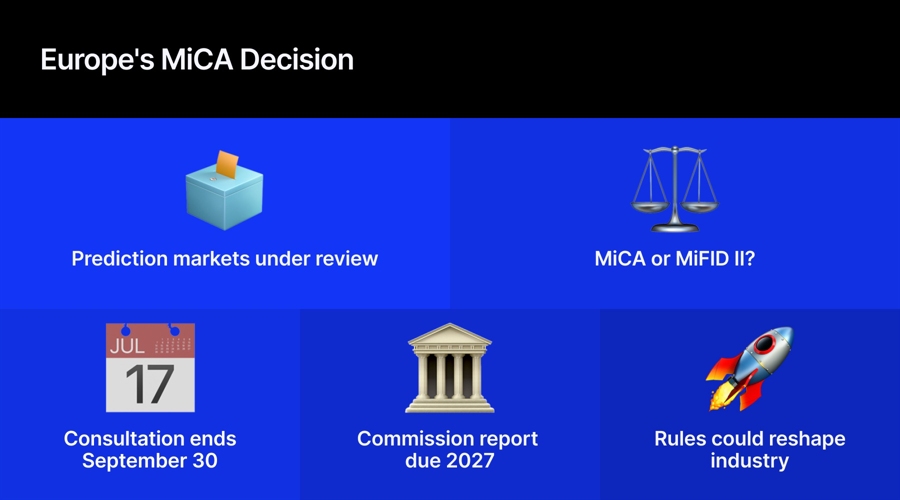
MiCA Is Not Only for Crypto. It Will Also Decide Prediction Markets’ European Future
While the industry spent the summer arguing about stablecoin reserves and DeFi certification schemes, the most consequential quest...