Google Integrates with Self, Leveling Up Enterprise ZK Adoption
ZK-powered identity protocol Self says it has joined hands with Google Cloud to fuel adoption of its Web3 infrastructure and AI tooling among verified human users. According to the press release, the partners aim to supp...
Archive context
Older archive item. Useful for background and entity history, but not a fresh market-moving signal.
ZK-powered identity protocol Self says it has joined hands with Google Cloud to fuel adoption of its Web3 infrastructure and AI tooling among verified human users.
According to the press release, the partners aim to support the Web3 developer ecosystem with new AI capabilities.
Namely, they will explore ways to integrate the Self Protocol with AI search tools in its Web3 Portal.
Also, Google Cloud’s Testnet Faucet will integrate with Self’s proof-of-humanity zero-knowledge proofs (ZKPs) for Sybil resistance. The latter refers to methods to prevent or mitigate Sybil attacks, where a malicious entity uses numerous fake identities/nodes to gain control over a network.
And lastly, Google Cloud will launch “a first-of-its-kind” Mainnet Faucet offering. To enable sanctions screening, it will use Self’s exclusion proofs from its OFAC list. Office of Foreign Assets Control (OFAC) is a division of the US Department of the Treasury that administers and enforces economic and trade sanctions.
2/ Self, a ZK-powered identity protocol that enables users to prove their humanity & unique attributes w/o revealing personal data, announces a new partnership w/ Google Cloud––what does this mean?
— Self Protocol (@SelfProtocol) July 23, 2025According to Richard Widmann, Head of Strategy for Web3 at Google Cloud, “the acceleration of AI in the Web3 developer ecosystem is lowering the barrier to entry for developers building in this space.”
Google Cloud’s works with Celo and Self to bring together ZKP-enabled identity technology with Web3 developer tools on the Google Cloud Web3 Portal. This will “demonstrate the value and timeliness of these technologies,” Widmann argues.
Speaking of which, while Self supports offchain and onchain attestations, the latter happen on the Celo blockchain.
Google Cloud has been a Celo partner since 2018. It has supported its development and sustainability-focused startups within the ecosystem, while also running a validator. A network validator participates in the verification of new transactions, thus helping secure the network against attacks.
It's official––the @googlecloud & @CeloOrg partnership continues!
Importantly, @googlecloud is running a validator on the Celo network, helping to strengthen the network’s security. pic.twitter.com/vTzadH8t1d
The Self team says that it’s audited by third-party zkSecurity. They state that the zero-knowledge technology ensures safety and privacy. No single person or entity, including the protocol developers, can access users’ data, they claim. Information is also not stored with a third entity.
Moreover, the protocol utilizes zk-SNARK (Zero-Knowledge Succinct Non-interactive Argument of Knowledge) cryptography to prove they are humans. This also allows them to reveal certain less sensitive data, if they choose so. For example, they can reveal their age but not their date of birth, the team says.
Moreover, Self reports over 8 million users, 1 billion biometric passport holders from 129 countries, and “tens of millions” of biometric ID holders across 27 EU countries, Turkey, Ukraine, Vietnam, Ghana, and Saudi Arabia.
5/ Self also supports offchain & onchain attestations, w/ onchain attestations occurring on @Celo, where Google Cloud ran a validator & has supported development of the protocol and sustainability-focused ecosystem projects since 2018 https://t.co/fT11NQG7wh
— Self Protocol (@SelfProtocol) July 23, 2025Now, this latest Self-Google Cloud partnership “marks an ongoing commitment” by the two teams “to promote the privacy and protection of users by harnessing cryptographic ZKPs, as with its announcement to enhance Google Wallets in the UK for age verification (April 2025), and more recently, to promote privacy in supporting EU age assurance (July 2025).”
Self co-founder Marek Olszewski commented that they are “honored that Google chose our SDK to provide secure, privacy-first identity solutions, and to further drive AI and Web3 innovation for real people.”
You may also like: CME Group and Google Cloud Pilot Asset Tokenization Solutions CME Group, a US-based derivatives marketplace, and Google Cloud have partnered to pilot solutions for secure wholesale payments and asset tokenization using Google Cloud Universal Ledger (GCUL). CME Group has already completed the initial integration and testing phase of GCUL, according to the companies' March 25 press release. Driving Efficiency for 24/7 Trading CME Group and Google Cloud are collaborating to enhance the efficiency of collateral, margin, settlement, and fee...The post Google Integrates with Self, Leveling Up Enterprise ZK Adoption appeared first on Cryptonews.
Why this matters
This cryptocurrency story adds another data point to the current market tape and is useful when read alongside nearby source coverage.
Original source
Read on CryptonewsRelated market context

Ripple Custody Adds Canton Network Support, Bringing CC and CIP-56 Into One Vault
Key Takeaways: Ripple Custody 1.43 adds support for Canton Network, CC and CIP-56 tokens. Institutions can be given the same custo...

Stealing $1.5B in crypto is easy, cashing out is the trap
North Korean hackers stole around $1.5 billion from Bybit in February 2025. While the hack itself has been widely covered and anal...
OpenAI, Google and Meta battle for AI internet domains as crypto firms target .bitcoin and .wallet
OpenAI, Google, and Meta are competing for AI-related internet domains as cryptocurrency firms pursue their own digital naming rig...

Sui’s Hashi Launches With $500M to Turn Bitcoin Into Productive DeFi Collateral Markets
Key Takeaways: With more than $500 million in locked-in tokens, Hashi will launch its phased mainnet launch. The protocol enables...
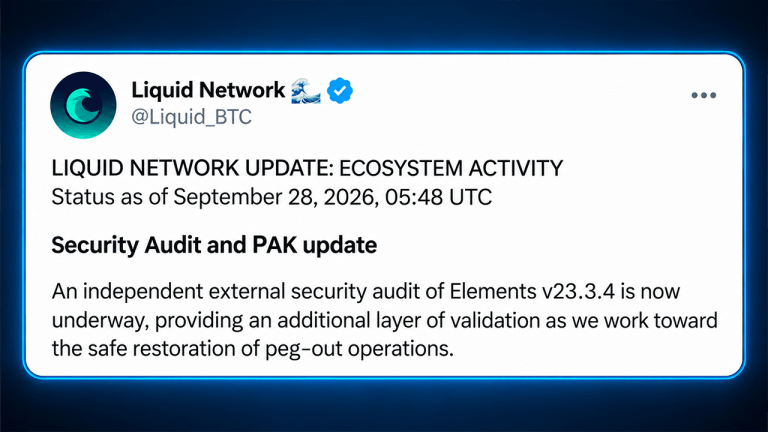
Liquid Network at 86% Backing as Bitcoin Redemption Freeze Drags On
It has been 35 days since an attacker exploited a vulnerability in the Liquid Network’s Elements software, draining nearly 4,000 B...

New iPhone spyware can hunt for crypto wallets and extract their data every 15 seconds
Researchers found a new iPhone spyware variant that can remotely extract cryptocurrency wallet data and sensitive credentials from...