Kraken Borrow Update Turns Idle Collateral Into A More Flexible Trading Tool
Kraken is updating its borrow product in a way that speaks directly to one of the central questions for active crypto traders: what can they do with collateral once it is sitting on the platform? The update focuses on ma...
Archive context
Older archive item. Useful for background and entity history, but not a fresh market-moving signal.

Kraken is updating its borrow product in a way that speaks directly to one of the central questions for active crypto traders: what can they do with collateral once it is sitting on the platform?
The update focuses on making borrowed funds and collateral mechanics more useful inside Kraken Pro, giving eligible users more flexibility around margin spend and liquidity access. That may not sound as exciting as a new token listing or a sharp price move, but for traders managing positions across volatile markets, collateral design matters.
Crypto trading is not only about picking direction. It is also about how capital is used, how much liquidity stays available, and how quickly a trader can react when the market moves.
A better borrow product can make that workflow smoother. A badly understood borrow product can add risk. That is why the details matter.
TL;DR- Kraken has updated borrow mechanics for eligible users, with a focus on collateral and margin spend.
- The update matters for active traders who want more flexible access to liquidity without immediately selling holdings.
- The important issues are interest rates, collateral thresholds, liquidation risk, and how clearly the product explains those trade-offs.
Borrowing against crypto holdings is a simple idea with complicated consequences.
A trader may not want to sell Bitcoin, Ethereum, or another asset, but may still want liquidity. Borrowing against collateral can provide that liquidity while keeping the underlying position intact. That can be useful for trading, hedging, short-term cash needs, or portfolio management.
The appeal is clear: users can access value without exiting a position.
The risk is just as clear: if collateral value falls, the borrower can face margin calls or liquidation. In crypto, where prices can move sharply in a short period, that risk is not theoretical.
That is why borrow products need to be judged by their mechanics, not just their headline convenience. Loan-to-value ratios, liquidation thresholds, interest rates, eligible collateral, and repayment terms are the real story.
For Kraken, the goal appears to be making borrowing more integrated with the trading experience. If users can manage collateral and spending more directly inside Kraken Pro, the product becomes part of the active trading stack rather than a separate finance tool.
Capital Efficiency Is The Real Selling PointActive traders care about capital efficiency because unused collateral can limit strategy.
A user holding crypto may want to keep long-term exposure while still having funds available for other trades. Another may want to avoid selling during a temporary dip. A more advanced trader may want to manage multiple positions while keeping a core portfolio intact.
Borrowing can help with those scenarios, but only when the platform gives users enough control and transparency.
That is where Kraken’s update becomes relevant. The exchange is building around the practical needs of traders who use crypto not just as a buy-and-hold asset, but as working collateral.
This is a broader market trend. Exchanges are trying to become financial platforms rather than simple trading venues. They want users to custody assets, borrow, trade derivatives, manage risk, and keep more of their activity inside one ecosystem.
That can be convenient, but it also concentrates risk. Users need to understand how one product affects another. A borrow position can become dangerous if the same collateral is exposed to market volatility, margin requirements, or sudden liquidity needs.
The Risk Is In The Fine PrintThe biggest danger with borrow products is that they feel calm until the market moves.
When prices are stable or rising, borrowing against crypto can look efficient. When prices fall quickly, the same structure can become stressful. Collateral values drop, borrowing ratios tighten, and users may need to add funds or repay quickly to avoid liquidation.
That is why any Kraken Borrow update should be read through the lens of risk controls.
Interest rates matter because they affect the true cost of liquidity. Liquidation thresholds matter because they decide how much breathing room a user has. Eligible collateral rules matter because not all assets behave the same way under stress.
For serious traders, those are not side details. They are the product.
The update may make Kraken more useful for users who already understand collateral management. It may also attract traders who want to do more from one account rather than moving funds between platforms.
But the benefit depends on whether users treat borrowing as a managed risk tool, not free liquidity.
The broader takeaway is that crypto exchanges are becoming more like full-service trading platforms. That can improve market structure, especially if products are transparent and properly risk-managed. It can also create new problems if users underestimate how quickly collateral can become vulnerable.
Kraken’s borrow update sits right in that tension. It offers more flexibility, but flexibility in crypto always needs discipline.
This article is based on information from Kraken.
This article was written by the News Desk and edited by Samuel Rae.
Why this matters
Kraken is showing up inside the Market Structure theme, so this story is worth tracking for follow-through rather than treating it as a one-off headline.
Original source
Read on NewsBTCRelated market context
Bitcoin hedge funds face a liquidation trap when their collateral is split across markets
Here's a hypothetical situation: a hedge fund is making money, but one of its exchanges is about to liquidate its position anyway....

What Is Crypto Spot Trading?
For example, a token can be up 70% and still be a terrible trade if you have no idea when to take profits. Likewise, a 30% dip can...

AI Could Weaken Ethereum Security as Cryptographic Risks Grow, Vitalik Buterin Warns
Buterin urged developers to prepare for potential AI vulnerabilities in both conventional and quantum-resistant cryptography, whil...

Sui’s Hashi Launches With $500M to Turn Bitcoin Into Productive DeFi Collateral Markets
Key Takeaways: With more than $500 million in locked-in tokens, Hashi will launch its phased mainnet launch. The protocol enables...
Tokenized stocks can carry the same rights without the same trading protections
Tokenized stocks eligible for the SEC’s September exemption must carry equivalent shareholder rights, yet their trading venues can...
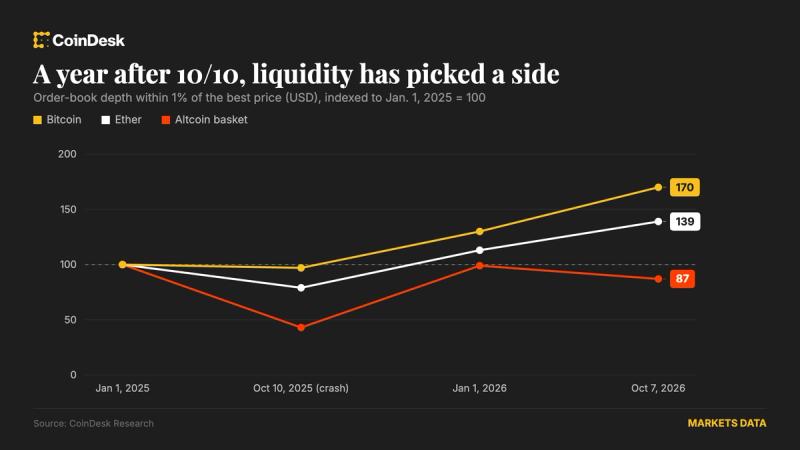
One year after 10/10, bitcoin and ether liquidity have rebuilt, but other altcoins still face risks
Bitcoin and ether order books are deeper than before the crash, while altcoin liquidity keeps eroding and spot trading remains wel...