Mashinsky’s 12-year sentence sets tone of enforcement in Trump era
The US federal court for the Southern District of New York has sentenced former Celsius CEO Alex Mashinsky to 12 years in prison for fraud. Mashinsky’s legal team sought a light sentence. They highlighted his spotless re...
Archive context
Older archive item. Useful for background and entity history, but not a fresh market-moving signal.

The US federal court for the Southern District of New York has sentenced former Celsius CEO Alex Mashinsky to 12 years in prison for fraud.
Mashinsky’s legal team sought a light sentence. They highlighted his spotless record before the Celsius incident, along with his military service and willingness to plead guilty. But US prosecutors were less inclined to leniency, suggesting on April 28 that the judge deliver a 20-year sentence for his actions.
Betting markets predicted a light sentence ahead of the May 8 hearing. Polymarket showed only 11% odds for a 20-year sentence or higher.
Source: PolymarketPresident Donald Trump began his second term with high-profile pardons of crypto executives, signalling that his administration may bring leniency to crypto fraudsters like Mashinsky. His sentencing today, however, suggests otherwise.
Trump’s DOJ wants Mashinsky sentence to serve as a warningCrypto-related crimes have their limits, according to the current US Department of Justice. Jay Clayton, the Trump-nominated US attorney leading the prosecution, said on April 28 that the suggested 20-year sentence serves as a “critical warning to other entrepreneurs, executives, and promoters in the cryptocurrency industry and in any future industry as-yet unconceived: that fraud will be punished severely, regardless of the technology or industry in which it occurs.”
Bitcoin advocate Jameson Lopp quotes the prosecution’s argument that Mashinsky targeted retail investors. Source: Jameson LoppClayton argued that a strong sentence was warranted as the fraud targeted unsophisticated retail investors rather than institutional parties with protections and expertise. Mashinsky “preyed on ordinary individuals who relied on his promises of safety and financial security.”
The Mashinsky defense team drew attention to Mashinsky’s character, highlighting his long career in business, devotion to family and service with the Israel Defense Forces.
His lawyers also drew distinctions between Mashinsky’s case and that of Bankman-Fried, claiming, “There are no allegations — let alone any proof — that Alex misappropriated, embezzled or stole any customer assets or any Celsius money.”
On May 5, Mashinsky’s legal team argued that these mitigating factors should warrant a sentence of no more than 366 days.
“The government’s venom-laced submission recasts this case as one involving a predator with an intent to target victims, harm them, and steal their money,” his team said.
Mashinsky’s lawyers called the suggested 20-year term a “death-in-prison sentence.”
Mashinsky’s sentence follows high-profile Trump pardons for crypto execsTrump started his term with the pardon of Silk Road 2.0 founder Ross Ulbricht, whose acceptance of Bitcoin (BTC) on his narcotics trading platform endeared him to the crypto community.
The president also commuted the sentences of Arthur Hayes, Benjamin Delo and Samuel Reed, three BitMEX crypto exchange executives who pleaded guilty to violating the Bank Secrecy Act and failing to establish a proper Anti-Money Laundering program.
Sam Mangel, a consultant to white-collar convicts who advised former Trump staffer Steve Bannon and Bankman-Fried, told Politico there has been a large spike in interest in presidential pardons.
“Everybody that is in prison now is keenly aware of the environment, and it’s become a very hot topic within the low- and minimum-security inmate communities,” said Mangel.
Related: US stablecoin bill loses democrats amid Trump corruption concerns
High-profile crypto defendants seem to have taken notice, too. Roger Ver, an early Bitcoin advocate and libertarian activist, is facing federal tax evasion charges. In January, he released a video making an outright plea to Trump for a commutation. Ver claimed that he is the victim of lawfare and likened his persecution to Trump’s legal problems following the Jan. 6 scandal.
Sam Bankman-Fried, the disgraced former CEO of now-defunct exchange FTX, likened his court experience with Trump’s defamation lawsuit in an interview with The New York Sun on Feb. 18.
He claimed his trial was politicized under the Biden administration and that he didn’t think there was “a very fair and balanced view or approach.” His parents also reportedly met with lawyers and people close to the Trump administration to explore the possibility of a presidential pardon.
Trump’s commutation of the BitMEX executives has even led former Binance CEO Changpeng Zhao to apply for clemency. On May 6, Zhao said that his lawyers had submitted an application and were awaiting a response.
The current administration is still writing the rules of the road as regulators reshuffle personnel and priorities and new legal frameworks for crypto take shape. The picture is further muddled by Trump’s own crypto projects, which have raised concerns over corruption and conflicts of interest. Mashinsky’s sentence shows that, for the financial world, certain crimes will not go unpunished.
Magazine: Adam Back says Bitcoin price cycle ’10x bigger’ but will still decisively break above $100K
Why this matters
This cryptocurrency story adds another data point to the current market tape and is useful when read alongside nearby source coverage.
Original source
Read on CointelegraphRelated market context

Former Hong Kong banker sentenced to four years for crypto bribery
The case highlights the growing risk of crypto in financial fraud, threatening Hong Kong's status as a global financial hub. The p...
Russian Crypto Industry Could Be Operating Legally by Year-End: Central Bank
Bitcoin Magazine Russian Crypto Industry Could Be Operating Legally by Year-End: Central Bank Russia’s crypto industry may have al...
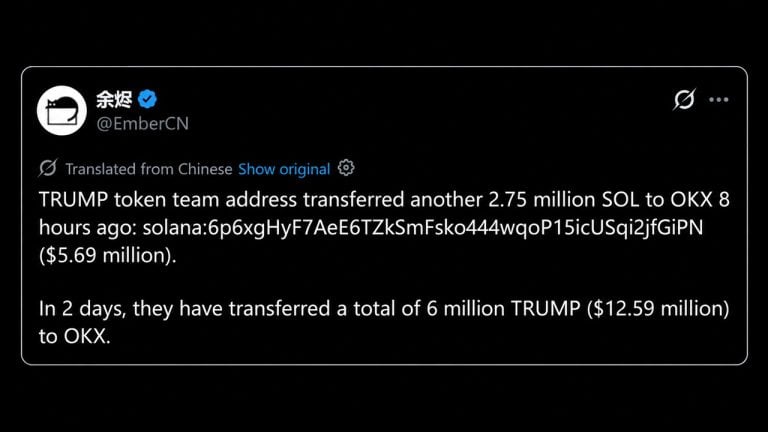
Trump Memecoin Team Sends 8.4M TRUMP to OKX as Bitcoin Price Nears $85K
Wallets tied to the Official Trump memecoin team have routed about 8.4 million TRUMP, worth roughly $18 million, into OKX deposit...
Bitcoin faces an October 18 test as Trump prepares new Russia tariffs
President Donald Trump’s new Russia sanctions law gives Bitcoin traders another macro deadline to watch: Oct. 18. On Sept. 18, Tru...
Why truly decentralized DeFi needs no legal exemption according to SEC Commissioner Hester Peirce
SEC Commissioner Hester Peirce drew a sharp line around decentralized finance on Sept. 17. She said investors need no exemption to...

FCA Targets Three London Premises In Illegal P2P Crypto Trading Crackdown
TL;DR The FCA, HMRC and Metropolitan Police inspected three London premises over suspected illegal crypto trading. Cease-and-desis...