Over 400 South Korean officials disclose $9.8M in crypto holdings
South Korea’s Ethics Commission revealed that high-ranking public officials in the country hold an average of 35.1 million won ($24,000) in crypto assets. On March 27, the country’s Ethics Commission for Government Offic...
Archive context
Older archive item. Useful for background and entity history, but not a fresh market-moving signal.

South Korea’s Ethics Commission revealed that high-ranking public officials in the country hold an average of 35.1 million won ($24,000) in crypto assets.
On March 27, the country’s Ethics Commission for Government Officials reportedly disclosed that more than 20% of the surveyed public officials hold 14.4 billion won ($9.8 million) in crypto. This means 411 of the 2,047 officials subjected to the country’s disclosure requirements hold crypto assets.
The highest amount disclosed was 1.76 billion won ($1.2 million) belonging to Seoul City Councilor Kim Hye-young.
The officials held different crypto assets, including Bitcoin (BTC), Ether (ETH), XRP (XRP), Dogecoin (DOGE), Luna Classic (LUNC) and others.
South Korean public officials disclosed crypto holdingsThe disclosure of public officials’ crypto assets follows calls for transparency from its prime minister.
In 2023, South Korean Prime Minister Han Deok-soo said in a news conference that high-ranking government officials must include crypto in their property disclosures. The official said crypto should be treated similarly to other assets like precious metals.
On May 25, 2023, South Korea passed a bill mandating public officials to include crypto in their public asset disclosures. The new system granted South Koreans access to the crypto holdings of at least 5,800 public officials starting in 2024.
In June 2024, crypto exchanges in the country launched information provision systems to simplify the registration of information about crypto holdings.
Related: South Korea temporarily lifts Upbit’s 3-month ban on serving new clients
Lawmaker controversy spurred crypto disclosure lawsThe new law was created in response to the controversy involving South Korean lawmaker Kim Nam-kuk, who was accused of liquidating crypto assets and concealing holdings of around $4.5 million before lawmakers in the country enforced the Financial Action Task Force’s (FATF) “Travel Rule.”
Kim departed from the Democratic Party at the height of the controversial lawsuit to relieve party members of the burden of the lawsuit.
While prosecutors requested a six-month prison sentence for Kim, the lawmaker was eventually acquitted after a judge ruled that crypto assets were not subject to public disclosures at the time Kim made the transactions.
Magazine: 3AC-related OX.FUN denies insolvency rumors, Bybit goes to war: Asia Express
Why this matters
This cryptocurrency story adds another data point to the current market tape and is useful when read alongside nearby source coverage.
Original source
Read on CointelegraphRelated market context

BitMine ETH Treasury Nears 6 Million Tokens As Total Holdings Reach $17.1B
TL;DR BitMine reported 5,983,940 ETH in its treasury, just short of 6 million tokens. The company valued its combined treasury hol...

Strategy Buys Another 950 Bitcoin As Holdings Reach 846,000 BTC
TL;DR Strategy bought 950 BTC during the week ending September 20 for $75.7 million. The purchases were made at an average price o...

GameStop may have surrendered $31 million of Bitcoin upside with one options trade
GameStop’s Bitcoin options strategy faces a key test Friday as the cryptocurrency trades well above its disclosed $70,000 call str...

Binance Becomes a Circle Shareholder in $100 Million Stock Sale Tied to USDC Deal
Circle sold 1,237,011 shares of its Class A common stock to Binance for $100 million and agreed to pay the exchange a recurring fe...
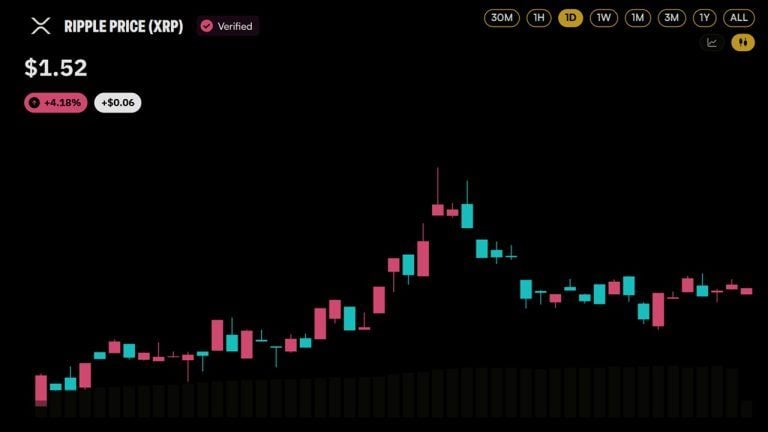
XRP Is Crushing Bitcoin on Korean Exchange Upbit: Here Are the Numbers
XRP drew $350M (about ₩481B) of trading volume on Upbit on Sept. 21, beating bitcoin’s $225.8M (₩308B), and it has out-traded bitc...

Stand With Crypto’s 4 million registered advocates couldn’t get the CLARITY Act through the Senate
The Senate fell short of advancing the CLARITY Act on Sept. 15, when a 49-50 cloture vote failed to reach the 60-vote threshold. S...