Sentient open-source AI search outperforms GPT-4o and Perplexity
Sentient, an artificial intelligence development platform backed by Peter Thiel’s Founders Fund, has released an open-source AI search framework that it says outperforms leading closed-source competitors.The company anno...
Archive context
Older archive item. Useful for background and entity history, but not a fresh market-moving signal.

Sentient, an artificial intelligence development platform backed by Peter Thiel’s Founders Fund, has released an open-source AI search framework that it says outperforms leading closed-source competitors.
The company announced the public release of Open Deep Search (ODS) on April 2, describing it as a high-performance, developer-friendly alternative to platforms like Perplexity AI and OpenAI’s GPT-4o.
Sentient’s ODS aims to empower developers with open-source “Loyal AI” models, which Sentient says preserve the original intent of their developers.
The firm’s fingerprinting technology allows developers to protect intellectual property while maintaining model openness — aiming to solve the biggest issue of open-source AI, the challenges of monetizing a model without centralization.
“AI should belong to the community, not controlled by closed-source corporations,” according to Himanshu Tyagi, co-founder of Sentient and professor at the Indian Institute of Science.
“We’re building, monetizing and delivering open-source AI with a key principle in mind: singularity in intelligence but plurality in use cases,” he added.
”Open-source development ensures performance and user control that closed systems simply cannot match.”Related: Crypto trader turns $2K PEPE into $43M, sells for $10M profit
Sentient’s ODS outperforms ChatGPT, PerplexitySentient’s ODS scored 75.3% accuracy on the “Frames” benchmark, which measures factuality, retrieval and reasoning capabilities, used to answer complex “multi-hop questions” that require the integration of multiple sources.
ODS surpassed OpenAI’s ChatGPT-4o Search Preview’s 50.5% and the Perplexity Sonar Reasoning Pro, which scored 44.4%.
To prevent potential bias, Sentient ensured that its researchers didn’t have access to the Frames testing sets during the benchmarking process.
Dobby NFT mint. Source: Sentient
“Independent verification is only needed for closed-source solutions because open-source solutions have no incentive to falsely report the evaluations,” Tyagi said, adding:
“Anyone with a computer can run our code, reproduce our results, and verify whether it is correct or not. The numbers reported can be reproduced using the repo's eval section by anyone and thus are globally verifiable.”The ODS release follows growing interest in Sentient’s platform. The firm said it amassed more than 1.8 million waitlist registrations in the lead-up to the launch.
Related: $1T stablecoin supply could drive next crypto rally — CoinFund’s Pakman
A turning point for open-source AIThe release of Sentient’s new open-source search framework comes amid a tipping point for open-source AI development.
“We’re witnessing a significant shift as open-source AI solutions increasingly challenge closed-source dominance,” Tyagi said.
“Examples such as DeepSeek’s advancements in reasoning, Manus’s innovations with agents, and now our own contributions to ODS with advanced AI search frameworks highlight this shift,” he added.
“Open-source models can easily outperform closed-source giants with the right architecture,” said Sewoong Oh, Sentient’s lead researcher and professor at the University of Washington. “The results of these benchmarks validate our mission to create an open ecosystem that benefits all AI builders and users.”
The launch also builds on Sentient’s earlier momentum. In February, the firm completed one of the largest NFT minting campaigns to date, with more than 650,000 participants gaining fractional ownership of its AI models.
Magazine: ‘Chernobyl’ needed to wake people to AI risks, Studio Ghibli memes: AI Eye
Why this matters
This cryptocurrency story adds another data point to the current market tape and is useful when read alongside nearby source coverage.
Original source
Read on CointelegraphRelated market context

Perplexity AI Predicts Weak XRP Price by 2027: Bull Run Canceled?
The Silicon Valley-based Perplexity AI predicts XRP could have a tame Q4, saying it believes the token will only hit $3.25 by Janu...

NOWPayments Releases Cross-Chain Payout Data Revealing Key Performance Benchmarks Across TRON, BNB Chain, and Solana
Tallinn, Estonia, September 21st, 2026, Chainwire NOWPayments today published new empirical data analyzing six months of enterpris...
A Bitcoin Lightning flaw could send a node’s entire balance straight to miners
A flaw in Bitcoin Lightning software Eclair could let malicious peers wipe out a node’s local channel balance through fees. ACINQ...

Researchers warn of Safari zero-day exploit targeting Apple iPhones and crypto wallets
The exploit highlights the critical need for enhanced security measures in mobile ecosystems, especially for safeguarding crypto a...
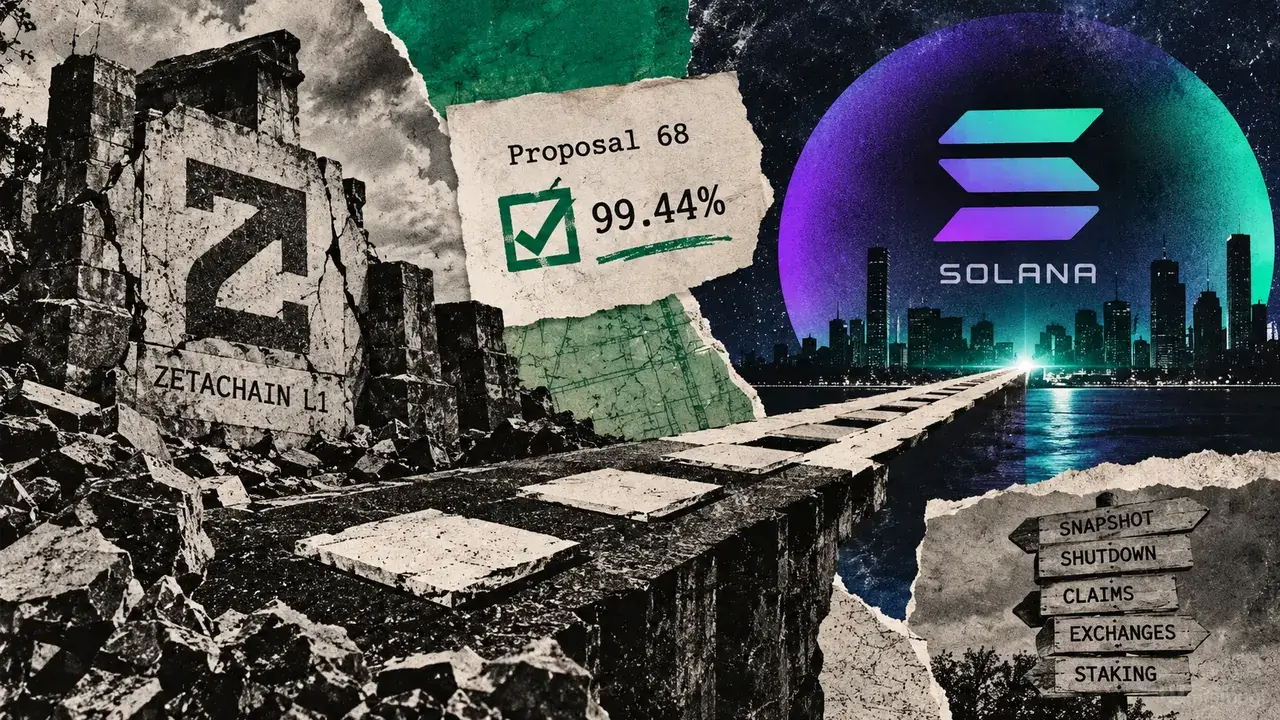
This blockchain just voted to shut itself down for a Solana-powered AI pivot
ZetaChain's on-chain governance has approved retiring the network’s standalone blockchain and moving ZETA to Solana as the project...

Kalshi Rejects Wash-Trading Claims After Analyst Flags Repeated $5,500 Ether Perp Trades
Kalshi is disputing allegations that trading volume in its crypto perpetual futures is inflated by handpicked market makers, or se...