Starknet Trading Debut Sees Initial Excitement Fade As STRK Plummets Over 50%
In a highly anticipated move, Starknet (STRK), an Ethereum (ETH) roll-up protocol, commenced trading on prominent cryptocurrency exchanges including Binance, Bybit, Bitfinex, and OKX on Tuesday. The token’s launch was ac...
Archive context
Older archive item. Useful for background and entity history, but not a fresh market-moving signal.

In a highly anticipated move, Starknet (STRK), an Ethereum (ETH) roll-up protocol, commenced trading on prominent cryptocurrency exchanges including Binance, Bybit, Bitfinex, and OKX on Tuesday.
The token’s launch was accompanied by an airdrop, distributing a staggering 728 million tokens to over one million addresses, making it one of the largest airdrops of the year. However, the initial excitement was dampened as the token experienced a significant retracement of 53.8%, plummeting to a current price of $2.04.
However, to better grasp the protocol’s capabilities and assess its potential future price actions, it is crucial to delve into the underlying technology and the buzz surrounding this player within the top 60 cryptocurrencies, boasting a substantial market capitalization of $1.4 billion.
Unveiling StarknetStarknet operates as a Layer 2 solution, offering scalability and Ethereum-level security by generating STARK proofs off-chain, which are relayed on-chain.
Developed by StarkWare Industries, a blockchain firm based in Israel, Starknet was specifically designed to address Ethereum’s scalability concerns. The protocol was fully launched in February 2022 as a permissionless Layer 2 network, allowing developers worldwide to build decentralized applications on its infrastructure.
StarkWare also developed another platform called StarkEx, which has been live since June 2020. However, StarkEx is a permissioned network tailored to specific decentralized app (Dapp) requirements.
Founded in 2018, StarkWare has garnered support from renowned investors such as Sequoia Capital, Paradigm, and Coatue, solidifying its position within the industry. In a Series D funding round held in May 2022, the company raised $100 million, valuing StarkWare at an impressive $8 billion.
StarkWare has raised $261 million in funding, demonstrating strong investor confidence in its vision and technology.
With that noted, a prominent decentralized finance (DeFi) researcher who goes by the pseudonym “DeFi Ignas” has identified three key catalysts that could fuel the long-term growth of Starknet.
STRK Airdrop And DeFi IncentivesThe researcher highlights Starknet’s utilization of STARKs, a cryptographic proof system, to validate transactions on the Ethereum network. In contrast to other zero-knowledge rollup solutions that employ SNARKs, STARKs offer quantum resilience and the potential for numerous scalability improvements.
In addition, DeFi Ignas believes that the use of the Cairo Development Language ensures that the protocol is resistant to “lazy copy-paste forks,” thereby increasing its “technical robustness.”
Ignas suggests that Starknet’s differentiators, such as “Quantum Resilience” and the comparison between SNARKs and STARKs, present an intriguing potential that is yet to be fully realized. By effectively communicating these distinctive features, Ignas suggests that Starknet can capture the imagination of the wider audience, generating increased interest and adoption.
Furthermore, Ignas identifies several factors that could contribute to the growth of the Starknet ecosystem. Firstly, the airdrop of STRK tokens is believed to create a “wealth effect,” attracting capital into the ecosystem.
Additionally, Starknet plans to allocate 50 million STRK tokens to incentivize DeFi protocols, which, in turn, will drive growth in Total Value Locked (TVL). Protocols operating on Starknet are expected to distribute new tokens to users through airdrops.
On top of that, the STRK token has a “robust” utility model for Ignas, serving as a means to pay gas fees, distribute voting power through delegates, and facilitate native staking for governance and security.
The initial staking Annual Percentage Yield (APY) is set at 12%, incentivizing users to stake their tokens rather than sell them. While some individuals expressed dissatisfaction with not receiving the airdrop, Ignas notes that 27% of survey respondents (3.4k people) received STRK tokens, indicating potential for growth within the Starknet ecosystem but not necessarily for the STRK token itself.
Featured image from Shutterstock, chart from TradingView.com
Why this matters
This cryptocurrency story adds another data point to the current market tape and is useful when read alongside nearby source coverage.
Original source
Read on NewsBTCRelated market context

Base vault drained of $6M in Aave deposit tokens after whitelist change
The incident highlights the critical need for robust security measures and governance protocols in DeFi to prevent unauthorized ac...
DeFi Development Corp Adds $3 Million in Solana as SOL Buys Slow
Nasdaq-listed DeFi Development Corp's latest SEC filing shows its Solana stash grew 1%, to about 2.56 million SOL and SOL equivale...

Could Polymarket reveal a crypto token at Token2049?
Polymarket CEO Shayne Coplan has fuelled rumors that the prediction market is about to launch its own token after teasing he may h...

Flying Tulip’s NFT Options Market Tops $5 Million in Volume, Cronje Says
Buying an ftPUT NFT transfers its remaining FT tokens and redemption rights, while spot FT purchases carry no such protection.......
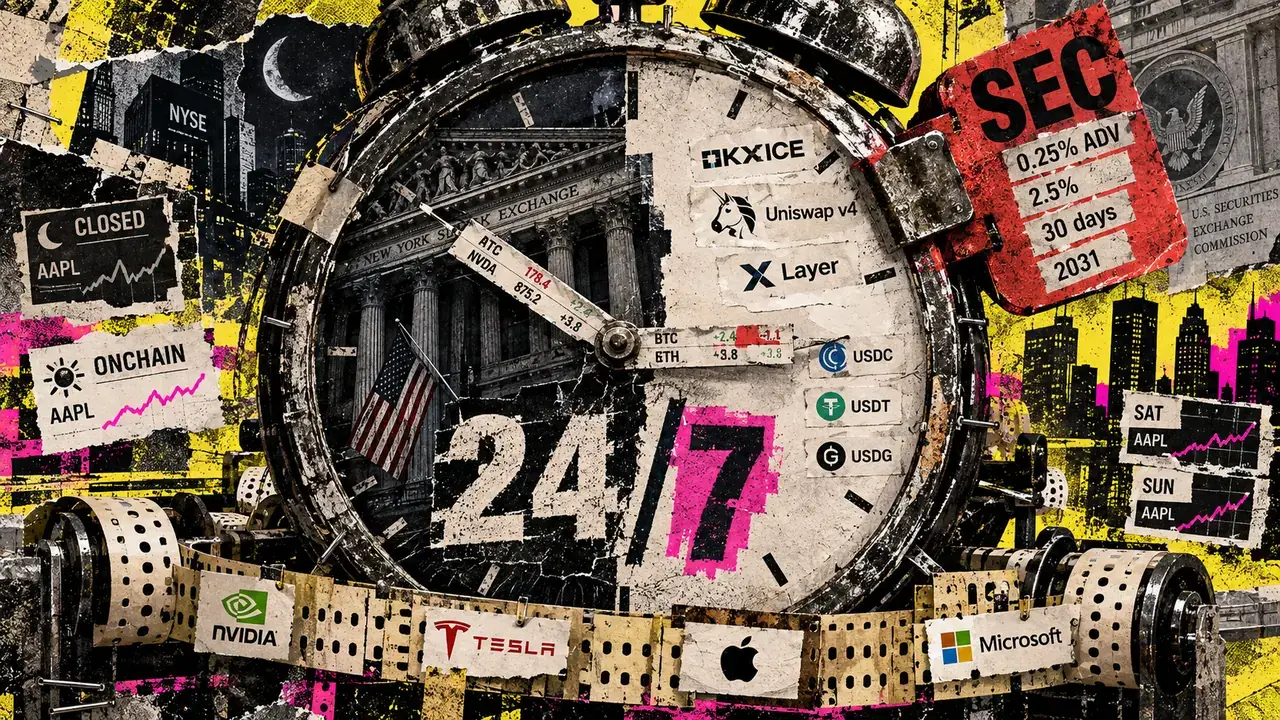
NYSE owner and OKX plan 24/7 tokenized stock trading using Uniswap
Intercontinental Exchange and OKX are preparing an always-open market where tokenized US stocks could keep repricing after Wall St...

Polymarket unveils Protocol V2, with full switchover for new markets on Nov 2
Polymarket's Protocol V2 enhances flexibility and efficiency, potentially reshaping market dynamics and developer engagement in pr...