The Akash Network Phenomenon: Breaking Down Its 2400% Uptrend And Market Outperformance
Decentralized and open-source computing platform Akash Network has captured significant attention in the cryptocurrency market as its native token, AKT, has outperformed the top 100 cryptocurrencies with a 2400% price in...
Archive context
Older archive item. Useful for background and entity history, but not a fresh market-moving signal.

Decentralized and open-source computing platform Akash Network has captured significant attention in the cryptocurrency market as its native token, AKT, has outperformed the top 100 cryptocurrencies with a 2400% price increase year-to-date.
While Bitcoin (BTC) and other major cryptocurrencies experience price corrections, the Akash Network and its native token are surging at a remarkable pace. To comprehend the driving factors behind this uptrend, it is crucial to delve deeper into what the Akash Network represents and its underlying technology.
What Is The Akash Network?The Akash Network, founded in March 2018 by Overclock Labs, emerged as a distributed cloud computing marketplace with the objective of decentralizing cloud computing. Originally focused on building a traditional multi-cloud deployment platform, Overclock Labs decided to launch Akash.
According to Messari, the network facilitates the connection between server owners in need of computing power to host applications and users offering cloud computing resources through the Akash Marketplace, where computing resources are bought and sold.
At the core of the Akash Network lies its blockchain infrastructure known as Akash, built using the Cosmos SDK and based on the Tendermint consensus mechanism.
Since the launch of Akash Mainnet in September 2020, the network has undergone notable upgrades to increase its functionality. These upgrades include the introduction of the Akash Marketplace, flexible bid pricing, Inter-Blockchain Communication (IBC) compatibility, deployment tools for improved user experience, audited attributes, and Tendermint’s State Sync.
Subsequent upgrades introduced features such as persistent storage, authorized spending, an inflation decay curve, fractional uAKT to eliminate minimum cost deployment, IP leases, provider service splits, Cosmos IBC3 update, and Interchain Accounts (ICA).
Messari points out that the most recent upgrades have positioned Akash as a prominent player in the cloud computing and artificial intelligence (AI) development space. Mainnet 6 introduced support for GPUs and stable payments, establishing Akash as an open-source marketplace for high-density GPUs and a distributed cloud for large language models (LLM).
In conjunction with this upgrade, Overclock Labs launched Akash ML, a cloud infrastructure that offers AI developers GPU spot instances, with plans to provide on-demand access in the future.
Subsequent upgrades focused on enforcing minimum validator commissions, improving GPU visibility, and ensuring validated bids on multi-service deployments.
AKT Token Breaks Key TrendlineIn terms of price action, the Akash Network’s native token, AKT, has recently demonstrated a notable breakthrough. Over the past 24 hours, AKT has experienced a significant surge of 15.63%, propelling its trading value to $5.64.
One key indicator of this positive development is the token’s ability to surpass a diagonal trendline in the 4-hour timeframe. Breaking this trendline suggests a potential reversal of the previous downward trajectory and opens up the possibility of further bullish market sentiment for AKT.
Moving forward, the focus for AKT is to sustain the previous week’s high of $5.095 as a crucial level of support. By maintaining this level, the token aims to consolidate its recent gains and solidify its position in the market.
In summary, the price increase of AKT can be attributed to several factors. The success of the Akash Network’s underlying technology and its value proposition in the decentralized cloud computing space contribute to the positive sentiment surrounding the token. As the network gains recognition and attracts users, demand for AKT may increase, resulting in upward pressure on the price.
In addition, the successful break of the diagonal trend line represents a potential shift in market dynamics as investors may take this as a bullish signal, leading to increased buying activity and further price appreciation.
Featured image from Shutterstock, chart from TradingView.com
Why this matters
This cryptocurrency story adds another data point to the current market tape and is useful when read alongside nearby source coverage.
Original source
Read on NewsBTCRelated market context

Tokenized Stocks, Investor Rights, and Their Crypto Role
Tokenized stocks could give crypto-native investors access to equity exposure through crypto platforms, but a token that tracks a...

Polymath And CineCity Explore Regulated Tokenized Film Investment Platform
TL;DR Polymath and Chicago-based CineCity Studios are exploring a platform for financing independent film through regulated digita...
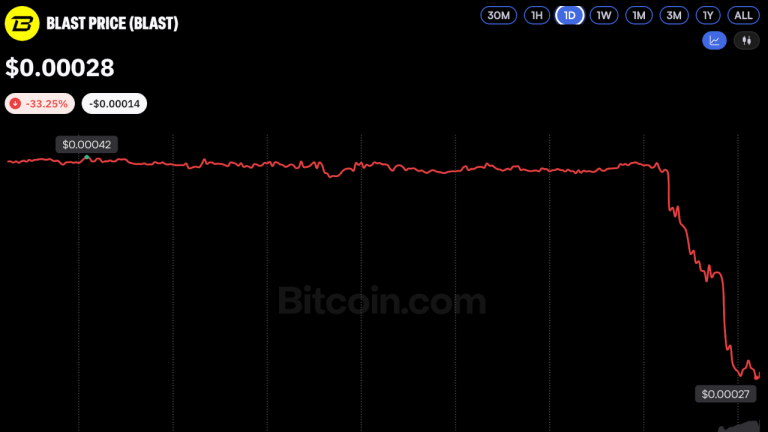
Ethereum Layer 2 Network Blast to Shut Down After Revenue Collapse
Blast, a once-buzzy Ethereum Layer 2 network, is set to shut down later this month after a dramatic decline in activity left the s...

US targets $17 billion Russia-linked crypto payment network using USDT as an escape route
The US sanctioned the Russia-linked A7 Network and proposed new restrictions to cut its crypto intermediaries off from global mark...

Chainlink And Swift Demo Automated Tokenized-Equity Dividends Across Four Blockchains
TL;DR Chainlink built a Swift Hackathon solution that automated a cash-dividend workflow for tokenized equities across four blockc...

OpenWorld Begins Nasdaq Trading As VerifyMe Deal Creates Public Tokenization Company
TL;DR OpenWorld and VerifyMe have completed their business combination, with the combined company trading on Nasdaq under OPNW fro...