A New Academic Paper Describes 3 Attack Methods Against an Ethereum PoS Chain
Following the Altair upgrade on the Ethereum network, the protocol’s native cryptocurrency reached a new all-time price high. Altair is the next step for the Ethereum’s network’s proof-of-stake (PoS) transition. However,...
Archive context
Older archive item. Useful for background and entity history, but not a fresh market-moving signal.

Following the Altair upgrade on the Ethereum network, the protocol’s native cryptocurrency reached a new all-time price high. Altair is the next step for the Ethereum’s network’s proof-of-stake (PoS) transition. However, a recently submitted white paper explains that a group of computer scientists from Stanford University and the Ethereum Foundation believe there are three attack vectors “on [a] proof-of-stake Ethereum” blockchain.
The 3 Attacks Against Ethereum Thesis Aims to Describe a Proof-of-Stake Problem Based on Evidence
The Ethereum network currently has a proof-of-work (PoW) consensus mechanism and in time, the protocol plans to fully transition into a proof-of-stake (PoS) network. Recent upgrades like Berlin, London, and Altair have been applied to help smooth the transition toward the PoS goal. Just recently, after Altair was implemented, the price per ether skyrocketed toward a new all-time high (ATH) at $4,467 per unit.
At the same time, network transfer fees have also swelled significantly as high as $50 for the average ether transaction on Saturday morning. Furthermore, on Saturday morning in the U.S. vertical trends from Twitter indicate the term “ETH 2.0” started trending. Some of the individuals discussing the ETH 2.0 upgrade have shared a new white paper written by computer scientists from Stanford University and the Ethereum Foundation.
The BTC proponent Tuur Demeester shared the paper on Saturday and two quotes from the paper that theorize how an adversary can attack the chain. The paper called “Three Attacks on Proof-of-Stake Ethereum” was submitted on October 19.
Quotes from ETH 2.0 attacks paper, via @KyleLogiks:
“With 99.6% probability an adversary with .09% stake can execute a 1-record for any given day”
“Under adversarial network delay, an adversary can perform a 10-reorg by merely controlling 19 validators”https://t.co/HGazdB0acV pic.twitter.com/MsZoyUGdev
— Tuur Demeester (@TuurDemeester) October 30, 2021
The white paper was authored by Caspar Schwarz-Schilling, Joachim Neu, Barnabé Monnot, Aditya Asgaonkar, Ertem Nusret Tas, and David Tse. Essentially, the white paper reveals that two Ethereum network attacks were presented in recent times and the paper’s authors refined the techniques.
In addition to the refinement of the first two which theoretically create “short-range reorganizations” and an “adversarial network delay,” the computer scientists came up with a third attack.
“Combining techniques from both refined attacks, we obtain a third attack which allows an adversary with vanishingly small fraction of stake and no control over network message propagation (assuming instead probabilistic message propagation) to cause even long-range consensus chain reorganizations,” the paper’s authors note. The three attacks to ETH PoS paper adds:
Honest-but-rational or ideologically motivated validators could use this attack to increase their profits or stall the protocol, threatening incentive alignment and security of PoS Ethereum. The attack can also lead to destabilization of consensus from congestion in vote processing.
Meanwhile, Ethereum network critics used the paper to highlight the possible vulnerabilities associated with these attacks when the network transitions to a full PoS system. The founder of the Chia project and the creator of Bittorrent, Bram Cohen, also tweeted about the new study on Saturday.
Some issues with ETH2 consensus "we obtain a third attack which allows an adversary with vanishingly small fraction of stake to cause even long-range consensus chain reorganizations" https://t.co/Vz3KG3ai1W
— Bram Cohen🌱 (@bramcohen) October 30, 2021
A Chia proponent responded and told Cohen: “Let’s revisit your tweet in a year and see what Chia has accomplished vs ETH. Please consider your attitude is turning away community members like myself.” The Ethereum attacks paper does provide a possible method of attacks against an Ethereum PoS chain, but also offers solutions. The paper’s authors believe the attacks provide incentives to malicious actors.
“Our attacks also enable apriori malign actors, perhaps ideologically motivated, to delay and in some cases outright stall consensus decisions,” the paper’s authors conclude. “The refined attack of Section 4.2 gives the adversary a tool to do just that, even if the adversary cannot control message propagation delays (which instead are assumed to be probabilistic).”
What do you think about the recently published paper on three attacks against an Ethereum PoS system? Let us know what you think about this subject in the comments section below.
Why this matters
This ethereum story adds another data point to the current market tape and is useful when read alongside nearby source coverage.
Original source
Read on Bitcoin NewsRelated market context
Solayer Pay Adds Five Blockchain Networks For Direct Stablecoin Card Deposits
TL;DR: Solayer Pay says its card app now accepts supported stablecoin deposits from Solana, Ethereum, Arbitrum, BNB Chain and Base...

China targets national blockchain network completion by 2030
China's blockchain network plan could enhance digital integration, boost economic activities, and strengthen cybersecurity by 2030...

Austin Griffith Demonstrates How Fast Bots Can Drain Weak Ethereum Keys
Austin Griffith of the Ethereum Foundation put about $1 in an Ethereum wallet whose private key was the number 6969, and bots went...

Ethereum Delays Glamsterdam Test On Hoodi Over Smart Contract Compatibility Questions
TL;DR: Ethereum developers have removed the planned October 26 Glamsterdam activation on Hoodi while they investigate EIP-8037 int...
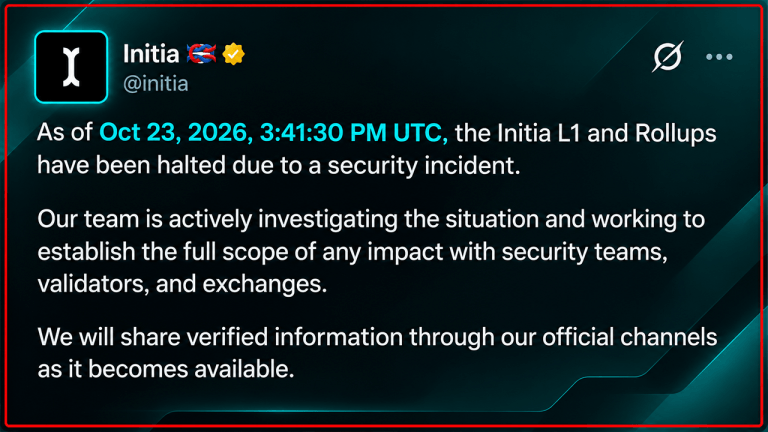
Hacker Prints $2.7M in Crypto as Initia Blockchain Grinds to a Halt
Modular blockchain platform Initia halted its network Friday after the team confirmed “a security incident” that compromised its o...

Initia halts blockchain after exploit reportedly drains over $2.6M
The blockchain suspended its layer-1 network and rollups after security researchers identified unauthorized token minting and mill...