Coinbase’s Ethereum staking dominance risks overcentralization: Execs
Coinbase’s emergence as the Ethereum network’s largest node operator raises concerns about network centralization that could worsen as institutional adoption accelerates, industry executives told Cointelegraph. On March...
Archive context
Older archive item. Useful for background and entity history, but not a fresh market-moving signal.

Coinbase’s emergence as the Ethereum network’s largest node operator raises concerns about network centralization that could worsen as institutional adoption accelerates, industry executives told Cointelegraph.
On March 19, Coinbase published a report disclosing that the US cryptocurrency exchange controlled more than 11% of staked Ether (ETH), more than any other Ethereum node operator.
According to Karan Sirdesai, CEO of Web3 startup Mira Network, Coinbase’s growing dominance highlights “a systemic issue in Ethereum’s staking architecture.”
“We’re creating a system where a handful of major players control an outsized portion of network security, undermining the core promise of decentralization,” Sirdesai told Cointelegraph.
According to the report, Coinbase controlled 3.84 million ETH staked to 120,000 validators, representing 11.42% of staked Ether as of March 4.
Liquid staking protocol Lido controls a larger share of staked Ether overall — approximately 9.4 million ETH, according to Lido’s website.
However, Lido’s staked Ether is distributed across dozens of independent node operators, Anthony Sassano, host of The Daily Gwei, said in a March 19 post on the X platform.
To limit risks, Coinbase spreads staking operations across five countries and employs multiple cloud providers, Ethereum clients, and relays, according to its report. “Diversification at the network level and the overall health of the network is always a priority for us. That’s why we periodically check network distribution," the exchange said.
Coinbase is the largest Ethereum node operator. Source: Coinbase
Related: Ether ETFs poised to surge in 2025, analysts say
Impending centralization risksEthereum’s network concentration could worsen if US exchange-traded funds (ETFs) are permitted to begin staking — a priority for asset managers such as BlackRock.
Coinbase is the largest custodian for US crypto ETFs and holds ETH on behalf of eight of the nine US spot Ether funds, the exchange said in January.
“This type of network consolidation brings with it increased risk of censorship and reduced network resilience,” Temujin Louie, CEO of Wanchain, a blockchain interoperability protocol, told Cointelegraph.
For instance, high staking concentrations “represent potential points of regulatory pressure… [and] these large staking entities will likely prioritize regulatory adherence over network censorship resistance when faced with difficult choices,” Sirdesai said.
Meanwhile, new US regulatory guidance allowing banks to act as validators for blockchain networks adds to centralization risks, several crypto executives said.
“If too much stake consolidates under regulated entities like Coinbase and US banks, Ethereum will become more like traditional financial systems,” Louie said.
Conversely, more institutional validators could actually improve staking concentrations. Cryptocurrency exchange Robinhood is especially well positioned to check Coinbase’s staking dominance, according to Sirdesai.
Robinhood already has “the crypto infrastructure, user base, and technical capabilities to move into staking rapidly. They could realistically challenge Coinbase’s position faster than any traditional bank,” Sirdesai said.
Magazine: Ethereum L2s will be interoperable ‘within months’ — Complete guide
Why this matters
This ethereum story adds another data point to the current market tape and is useful when read alongside nearby source coverage.
Original source
Read on CointelegraphRelated market context

Ethereum Dancing on Two Fronts as Quantum Upgrade Advances and Treasury Leverage Bites
Ethereum developers want to upgrade the network to be quantum-ready by 2027, potentially accelerating one of its biggest security...

Ethereum faces temporary issues due to cloud provider malfunction
Cloud dependency highlights Ethereum's vulnerability, urging diversification to ensure network resilience and uninterrupted user a...

Ethereum and Layer 1s Explained
Ethereum 101 explains how Ethereum made blockchains programmable. It covers smart contracts, accounts and the EVM, ETH and gas fee...
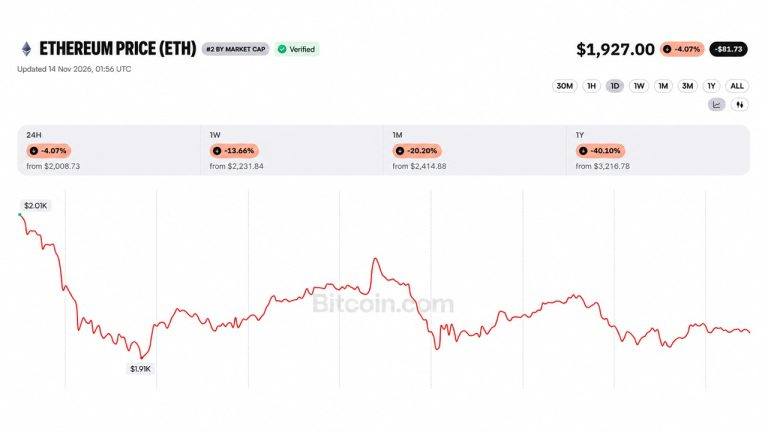
Ether Price Dips Below $2K as Ethereum Foundation Dumps 5000 ETH in 5 Day
A wallet linked to the Ethereum Foundation sold another 1,000 ETH on Saturday, taking its five-day total to 5,000 ETH, or about $9...

Baillie Gifford adopts Ethereum as legal register for UK funds
Baillie Gifford's use of Ethereum as a legal register for UK funds signals a shift towards blockchain as a mainstream financial in...

Arca’s Jeff Dorman Calls Vitalik Buterin’s ETH Store-of-Value Pitch ‘Really Misguided’
Jeff Dorman said on Unchained that Ethereum co-founder Vitalik Buterin‘s case for ETH as a store of value is “really misguided.” D...