Ethereum Just Got Its MicroStrategy—Tom Lee Bets On Soaring ETH Price
Nearly three years after the Merge formally switched Ethereum to proof-of-stake on 15 September 2022, a publicly listed Bitcoin miner is adopting the network’s native token as its primary treasury asset. BitMine Immersio...
Archive context
Older archive item. Useful for background and entity history, but not a fresh market-moving signal.

Nearly three years after the Merge formally switched Ethereum to proof-of-stake on 15 September 2022, a publicly listed Bitcoin miner is adopting the network’s native token as its primary treasury asset. BitMine Immersion Technologies (NYSE American: BMNR) on 30 June priced a $250 million private placement of 55,555,556 new shares at $4.50 each and appointed Fundstrat co-founder Tom Lee as chairman. The company’s SEC filing and press release make the purpose explicit: all net proceeds will be used to acquire and stake ether, a move management likens to Michael Saylor’s now-legendary Bitcoin strategy at MicroStrategy.
Tom Lee Goes Full MicroStrategy On EthereumSpeaking hours later on CNBC’s Squawk Box, Lee framed the pivot as a logical response to the explosive growth of stablecoins, most of which settle on Ethereum. “Stablecoins, which is the ChatGPT of crypto, because it’s viral adoption by consumers, businesses, banks and now even Visa,” he said, underscoring why a treasury heavy in ETH could become strategically indispensable. Ethereum’s proof-of-stake design means that large holders who validate blocks “secure the fidelity of stablecoins,” Lee continued. “When Goldman issues a stablecoin and JP Morgan [issues] it on Ethereum as a layer-one blockchain, they’re going to want to secure it by staking Ethereum.”
Lee tied the long-term upside to macro numbers the US Treasury itself has started to cite. Stablecoins today hover around $250 billion; Treasury Secretary Scott Bessent recently suggested the figure could hit $2 trillion—a potential ten-fold expansion that, in Lee’s words, would “insure dollar dominance.” Because Ethereum already underpins more than half of stable-value tokens, a multi-trillion-dollar stablecoin market would translate directly into rising transaction fees for the network and, by extension, higher staking rewards for BitMine’s planned validator clusters.
The private-placement syndicate reads like a who’s-who roster from both TradFi and crypto: MOZAYYX led the round, joined by Founders Fund, Pantera, FalconX, Republic Digital, Kraken, Galaxy Digital, Digital Currency Group, Diametric Capital and Occam Crest. Closing is expected on or about 3 July, subject to NYSE American approval. BitMine, headquartered in Las Vegas, will immediately deploy the ETH position into staking, giving the miner a yield-bearing balance-sheet asset while reinforcing Ethereum’s security budget. “One of the key performance metrics for BitMine going forward is to increase the value of ETH held per share,” chief executive Jonathan Bates said in the statement.
For investors, the comparison with MicroStrategy is unavoidable but imperfect. Saylor’s company amassed bitcoin under a proof-of-work regime that offers no native yield; BitMine’s ether can generate income through both staking rewards and potential capital-markets transactions collateralized by those staked coins.
Yet both strategies share a central bet: that a scarce digital asset sitting at the core of global finance will appreciate faster than cash alternatives on a corporate balance sheet. Whether BitMine achieves MicroStrategy-level returns will depend on execution, regulatory clarity for staking, and—most of all—Ethereum’s price path. What is clear, however, is that corporate treasuries are beginning to see ether not merely as “gas” for decentralized applications but as a strategic reserve asset in its own right.
From a market-structure vantage, the new treasury model could translate into meaningful price torque for Ether if it scales. MicroStrategy’s serial purchases have now absorbed nearly 600,000 BTC—around 2.8 percent of the 21 million-coin cap—and coincided with Bitcoin’s ascent from roughly $11,000 in August 2020, when the company made its first buy, to more than $107,000 today, a near-ten-fold move.
BitMine’s opening salvo—$250 million, or about 100,000 ETH at current prices—represents barely 0.08 percent of Ethereum’s 122 million-coin supply, yet roughly 28 percent of that supply is already locked in staking contracts while net issuance has turned negative post-EIP-1559, shrinking the freely tradable float. If even a handful of additional balance sheets emulate this “ETH-as-reserve” playbook, the resulting demand shock could replicate the supply-squeeze dynamics that propelled Bitcoin into six-figure territory.
At press time, Ether traded at $2,459.
Why this matters
This ethereum story adds another data point to the current market tape and is useful when read alongside nearby source coverage.
Original source
Read on NewsBTCRelated market context

Strive CEO Matt Cole Declares Bitcoin ‘Will Go to the Moon’ as Digital Assets Reclaim $3 Trillion
Strive CEO Matt Cole says Bitcoin will go to the moon, backing a 50% CAGR to $400K-$500K by 2030 as digital assets reclaim $3 tril...

Solana flips Ethereum in fees, while ETH holds the burn lead
Solana generated more user fees than Ethereum in data provider DefiLlama's Sept. 22 dashboard snapshot, while Ethereum burned more...

ETH USD Loses Ground as Ethereum Price Analysis Remains Targeting $3,000 This Week
Ethereum Price Prediction, September 23: Ethereum (ETH) trades at $2,735, down a marginal 0.61% over the past 24 hours, a pause, n...

Ethereum ETFs Pull In $270M As BlackRock Leads September 21 Rebound
TL;DR US spot Ethereum ETFs recorded $270.0 million of net inflows for the September 21 session. BlackRock’s ETHA led the day with...

NYSE and Blockchain.com Working Together To List Tokenized Stocks
Bitcoin Magazine NYSE and Blockchain.com Working Together To List Tokenized Stocks The New York Stock Exchange and crypto exchang...
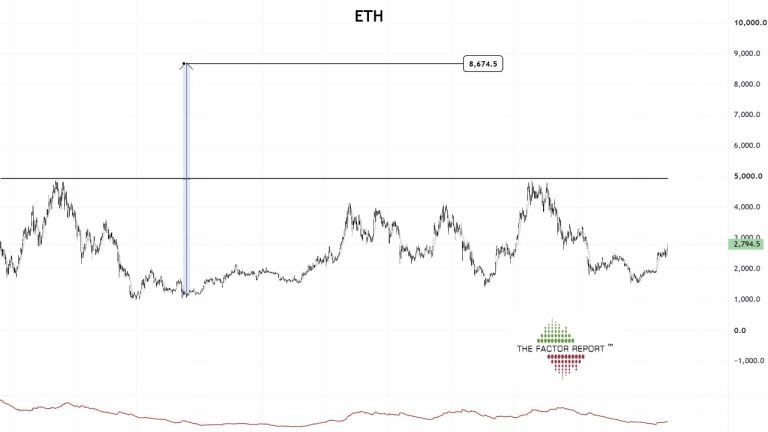
Peter Brandt Sees Ethereum at $8,600 if ETH Clears $5,000
Ethereum could eventually reach $8,600 if it first clears $5,000, according to a long-term chart posted by veteran trader Peter Br...