Ethereum Outflows Hit Spot Exchanges Again: Bullish Signal Or Neutral Flows?
Ethereum had a relatively quiet weekend, with price action showing signs of stability after last week’s volatility. ETH has reclaimed the $4,100 level, and analysts now point to the $4,000 mark as a crucial line of defen...
Archive context
Older archive item. Useful for background and entity history, but not a fresh market-moving signal.

Ethereum had a relatively quiet weekend, with price action showing signs of stability after last week’s volatility. ETH has reclaimed the $4,100 level, and analysts now point to the $4,000 mark as a crucial line of defense. If bulls manage to hold above this support, the market could see a strong surge in the coming days, setting the stage for Ethereum to retest higher levels.
Adding weight to this outlook, a key report by CryptoQuant highlights that Ethereum supply on spot exchanges continues to decline. This trend often signals that investors are withdrawing ETH to self-custody or staking, reducing available sell-side liquidity on exchanges. Historically, such declines in exchange reserves have paved the way for rallies, as demand eventually absorbs the reduced supply.
However, while the data is supportive, analysts caution that the real catalyst remains demand. Without strong inflows of new buyers, supply-side reductions alone may not be enough to push ETH significantly higher. The coming days will therefore be critical, with Ethereum’s ability to hold above $4,000 serving as a key indicator of whether the next leg of the rally is ready to unfold.
Ethereum Outflows Point to Long-Term Bullish SetupAccording to the CryptoQuant report, recent Ethereum outflows from spot exchanges are largely tied to new buys, where investors purchase ETH and immediately move it into self-custody or staking. This behavior reduces sell-side liquidity and, over time, can create the foundation for price appreciation.
Looking at past cycles, clear patterns emerge:
Network Congestion & UNI Airdrops: During this phase, high gas fees and strong macro tailwinds fueled demand. Outflows accelerated, leading to a robust bull run as liquidity tightened.
Late Bear Phase & FTX Collapse: At the peak of quantitative tightening (QT), the FTX crisis sparked a bank run, with older coins leaving exchanges. Despite fear, improving macro conditions soon restored demand, driving ETH higher.
We see the same trend today: reserves are falling, yet prices remain flat as selling offsets new buying. Historically, once demand strengthens, these periods lead to rallies.
Importantly, this is not a supply shock in the strict financial sense. Instead, it reflects reduced exchange reserves and lower sell-side pressure. The question is whether demand will accelerate. If rate cuts, slower QT, and rising global liquidity continue, ETH could be primed for a strong long-term move.
In the meantime, price volatility is expected. If ETH dips below the accumulating whales’ realized price, it may offer a buying opportunity, just as it has in past cycles. This dynamic shows investor trust in Ethereum and reinforces the view that falling reserves prepare the ground for the next rally.
Price Action Details: Relief Rally Or Recovery?Ethereum (ETH) is attempting to stabilize after its sharp drop below the $4,000 level, with the latest chart showing a modest recovery to around $4,131. The bounce comes after ETH briefly tested lows near $3,900, suggesting that buyers are stepping in to defend this critical support area.
On the 8-hour chart, ETH has reclaimed the 200-day EMA (red line), which is now acting as a short-term pivot point. However, the 50-day (blue) and 100-day (green) moving averages remain above the current price, creating overhead resistance between $4,250 and $4,400. A clean break and consolidation above these levels will be necessary for bulls to regain momentum and target higher ranges toward $4,600.
For now, ETH’s structure is fragile. The recent rejection from $4,600 and the subsequent breakdown highlight the intensity of selling pressure. Still, the rebound from sub-$4,000 levels signals that demand remains strong, particularly from accumulation wallets and whales, which have been absorbing supply.
If ETH holds above $4,000 and pushes through $4,250, the market could enter a recovery phase. Conversely, failure to maintain this rebound may expose ETH to a retest of $3,800 or even lower support zones. The coming sessions will be critical in defining ETH’s short-term trend.
Featured image from Dall-E, chart from TradingView
Why this matters
This ethereum story adds another data point to the current market tape and is useful when read alongside nearby source coverage.
Original source
Read on NewsBTCRelated market context

Massive ETF capital exits threaten Bitcoin’s fragile $86,000 price surge
Bitcoin’s 11.65% weekly rebound now carries evidence of genuine spot and on-chain participation, widening a move that began with h...

Beefy launches automated concentrated liquidity managers on Ethereum mainnet
Beefy's automated liquidity management on Ethereum could enhance capital efficiency and user convenience, impacting DeFi's trading...

Contrarian Crypto Analyst Who Predicted 2026 Perfectly Calls for Caution and Q4 Crash
Bitcoin pushing back toward $86,000 has many retail traders convinced the bear market is dead and the bulls are back in full contr...

Narrowing price cushions leave Bitcoin loans vulnerable to 4.7% price dips as Aave weighs higher leverage
Aave governance has advanced a proposal that would give Bitcoin-backed borrowers materially more leverage while leaving less room...
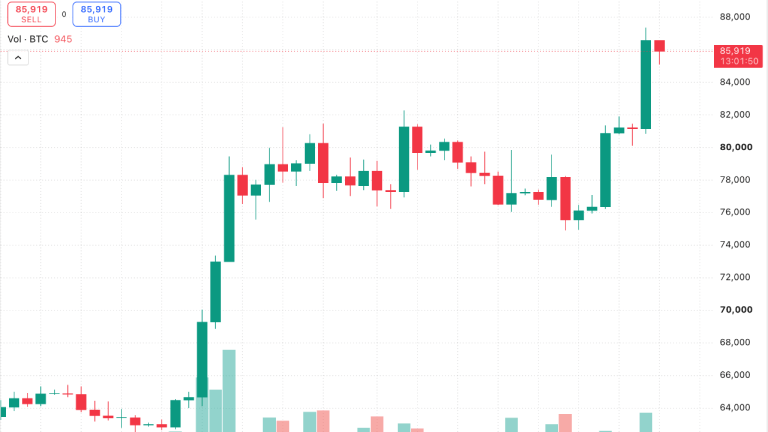
Bitcoin Price Tests $86K as 1.07M BTC Supply Wall Looms
Bitcoin has climbed into the $86K resistance zone, one of the market’s most important technical and onchain barriers. With 1.07 mi...

Moscow Exchange launches 5 crypto perpetual futures as demand tops 600 billion rubles
Moscow Exchange will launch perpetual futures tied to five major cryptocurrencies on Sept. 22, giving qualified investors continuo...