Bitcoin hashrate tops 1 Zetahash in historic first, trackers show
The Bitcoin network hashrate has topped 1 Zetahash per second (ZH/s) for the first time in Bitcoin’s 16-year history, according to several blockchain data sources.Bitcoin’s hashrate crossed the milestone on April 5 at a...
Archive context
Older archive item. Useful for background and entity history, but not a fresh market-moving signal.

The Bitcoin network hashrate has topped 1 Zetahash per second (ZH/s) for the first time in Bitcoin’s 16-year history, according to several blockchain data sources.
Bitcoin’s hashrate crossed the milestone on April 5 at a peak of 1.025 ZH/s, according to mempool.space data, while BTC Frame data said it hit 1.02 ZH/s a day earlier.
Data from Coinwarz says that Bitcoin hashrate soared to as high as 1.1 ZH/s on April 4 at block height 890,915 — however, the same data indicates that Bitcoin first crossed 1 ZH/s on March 24.
Bitcoin’s hashrate has fallen back below 0.95 ZH/s on April 7 since reaching 1 ZH/s. Source: BTC Frame
Discrepancy in Bitcoin hashrate trackersThe differences result from the varying approaches used to calculate hashrate — such as when block times and difficulty adjustments are measured, which Bitcoin nodes and miner pools are used to pull data from and more.
Bitcoin cypherpunk Jameson Lopp also previously pointed out that estimating Bitcoin’s hashrate with one “trailing block” as opposed to five can result in a difference of over 0.04 ZH/s.
“Viewing the raw Hashrate metric can be deceiving due to random variations in block times,” added Blockware Solutions head analyst Mitchell Askew, who pointed out that Bitcoin’s 30-day moving average hashrate is still around 0.845 ZH/s mark in a note to Cointelegraph.
Notching 1 ZH/s is a massive network achievementDespite the discrepancies, the feat highlights the massive amount of computational power and increasing decentralization of the Bitcoin network, making it more secure than ever and significantly reducing the likelihood of a 51% attack.
The Bitcoin network’s reported rise to 1 ZH/s — equivalent to 1,000 Exahashes per second — marks a 1,000x increase since late January 2016, when Bitcoin first hit 1 EH/s for the first time.
The second-largest proof-of-work crypto network, Litecoin, currently boasts a hashrate of 2.49 Petahashes per second according to Coinwarz — making it around 40,000 times less computationally powerful than Bitcoin.
Source: Pierre Rochard
Askew noted that the huge rise in hashrate has coincided with more commercial Bitcoin mining firms competing to solve Bitcoin blocks in recent years.
“Miners are doubling down: expanding sites and plugging in more efficient machines,” Askew said, adding that less efficient miners could soon be washed out unless Bitcoin’s (BTC) price rallies again in the coming months.
MARA Holdings is the largest Bitcoin miner with more than 50 EH/s of compute power, while the largest share of hashrate is channeled to Bitcoin mining pools Foundry USA Pool and AntPool, according to the Hashrate Index.
Related: Bitcoin price drops below $80K as stocks face 1987 Black Monday rerun
At least 24 publicly listed Bitcoin companies have machines set up to mine Bitcoin, according to CompaniesMarketCap.com.
Among the other large miners contributing hashrate are Riot Platforms, Core Scientific, CleanSpark, Hut 8 Mining and TeraWulf.
Bitcoin’s hashrate soars as BTC plummets on recession fearsThe new all-time high in Bitcoin hashrate came in the middle of a sharp market downturn — with Bitcoin (BTC) falling nearly 10% over the last four days to $78,750, while US stocks saw an estimated $6.6 trillion loss on April 3 and 4 — the largest two-day loss ever.
Much of the fall has been attributed to US President Donald Trump’s tariff plans, which many industry analysts say are sparking recession fears.
Magazine: Financial nihilism in crypto is over — It’s time to dream big again
Why this matters
This mining story adds another data point to the current market tape and is useful when read alongside nearby source coverage.
Original source
Read on CointelegraphRelated market context
Bitcoin Hashrate Reclaims One Zettahash As Mining Competition Rebounds
TL;DR: BlocksBridge reported Bitcoin’s seven-day hashrate above one zettahash in the week to October 22. Mining competition has re...
Solayer Pay Adds Five Blockchain Networks For Direct Stablecoin Card Deposits
TL;DR: Solayer Pay says its card app now accepts supported stablecoin deposits from Solana, Ethereum, Arbitrum, BNB Chain and Base...
Tether Wins Mining Industry Support For Its Open Automation Toolkit
Tether is trying to make Bitcoin mining equipment easier to operate as one system. Its October 24 announcement brings 15 industry...
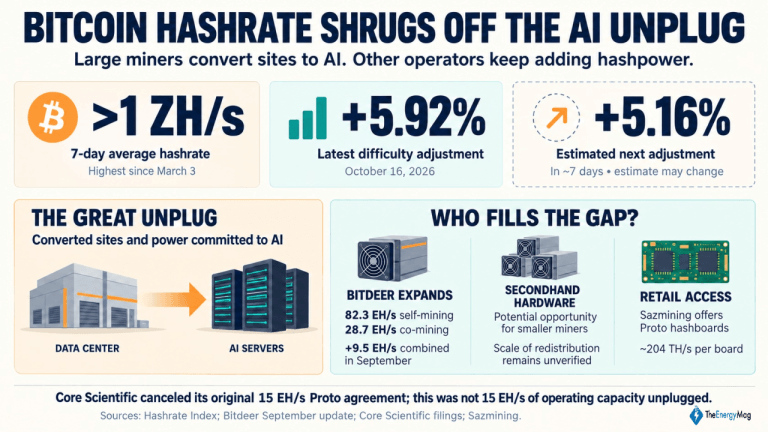
Miner Weekly: Bitcoin Hashrate Shrugs off the AI Unplug, Regaining 1 ZH/s Level
Big public miners are making room for artificial intelligence (AI). Bitcoin’s hashrate is climbing anyway. This article first appe...

China Targets 2030 to Complete National Blockchain Network
As part of a 15-year plan outlined by the Central Cyberspace Affairs Commission, China’s national blockchain network is expected t...
SEC Examiners Set Sights on Tokenization at Clearing Agencies for Fiscal 2027
The SEC’s Division of Examinations has named tokenization among the “high-risk areas” its staff will focus on when examining clear...