Bitcoin Mining Under Threat: Braiins Uncovers Hashrate Hijacks Across 1,600 Sites
Key Takeaways: Up to 1600 sites per attack were impacted by Bitcoin mining attacks. Hijackers used unsecured connections of version Stratum V1. Braiins recommends using encrypted and authenticated connections. User Score...
Watchlist
Published in the last two hours. A tracked entity is involved.

Key Takeaways:
- Up to 1600 sites per attack were impacted by Bitcoin mining attacks.
- Hijackers used unsecured connections of version Stratum V1.
- Braiins recommends using encrypted and authenticated connections.
User Score
8.7
Follow us on Google NewsBitcoin mining pool operator Braiins issued a security alert on November 25 after uncovering a series of hashrate hijacking attacks across Latin America and Europe. The incidents enabled an attacker to reroute mining power without attacking mining hardware, pool infrastructure or software.
Bitcoin Hashrate Hijacking Surges Nearly Elevenfold in Two WeeksBetween Nov. 7 and 20, Braiins counted 24 such incidents, which grew in size throughout that time.
The first group mostly focused on goeslem in Brazil and Argentina. As far as individual incidents are concerned, they impacted between 120 and 400 sites, as many as 174 petahashes per second (PH/s) of computing power.
They then moved to Europe, three incidents in Norway and a fourth in Sweden on November 20 damaging between 1,050 and 1,600 mining sites in each country. Events up to 1.9 exahashes per second (EH/s) were the most severe, and lasted up to 49 minutes.
Braiins also detected unusual routing from other major mining pools’ internet address ranges, indicating that potential security problems are not only present in their network, but other mining pools as well.
The company has not revealed the quantity of lost Bitcoin rewards during the events.
Read More: CleanSpark May Sell More Bitcoin Than It Mines to Cut Treasury Risk After $987M Loss
Bitcoin Miners Could Lose Revenue Without Detecting an AttackThe weakness is due to a communication protocol called Stratum V1, which was adopted for mining in 2012. It cannot offer proper authentication of mining pools in its unencrypted connections.
An attacker can mine rewards from other pools using their own resources by redirecting the network traffic and acting like a legitimate pool.
Mining Hardware Continues Running Despite Lost EarningsThe thing that makes the attack so worrisome is that it is hard to be visible. While producing no credited hashrate for their owners, affected machines can continue running under normal temperature and normal computing capacity.
This results, in turn, in operators having to pay electricity costs but not receiving mining rewards for the hardware to be used.
Affected machines were found to be running a minimum of 12 different firmware types, which suggests that it is not targeted by a specific software supplier or hardware combination.
Braiins Rolls Out New Tools to Protect Bitcoin MinersBraiins suggests moving to their Stratum V2, which implements encryption and authentication to stop bad servers from managing miners.
For operators that can’t upgrade, encrypted Stratum V1 connections may be made with suitable certificate authentication. Braiins was able to get two popular miners to accept an invalid security certificate in the lab, though, even after they were configured to accept encryption.
On November 25, the company issued Braiins OS 26.11, which added more robust security for certificate verification and prevented automatic switching to unsecure connections.
It also released a free Stratum V2 proxy that does not support secure communication protocols by its native features for mining bitcoin equipment.
Braiins told miners to keep track of the local discrepancy between the computing power reported in the transactions and the locally calculated hashrate, and urged the people producing the firmware and pool operators to move faster with authentication.
Read More: JPMorgan Chase Discloses Vendor Cyberattack That May Expose Customer Names and Emails
The post Bitcoin Mining Under Threat: Braiins Uncovers Hashrate Hijacks Across 1,600 Sites appeared first on CryptoNinjas.
Why this matters
Bitcoin is showing up inside the Security Incidents theme, so this story is worth tracking for follow-through rather than treating it as a one-off headline.
Original source
Read on CryptoNinjasRelated market context

Unencrypted Bitcoin Mining Connections Are Being Hijacked at Scale: Braiins
Braiins, which runs Braiins Pool and makes the Braiins OS mining firmware, said on Nov. 25 that an attacker rerouted internet traf...
Braiins warns of Bitcoin mining attacks affecting over 1,000 sites
Bitcoin mining pool operator Braiins warned that attackers are exploiting unsecured connections to hijack miners’ computing power...

Bitcoin miners hit by hashrate hijacking attack exploiting unencrypted connections
Braiins warns that an attacker is redirecting miners' compute power to steal bitcoin mining rewards.

Another Bitcoin Mining Firm Flags 'Hashrate Hijacking' Attacks That Reroute Rewards
Braiins says an attacker exploited the unencrypted Stratum V1 protocol and internet route hijacking to impersonate mining pools, s...
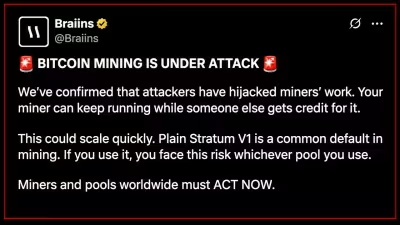
Braiins Warns of Widespread Bitcoin Hashrate Hijacking Attacks
Bitcoin mining pool operator Braiins issued a security alert Wednesday, Nov. 25, revealing a series of network hijacking attacks t...

Bitcoin Mining Difficulty Faces a 9% Jump at the Worst Possible Time for Miners
Key takeaways Bitcoin mining difficulty is on course to rise about 9% on November 27, from 134.82 trillion toward 147 trillion, re...