The Environmental Cost of Gold Mining
King Ferdinand of Spain, sponsor of Christopher Columbus, had only one command for the conquistadors: “Get Gold! Humanely, if possible, but at all hazards!” 500 years later this sentiment still seems to be the same, with...
Archive context
Older archive item. Useful for background and entity history, but not a fresh market-moving signal.
King Ferdinand of Spain, sponsor of Christopher Columbus, had only one command for the conquistadors: “Get Gold! Humanely, if possible, but at all hazards!”
500 years later this sentiment still seems to be the same, with the addition of new hazards. Gold bugs and Bitcoin advocates share the common belief that the fiat currency system is on the brink of collapse, while continuously debasing itself to stay alive. The solution? A commodity-based alternative that ensures the preservation of accrued value, impervious to debasement.
With the upcoming 4th halving of the block subsidy from 6.25 to 3.125 BTC in April 2024 the inflation rate (annual growth rate of total supply) of Bitcoin will be 0.9%. Additionally to its higher portability and divisibility than conventional gold, the “digital gold’s” inflation rate will be lower than gold’s inflation rate (~ 1.7%) and continue to drop to lower rates in the future.
But when asked for their choice of a store of value, many investors say things like:
“I’d choose gold. Not Bitcoin, because of the environment!” Really?!
Contrary to that perception, research tells us that Bitcoin mining can enhance renewable energy expansion (Bastian-Pinto 2021, Rudd 2023; Ibañez 2023; Lal 2023) and incentivize methane emission reduction (Rudd 2023, Neumüller 2023) while having half of the carbon footprint (70 Mt CO2e) of gold mining (126 Mt CO2e).
When people think of gold, they think of a pure and clean substance. The reality of gold production, however, looks very different. As I have watched environmental scientists developing water pollutant adsorbers, I have learned that gold mining is one of the most polluting industries in the world. Further digging into the topic leads to the following facts.
Gold mining ranks second after coal mining (7200 km2) in land coverage. Gold mining sites (4600 km2) cover more than the next 3 metal sites combined (copper: 1700 km2, iron: 1300 km2 and aluminum: 470 km2).
As many high yield gold mines have been exhausted, chemical processes, like cyanide-leaching or amalgamation, with extensive use of toxic chemicals are being used today. The contaminated water from gold mining called acid mine drainage is a toxic cocktail for aquatic life and works its way into the food chain.
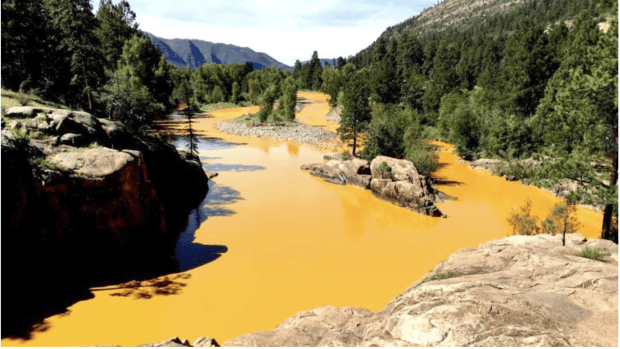
Colorado’s Animas River turned yellow after the Gold King Mine spill of 3 million gallons of toxic waste water in August 2015. From:
In the U.S., 90% of the cyanide is used solely to recover hard-to-extract gold. The toxic material and its production and transport is in direct relationship with the gold market. It is estimated that gold mines use more than 100,000 tons of cyanide each year. That means massive production and transport of a compound with a human fatal dose of a few milligrams.
In 2000, a tailings dam at a gold mine in Romania failed and 100,000 m3 of cyanide-contaminated water went into the Danube River watershed. The spill caused a mass die-off of aquatic life in the river ecosystem and contaminated the drinking water of 2.5 million Hungarians. Mines in Brazil and China widely use the historic amalgamation method that creates mercury waste. Roughly 1 kg mercury is emitted for 1 kg of mined gold.
Gold production from artisanal and small-scale mines, mostly in the global South, accounts for 38% of global mercury emissions.
Thousands of tons have been discharged into the environment in Latin America since 1980. 15 million small scale mine workers were exposed to mercury vapor and the residents of downstream communities ate fish heavily contaminated with methylmercury.
Mercury poisoning among these populations causes severe neurological issues, such as vision and hearing loss, seizures, and memory problems. Similarly, in the townships of Johannesburg in South Africa, poor communities are paying the price for the country’s rich gold mining past.
Knowing about the risks, western mining companies have moved increasingly to developing countries as a response to stricter environmental and labor regulations at home. Surprisingly, only 7% of mined gold is used for material property purposes in industry (e.g., in electronics). The rest is processed for jewelry (46%) or directly purchased as a store of value by retail or central banks (47%). That’s why periods of high monetary debasement are boosting the price of gold. Last year central banks bought 1000 tons of bullion, the most ever recorded, while gold has been hovering close to its nominal all-time high (status: December 2023).
The last time gold demand increased its price substantially was the monetary debasement following the 2008 global financial crisis. During that time gold mining in western Amazonian forests of Peru increased by 400%, while the average annual rate of forest loss tripled.
As virtually all of Peru's mercury imports are used in gold mining, the gold price corresponded with an exponential increase in Peruvian mercury imports.
As a result of the artisanal mercury handling, large quantities of mercury were being released into the atmosphere, sediments and waterways.
The massive mercury exposure can be detected in birds in central America. A region that supports over half of the world’s species.
Figure 1: Gold price, Peruvian mercury imports and mining area, from “Gold Mining in the Peruvian Amazon: Global Prices, Deforestation, and Mercury Imports.” 2011, PLoS ONE 6(4): e18875.
Other natural areas endowed with gold deposits like the Magadan Region in Northeast Russia are experiencing similar expanding mining activity over the past years including environmental destruction in response to high gold prices.
Gold mining, largely driven by demand for a store of value, causes widespread ecological and social harm across the world. It is the coal of value storage mediums.
At least half of today’s gold mining could be prevented by using a different store of value - a digital commodity with higher portability, divisibility and scarcity.
So, next time an environmental conscious investor argues for gold vs. Bitcoin, tell them:
A 21st century store of value should not rely on huge carved out fields of destruction and poisonous hazards but on electricity from non-rival energy, subsidizing renewable expansion.
This is a guest post by Weezel. Opinions expressed are entirely their own and do not necessarily reflect those of BTC Inc or Bitcoin Magazine.
Why this matters
This mining story adds another data point to the current market tape and is useful when read alongside nearby source coverage.
Original source
Read on Bitcoin MagazineRelated market context
Bitcoin Hashrate Reclaims One Zettahash As Mining Competition Rebounds
TL;DR: BlocksBridge reported Bitcoin’s seven-day hashrate above one zettahash in the week to October 22. Mining competition has re...

Lido Opens Higher-Balance Ethereum Validators With A Deliberately Small Start
Lido has opened a permissionless route to Ethereum validators that can hold much larger effective balances, but the first allocati...

Ripple Targets High-Value Real Estate Deals With New Crypto Partnership
Cryptocurrency holders could gain a smoother route to property purchases through a new partnership between Ripple and Cryptescrow....
Tether Wins Mining Industry Support For Its Open Automation Toolkit
Tether is trying to make Bitcoin mining equipment easier to operate as one system. Its October 24 announcement brings 15 industry...
Aave Opens Its First Externally Curated V4 Markets With Sentora
Aave’s first externally curated V4 markets are live on Ethereum, according to Sentora’s October 22 launch explanation. The curator...

Bitcoin’s 7-Day Hashrate Returns to 1 ZH/s After Nearly 8 Months
Bitcoin’s computational firepower, measured by its network hashrate, has reclaimed the 1 zettahash per second (ZH/s) threshold, wi...