With Over 90% of BTC’s Supply Issued, Bitcoin’s Mining Difficulty Reaches a Lifetime High
Bitcoin’s mining difficulty increased this week on March 31, 2022, at block height 729,792 for the first time since February 17. The network’s difficulty jumped 4.31% higher bringing the metric to a lifetime high at 28.5...
Archive context
Older archive item. Useful for background and entity history, but not a fresh market-moving signal.

Bitcoin’s mining difficulty increased this week on March 31, 2022, at block height 729,792 for the first time since February 17. The network’s difficulty jumped 4.31% higher bringing the metric to a lifetime high at 28.59 trillion. Since the increase, the network’s hashrate has been a bit more volatile dropping from 217 exahash per second (EH/s) on April 1, to today’s 175 EH/s.
Since Thursday, It Has Never Been More Difficult to Find a Bitcoin Block, Difficulty Adjusts 4.31% Higher
Bitcoin has hit yet another milestone this week, as the network’s mining difficulty is the highest it has ever been, and that means it is currently the hardest point in history to find a bitcoin (BTC) block. Satoshi Nakamoto created the mining difficulty to ensure that block times were around ten minutes apart and the difficulty adjustment algorithm (DAA) readjusts every two weeks.
The term “mining difficulty” refers to how difficult it is for mining participants to find a block subsidy, otherwise known as a block reward. Bitcoin’s mining difficulty is very important and keeps the network as consistent as possible. When new mining participants join the network and the hashrate increases, the DAA readjusts higher and it becomes more difficult for miners to find a block reward.
If the opposite happens, and hashrate subsides, then the DAA will decrease lower making it easier for the aggregate of mining participants. The 4.31% increase on Thursday, was the first increase in over four weeks or 2 DAA changes. The DAA readjusts every 2016 blocks and at the time of writing, 1,682 blocks remain until the retarget which is expected on April 13.
Currently, the next DAA change is expected on April 13 and is estimated to be a decrease. Since the increase on March 31, six-month charts show the hashrate has been fluctuating and is currently around 175.49 EH/s. Statistics on Saturday, April 2, show the hashrate’s 90-day average is roughly 195 EH/s.
Three-day statistics show that F2pool has gained the lead as the top miner with 18.91% of the global hashrate or 37.19 EH/s. Foundry USA is the second-largest pool, according to three-day metrics, with 18.66% of the global hashrate or 36.70 EH/s. In three days F2pool found 76 blocks, and during the same time frame, Foundry USA discovered 75 blocks.
The difficulty’s lifetime high of 28.59 trillion makes it harder than ever before for all the mining pools to find a block reward. Currently, there are 11 known mining pools with computational power dedicated to the network, and 1.99% of the global hashpower or 3.91 EH/s is owned by unknown mining entities.
The mining difficulty’s lifetime high also occurred a day before miners found the 19 millionth bitcoin at block height 730,034. Since then, miners have discovered 19,000,592.18 BTC (at the time of writing) so far and the issuance remaining is 1,999,193.73 BTC.
What do you think about the network’s difficulty increasing 4.31% higher this week? Let us know what you think about this subject in the comments section below.
Why this matters
This mining story adds another data point to the current market tape and is useful when read alongside nearby source coverage.
Original source
Read on Bitcoin NewsRelated market context
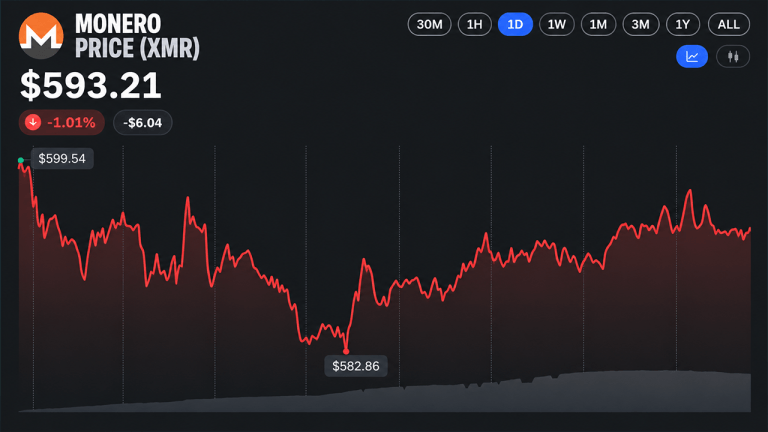
Monero Hashrate Nears Record Highs as XMR Price Gains 70% in a Year
Monero’s network hashrate is hovering near historic highs, but its mining distribution tells an equally compelling story. On Monda...

XRP whales now control 68.5% of supply, the highest share since November 2022
The increased concentration of XRP among whales raises concerns about market manipulation and challenges the token's decentralizat...

Binance Founder CZ Backs BNB Chain’s New High-Speed Layer 1 Network
BNB Chain is preparing a new EVM-compatible Layer 1 that will run alongside the main network, using BNB for gas, staking, and gove...

Bitcoin’s Bear Market Is Over, Galaxy Says
Bitcoin Magazine Bitcoin’s Bear Market Is Over, Galaxy Says Galaxy Research believes bitcoin’s bear market ended in June and that...

Ault Blockchain – Silver First, Then Everything Else
Why you should listen Most new layer ones are built to trade perpetual futures. Ault thinks the bigger gap is in spot commodities....

BNB Chain leads all blockchains in tokenized fund growth, adding $3.7 billion
BNB Chain's rapid growth in tokenized funds highlights the increasing demand for blockchain-based financial products, reshaping tr...