US Government Partners with Blockchain Companies to Publish Economic Data
On August 28, 2025, the Commerce Department announced partnerships with Chainlink and Pyth Network to distribute key economic statistics across multiple blockchain networks. Commerce Secretary Howard Lutnick had first re...
Archive context
Older archive item. Useful for background and entity history, but not a fresh market-moving signal.

On August 28, 2025, the Commerce Department announced partnerships with Chainlink and Pyth Network to distribute key economic statistics across multiple blockchain networks. Commerce Secretary Howard Lutnick had first revealed the plan during a White House cabinet meeting on August 26, telling President Trump: “The Department of Commerce is going to start issuing its statistics on the blockchain, because you are the crypto president.”
What Data Goes on BlockchainThe initiative focuses on six important economic indicators from the Bureau of Economic Analysis. These include real Gross Domestic Product (GDP), which measures the country’s total economic output, and the Personal Consumption Expenditures Price Index, a key inflation measure.
The data covers both actual numbers and percentage changes over time. Updates happen monthly or quarterly, matching the regular government release schedule. This information helps economists, businesses, and investors understand how the US economy is performing.
Source: @chainlink
Chainlink handles most of the technical work, creating secure data feeds that deliver information to blockchain networks. Pyth Network will provide quarterly GDP data going back five years, with plans to expand to other economic datasets later.
Multiple Blockchain Networks InvolvedThe economic data will appear on ten different blockchain networks initially through Chainlink, including Ethereum, Avalanche, and Arbitrum, along with newer networks like Base and Optimism. The Commerce Department also mentioned broader distribution across additional networks including Bitcoin and Solana.
The government uses a special process to ensure data accuracy. It creates a unique digital fingerprint (cryptographic hash) of each data point and stores it on the blockchain. This makes it nearly impossible to change or fake the information once it’s published.
Major cryptocurrency exchanges Coinbase, Gemini, and Kraken helped set up the system. They provided the digital currency needed to pay for blockchain transaction fees.
Strong Market ResponseThe announcement caused immediate price jumps for both companies’ tokens. Pyth Network’s PYTH token surged 70% in one day, reaching its highest price since February. The token’s value peaked above $0.20, pushing the company’s market value over $1 billion.
Trading volume for PYTH increased by more than 2,700% as investors rushed to buy. Chainlink’s LINK token also gained over 5%, climbing close to $25 per token.
These price movements show strong investor confidence in government partnerships with blockchain companies. The market sees this as validation that blockchain technology can handle serious government applications.
Trump Administration’s Crypto PushThis blockchain initiative fits into the Trump administration’s broader embrace of cryptocurrency and blockchain technology. The Commerce Department views blockchain as a way to modernize government operations and increase transparency.
Source: @PythNetwork
The timing is significant because the administration has criticized traditional government data collection methods. Earlier in August 2025, President Trump fired the Commissioner of Labor Statistics after questioning the accuracy of employment reports. Trump claimed some government statistics were “rigged” for political purposes.
By using blockchain technology, officials hope to create a system where published data cannot be secretly changed later. This could help rebuild public trust in government statistics.
The Deploying American Blockchains Act, which passed the House with bipartisan support in June 2025, gives the Commerce Department authority to lead federal blockchain policy. The bill awaits Senate approval.
Practical ApplicationsThe blockchain economic data opens up new possibilities for financial technology developers. They can build automated trading systems that respond to economic changes in real-time. Prediction markets could use the data to forecast economic trends.
Decentralized finance (DeFi) platforms might adjust interest rates based on GDP growth or inflation data. Stablecoins and tokenized assets could benefit from having reliable government economic data built into their systems.
However, blockchain technology has limitations. While it prevents data tampering after publication, it cannot fix problems with how the government collects information in the first place. If agencies gather incorrect data, blockchain will permanently preserve those errors.
Future ImplicationsThe US government’s partnership with Chainlink and Pyth Network represents a major step forward for both blockchain technology and government transparency. Secretary Lutnick indicated that blockchain-based data publishing could expand across the entire federal government, with other agencies potentially adopting similar systems once technical details are worked out.
This initiative demonstrates that blockchain infrastructure has matured enough to handle critical government functions. The immediate market reaction shows strong investor enthusiasm for government-blockchain partnerships, suggesting these collaborations could become increasingly valuable for infrastructure providers.
The trend extends beyond US borders. Estonia has used blockchain to protect medical records since 2016, while California moved 42 million vehicle titles to blockchain in 2024 to prevent fraud. The Philippines, United Kingdom, and El Salvador are all considering putting government spending data on blockchain networks, indicating growing international adoption of blockchain in government operations.
Why this matters
This research story adds another data point to the current market tape and is useful when read alongside nearby source coverage.
Original source
Read on Brave New CoinRelated market context

Bitcoin Price Surges Above $87,000 on Softer-Than-Expected Jobs Data
Bitcoin Magazine Bitcoin Price Surges Above $87,000 on Softer-Than-Expected Jobs Data The price of bitcoin surged above $87,000 on...

Chainlink And Swift Demo Automated Tokenized-Equity Dividends Across Four Blockchains
TL;DR Chainlink built a Swift Hackathon solution that automated a cash-dividend workflow for tokenized equities across four blockc...

US targets $17 billion Russia-linked crypto payment network using USDT as an escape route
The US sanctioned the Russia-linked A7 Network and proposed new restrictions to cut its crypto intermediaries off from global mark...

New SEC crypto rules threaten small advisers, but big firms win
The US Securities and Exchange Commission’s proposed crypto custody fallback could broaden investment choices while making them ea...
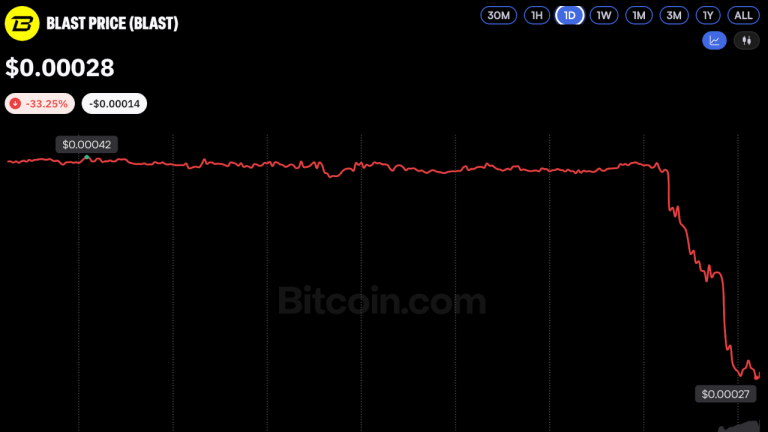
Ethereum Layer 2 Network Blast to Shut Down After Revenue Collapse
Blast, a once-buzzy Ethereum Layer 2 network, is set to shut down later this month after a dramatic decline in activity left the s...

Trump’s potential AI czar, Jay Clayton, helped pioneer the SEC’s crypto crackdown
The former SEC chairman who may be tapped to oversee the Trump administration's AI work has a potentially divisive history as a wa...