OFAC Update Claims Ronin Hack Is Tethered to North Korea’s Hacker Syndicate Lazarus Group
According to the U.S. Treasury and the Office of Foreign Assets Control (OFAC), the recent Ronin bridge hack may have been tied to the North Korean hacker syndicate called Lazarus Group. Federal law enforcement officials...
Archive context
Older archive item. Useful for background and entity history, but not a fresh market-moving signal.

According to the U.S. Treasury and the Office of Foreign Assets Control (OFAC), the recent Ronin bridge hack may have been tied to the North Korean hacker syndicate called Lazarus Group. Federal law enforcement officials have tied the flagged ethereum address connected with the Ronin bridge exploit to the group of hackers and added the crypto address to OFAC’s Specially Designated Nationals And Blocked Persons list (SDN).
Ronin Bridge Exploiter’s Address Added to OFAC’s SDN List
On April 14, the U.S. government published an OFAC SDN list update which includes the ethereum (ETH) address involved in the recent Ronin bridge exploit. Bitcoin.com News reported on the Ronin bridge attack on March 29, after the protocol associated with the blockchain game Axie Infinity lost $620 million in crypto assets. To date, the Ronin bridge attack has been one of the largest decentralized finance (defi) exploits in 2022.
According to the U.S. Treasury and OFAC, the ethereum address, which is already flagged on blockchain explorers under the name “Ronin bridge exploiters,” belongs to the North Korean hacker syndicate called Lazarus Group. The ethereum wallet holds 144,837.79 ether worth roughly $438.6 million using today’s ether exchange rates. The newly updated SDN list explains that Lazarus Group has various names including the “Guardians of Peace,” “Hidden Cobra,” “Red Dot,” “Temp.Hermit,” and the “New Romantic Cyber Army Team.”
OFAC has warned the public about Lazarus Group in the past, as U.S. authorities believe the hackers have been involved with major crypto hacks and ransomware threats. There have also been many research studies that investigate the North Korean hacking group’s alleged activities. The U.S. Treasury’s and OFAC’s update on Thursday notes that the hacker syndicate is reportedly located in the Potonggang District, Pyongyang, North Korea. Transactions with the OFAC specified ethereum address are prohibited for U.S. persons and financial institutions.
According to a report published by the United Nations (UN) in March 2019, North Korea and the country’s supreme leader Kim Jong-un allegedly stockpiled at least $670 million worth of cryptocurrencies. On July 24, 2020, the U.S. Army published an investigative report that alleged North Korea has roughly 6,000 cyber hackers including the notorious Lazarus Group.
What do you think about the U.S. government claiming that the Ronin bridge hacker is associated with the infamous Lazarus Group? Let us know what you think about this subject in the comments section below.
Why this matters
This security story adds another data point to the current market tape and is useful when read alongside nearby source coverage.
Original source
Read on Bitcoin NewsRelated market context

Laura Shin interviews North Korean crypto hacker Justin Lim undercover
The exposure of North Korean crypto infiltration highlights the urgent need for rigorous identity verification in remote hiring to...

FalconX and Interstice Launch $9T Cross-Chain Engine Linking Canton, Solana and Ethereum
Key Takeaways: Interstice Digital and FalconX rolled out a non-custodial Cross-Chain Swap Engine that connects Canton, Ethereum, S...

Aave TVL still down 43% since KelpDAO hack
Aave, one of crypto’s largest lending and borrowing protocols, still hasn’t recovered from the April 18 hack of KelpDAO. Indeed, t...

Ethereum wants to hide your trades from bots before they can attack
Ethereum developers are weighing a new defense against predatory trading bots that exploit pending transactions before they reach...

Half of Aave’s debt sits in just 9% of positions built around one Ethereum correlation trade
Galaxy's Aug. 7 snapshot of Aave V3 Core found 19,073 loans on the protocol after applying standard filters. Fewer than 9% of thos...
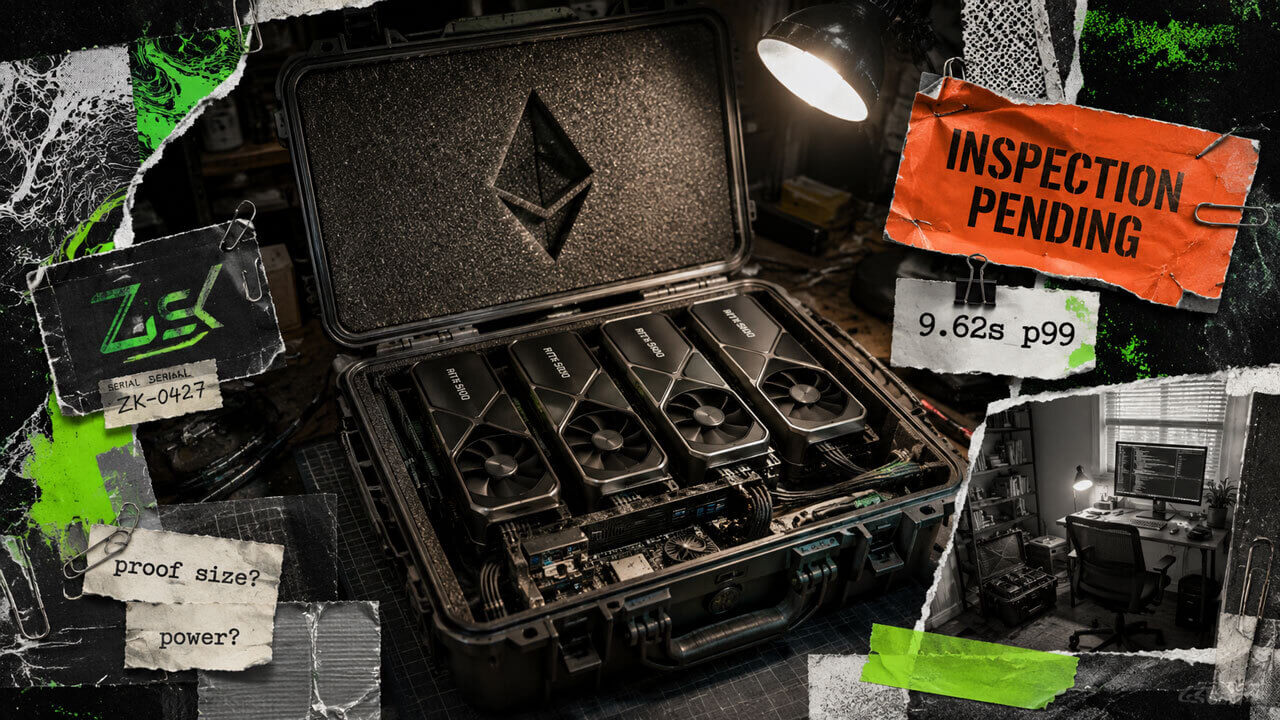
Ethereum’s 12-GPU proving problem just got a 4-GPU answer
ZisK's new four-GPU benchmark claim has lowered the headline hardware count in Ethereum's real-time proving race. In February, Cry...