Tim Scott Pushes Landmark U.S. Crypto Market Structure Bill to Secure Innovation, Investors, and National Security
Key Takeaways: Senate Banking Committee Chairman Tim Scott is advancing a comprehensive U.S. crypto market structure bill for markup in January 2026. The proposal aims to deliver clear regulatory boundaries, protect reta...
Archive context
Older archive item. Useful for background and entity history, but not a fresh market-moving signal.
Key Takeaways:
- Senate Banking Committee Chairman Tim Scott is advancing a comprehensive U.S. crypto market structure bill for markup in January 2026.
- The proposal aims to deliver clear regulatory boundaries, protect retail investors, and keep blockchain innovation inside the U.S.
- Lawmakers are negotiating high-impact issues including DeFi oversight, stablecoin rules, and regulatory jurisdiction splits.
Chairman Tim Scott has formally moved U.S. digital asset regulation into its most decisive phase yet. With a committee markup scheduled, Congress is now testing whether America can lock in clear crypto rules or risk losing the industry to overseas markets.
Senate Banking Committee Moves Crypto Regulation Toward a Defining VoteThe U.S. Senate Banking Committee is preparing to mark up sweeping digital asset market structure legislation, signaling a turning point in Washington’s approach to crypto oversight.
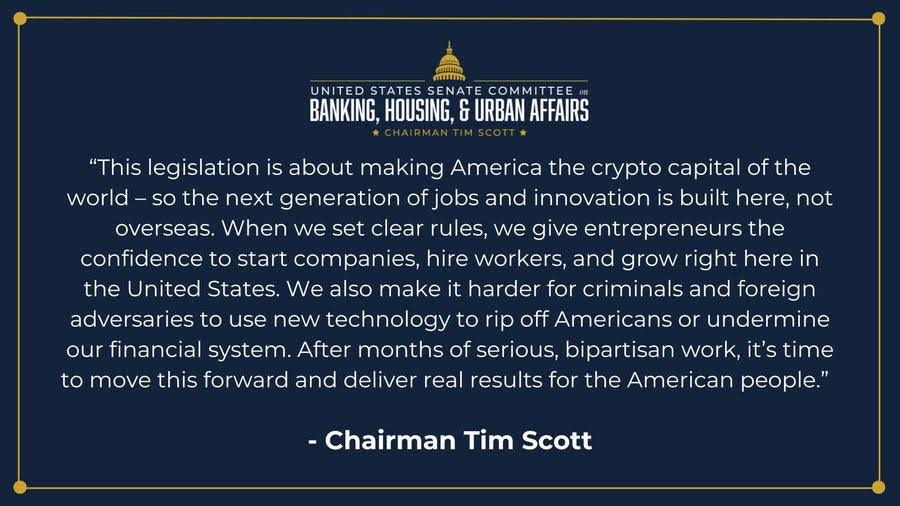
Chairman Tim Scott confirmed that the bill is designed to establish firm regulatory boundaries while balancing innovation, investor protection, and national security. According to the committee, the legislation focuses on protecting “Main Street,” preventing illicit activity, and ensuring that crypto development stays anchored in the United States rather than migrating to more permissive jurisdictions.
This markup follows months of hearings, stakeholder consultations, and bipartisan negotiations. Senate Republicans released their initial market structure principles in mid-2025, followed by two discussion drafts and a broad Request for Information from industry participants. The current version represents the most mature attempt yet to define how digital assets fit into U.S. financial law.
Read More: Over 110 Crypto Firms Urge U.S. Senate to Guarantee Developer Protections in Market Bill
Why Market Structure Has Become Crypto’s Top Policy BattleMarket structure legislation goes far beyond simple compliance. The bill, in its minimum form, attempts to answer questions that the crypto industry has been puzzled by over the years:
- Which digital assets qualify as securities versus commodities?
- Which regulator has authority over each category?
- How can exchanges, brokers, and custodians operate legally across asset classes?
In the absence of a statutory clarification, the companies have had to make use of their enforcement measures, piecemeal guidance and judicial decisions in interpreting their duties. Accordingly, Chairman Scott contends that such uncertainty disincentivizes investment and drives innovation away.
Clear rules, in turn, would unlock institutional involvement, facilitate job creation, and minimize the legal risks that have brought U.S. crypto adoption to a halt.
Investor Protection and National Security at the CoreAccording to the words of its supporters, this bill is not only pro-innovation, but it is specifically defensive. The framework focuses on providing protection to retail investors, enhanced level of transparency and fraud reduction mechanisms. It is also intended to curb the capacity of foreign enemies or criminal gangs to use decentralized systems to launder money, avoid sanctions, or perpetrate crime with the help of computers.
To the eyes of the committee, it is safer to regulate crypto within the U.S financial system rather than letting it spiral out of control to become something that cannot be regulated. Such framing has served to make both parties interested in the idea, despite the ongoing dispute over the strictness of the final regulations.
Read More: Vietnam Launches Bold Digital Assets Regulation With $379M Entry Bar and Crypto Pilot
Bipartisan Support Will Decide the Bill’s FateThe upcoming markup will serve as an early test of whether the legislation can attract genuine bipartisan backing.
In a closely divided Senate, advancing any major bill typically requires support from multiple Democratic senators. Previous crypto legislation has shown that bipartisan coalitions are possible, but not guaranteed.
A strong committee vote would significantly improve the bill’s chances of reaching the Senate floor and ultimately becoming law. A weak or partisan outcome, however, could stall progress well into 2026, especially as election pressures intensify.
The post Tim Scott Pushes Landmark U.S. Crypto Market Structure Bill to Secure Innovation, Investors, and National Security appeared first on CryptoNinjas.
Why this matters
This maps to the Regulation hub, so it can help confirm whether that theme is gaining breadth across the crypto news cycle.
Original source
Read on CryptoNinjasRelated market context

$900 billion asset manager Federated Hermes taps crypto infrastructure to bring tokenized funds to brokerages
This partnership could accelerate the integration of blockchain in traditional finance, potentially reshaping investment accessibi...

Crypto Regulation: UK Lands £3.8Bn Bitcoin Seizure as Korea Blocks KuCoin and MEXC
In recent crypto regulation news, The High Court in London has strengthened the UK authorities’ position in a dispute over roughly...

A $5 billion Bitcoin fortune is at stake, but UK court says being defrauded isn’t enough to claim it
A London judge rejected Chinese fraud victims' bid to use English law to claim more than 61,000 seized Bitcoin. In an Oct. 12 ruli...

Citi says Galaxy Digital stands to gain as crypto rebounds
Galaxy Digital could see significant growth as crypto market conditions improve, driven by increased fund inflows and clearer regu...

Researchers Build First Working Post-Quantum Defense for Bitcoin’s Lightning Network
Bitcoin Magazine Researchers Build First Working Post-Quantum Defense for Bitcoin’s Lightning Network Whether or not quantum compu...

Ledger’s crypto wallet implant scare triggers Trezor reseller crackdown as security fears spread
Trezor is cutting authorized resellers after a hardware-implant attack against rival Ledger exposed vulnerabilities in cryptocurre...