Bitcoin Back Below $30,000 After A Record 8 Weeks In The Red
Bitcoin decoupled from equity markets to the downside on Monday after ending last week as the eighth consecutive weekly loss.Bitcoin has failed to hold the $30,000 level on Monday after scoring its eighth consecutive wee...
Archive context
Older archive item. Useful for background and entity history, but not a fresh market-moving signal.
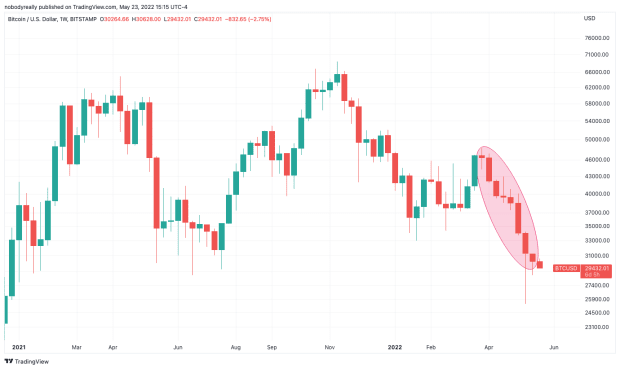
Bitcoin decoupled from equity markets to the downside on Monday after ending last week as the eighth consecutive weekly loss.
Bitcoin has failed to hold the $30,000 level on Monday after scoring its eighth consecutive week in the red for the first time ever.
During these eight weeks, which began in late March and ended on Sunday, bitcoin has lost over 35% of its U.S. dollar value according to TradingView data. Before the beginning of the losing streak, BTC was trading at around $46,800.
Bitcoin has scored losses for eight consecutive weeks for the first time in its history and it is starting the ninth with yet another red candle. Image source: TradingView.Bitcoin is changing hands slightly below $30,000 at the time of writing. The peer-to-peer currency climbed as high as $30,600 earlier on Monday to trade at around $29,400 as the trading in equity markets nears its end in New York.
While bitcoin turns south, major U.S. stock indices have been in the green. The Nasdaq, which is said to be highly correlated with bitcoin, decoupled from the digital money along with the S&P 500 to denote modest gains near market close on Monday, per TradingView data.
While bitcoin, Nasdaq and S&P 500 were trading in tandem for some time on Monday, the P2P currency saw a sharp sell-off decouple it from the two indices and take it to a more than 3% loss for the day. Image source: TradingView. A Tough Year For BitcoinDespite making two new all-time highs in 2021, bitcoin already erased nearly all of those gains in 2022.
Bitcoin’s choppy trading year so far can be partly attributed to a broader sentiment of economic uncertainty as the Federal Reserve tightens the U.S. economy, withdrawing liquidity from the market after almost two years of quantitative easing.
The central bank has already raised its basic interest rates two times this year, the last of which was double the magnitude of the previous one and represented the largest hike in two decades: While the Fed increased interest rates by 0.25% in March, it raised them by 0.50% earlier this month.
Image source: Federal Reserve Economic Data (FRED).When the Fed raises or lowers interest rates through its Federal Open Markets Committee (FOMC), what it is actually doing is setting a target range. The graph above depicts the lower and upper bounds of that target range in red and blue, respectively.
While the U.S. central bank system sets the target, it cannot mandate that commercial banks use it — rather, it serves as a recommendation. Therefore, what banks end up using for lending and borrowing excess cash between them overnight is called the effective rate. This is shown by the green line in the graph above.
The Fed previously hiked interest rates consistently from 2016 to 2019, until plunging it near zero in the aftermath of the COVID-19 pandemic outbreak, as noted in the graph.
Bitcoin’s higher sensitivity to liquidity and therefore interest rates can be explained by a greater participation of institutional investors in the market, whose allocations are based on the availability of capital and broader economic conditions, Morgan Stanley reportedly said.
Therefore, while Bitcoin was able to sustain a bull market in the midst of the Fed increasing interest rates in 2017, raising nearly 2,000% from January to December that year, the odds aren’t on the side of the bulls this year.
For two weeks, bitcoin has now closed below a level of weekly support it formed over a year ago and had respected since, indicating it might be turning into a zone of resistance. Image source: TradingView.Why this matters
This bitcoin story adds another data point to the current market tape and is useful when read alongside nearby source coverage.
Original source
Read on Bitcoin MagazineRelated market context

Bitcoin survived 5% yields but crypto’s cheap-money era did not
The US 10-year Treasury yield touched 5.34% on Oct. 1, its highest since 2002, capping a third quarter in which it climbed almost...

Bitcoin (BTC) Price Today: 2028 Halving Cycle and BlackRock ETF Inflow Signal Long-Term Rally
Recent market data also show that Bitcoin buyers have absorbed a key sell wall around $85,000, reducing one source of near-term re...

XRP Price Prediction: Ripple Range-Bound at $1.50, Breakout Soon?
XRP price prediction shows Ripple entering October still trading within a broad range. XRP is currently around $1.50, with key res...

Unpatched Eclair Bitcoin Lightning nodes could crash again every time they restart
A newly disclosed unfunded-channel flaw could leave Eclair, a Bitcoin Lightning implementation, crashing repeatedly without an att...

Stellar’s tokenized RWA market reaches the $4 billion line, up 360% this year
Stellar's RWA market growth highlights institutional interest but poses concentration risks, with potential volatility if major is...

Cardano’s DeFi has shrunk by more than half and RealFi is betting credit can revive it
Cardano’s “bank the unbanked” push went live with RealFi, putting real-world credit behind a new dollar-token system. On Oct. 1, R...