Economic Uncertainty Is Impacting Bitcoin Price
Bitcoin’s monetary competition is flailing as evidence mounts that the “everything bubble” will soon pop.The below is from a recent edition of the Deep Dive, Bitcoin Magazine's premium markets newsletter. To be among the...
Archive context
Older archive item. Useful for background and entity history, but not a fresh market-moving signal.
Bitcoin’s monetary competition is flailing as evidence mounts that the “everything bubble” will soon pop.
The below is from a recent edition of the Deep Dive, Bitcoin Magazine's premium markets newsletter. To be among the first to receive these insights and other on-chain bitcoin market analysis straight to your inbox, subscribe now.
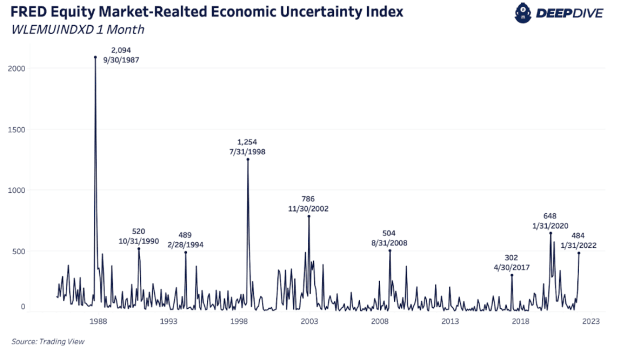
The FRED Equity-Related Economic Uncertainty Index reached its sixth-highest reading ever today, as liquidity continues to dry up for risk assets. Spikes in this index typically coincide with significant drawdown periods in the S&P 500 Index.
FRED equity market-related economic uncertainty demonstrates fundamental macroeconomic issues and ultimately impacts the bitcoin price. FRED equity market-related uncertainty corresponds with S&P 500 drawdown.As inflation has reached 40-year highs in the U.S. (as well as high readings throughout the rest of the world), investment-grade bonds essentially ceased to exist with nominal yields far below the inflation rate without accounting for credit (default) risk whatsoever.
We have continued to state in The Deep Dive that bitcoin’s monetary competition isn’t just gold, but rather the monetary premium that has nestled itself into global bond and even equity markets amidst the everything bubble.
The Everything BubbleWe continue to use the term “Everything Bubble” in The Deep Dive to frame the state of the international monetary system, but what do we actually mean?
The Federal Reserve Board, and its actions as “lender of last resort” for the U.S. dollar (with the dollar serving as the world reserve currency) have acted as a volatility suppression scheme for decades.
Most notably starting with Alan Greenspan and the “Greenspan put” (later to be known as the Fed put), financial markets came to learn that the Fed would save the day by bailing out credit markets and keeping the easy money flowing. Now in 2022, with the Fed’s fund rate still at the zero lower bound, the Fed has become a political liability, and is caught underprepared attempting to tighten as liquidity across financial markets is pulling back.
In The Daily Dive #142 we discussed the implications of the current credit market sell-off:
“The consequences of the falling prices in debt instruments is higher financing costs in the broader economy, as a forty-year high in the consumer price index along with a slightly hawkish Federal Reserve Board has lenders looking for higher yields.
“What should be watched going forward is how credit markets trade, as this has a direct impact on equity markets from a corporate financing perspective but also a market valuation perspective.
“This is something we will keep a very close eye on over the coming months, into a potential Fed rate hike cycle.”
Why this matters
This bitcoin story adds another data point to the current market tape and is useful when read alongside nearby source coverage.
Original source
Read on Bitcoin MagazineRelated market context

Stablecoin issuers have replaced 40% of China’s lost US Treasury demand
Stablecoin issuers are emerging as a new source of demand for US government debt as foreign official holdings lose ground. Tether...

Cardano’s DeFi has shrunk by more than half and RealFi is betting credit can revive it
Cardano’s “bank the unbanked” push went live with RealFi, putting real-world credit behind a new dollar-token system. On Oct. 1, R...

Chainlink And Swift Demo Automated Tokenized-Equity Dividends Across Four Blockchains
TL;DR Chainlink built a Swift Hackathon solution that automated a cash-dividend workflow for tokenized equities across four blockc...
Crypto hackers have taken $2.7 billion in 2026 and the losses are alarmingly concentrated
Crypto firms and users have lost nearly $2.7 billion to security incidents this year, with North Korea-linked thefts exceeding $1...

South Korea unveils a roughly $900B AI and chip plan it calls a survival strategy
South Korea's ambitious AI and chip strategy could redefine its global tech standing, but hinges on power supply and talent develo...

Binance will hold some Brazil crypto deposits until users explain where the money came from
Binance will require Brazilian users to provide additional information for cross-border crypto transfers starting Nov. 1. The exch...